Stewart Calculus, Sect 9 1 #9
TL;DR
The video discusses how to determine if a population is increasing or decreasing based on the given differential equation.
Transcript
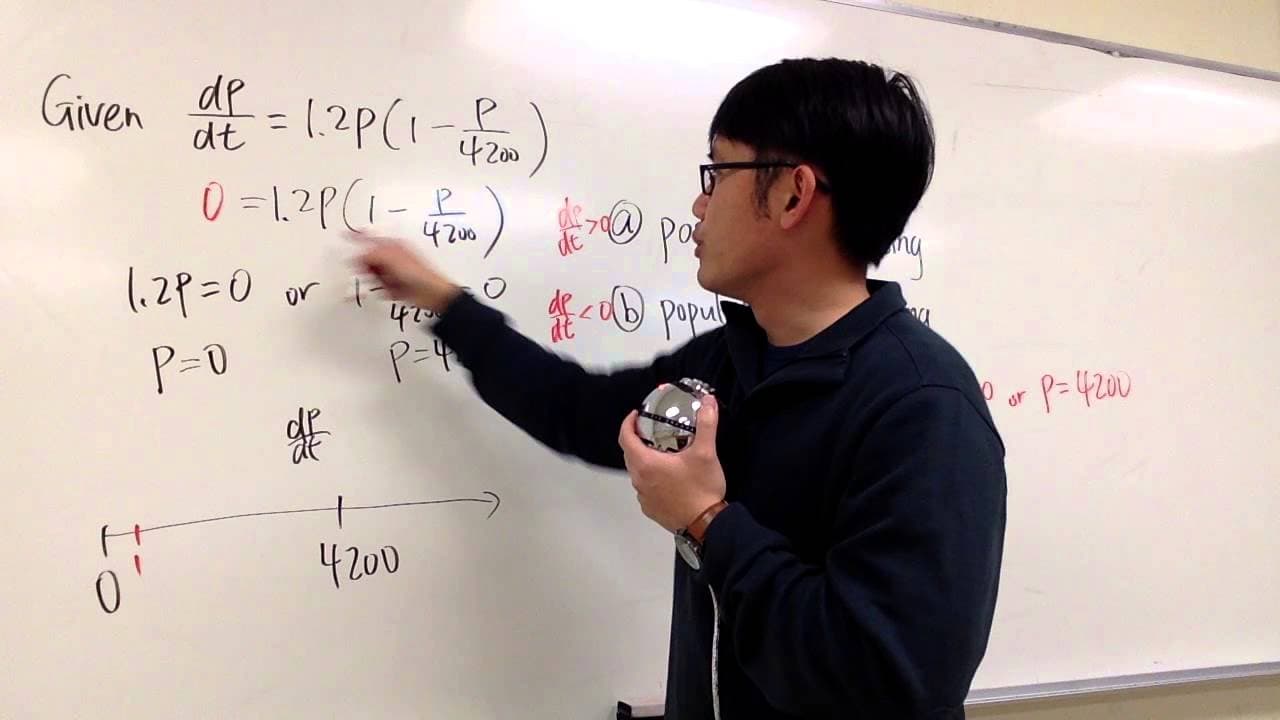
okay well given a differential equation the ptg distance for population and then we have one point two P times the parenthesis 1 minus P over 4200 and we have three questions to answer first one is we're going to know for what value of P where the population being increasing and then the second one's talking about decreasing and that's the ones who... Read More
Key Insights
- 🆘 The given differential equation helps determine population growth or decline.
- 😥 The first derivative (DP/DT) is used to determine if the population is increasing or decreasing.
- 😥 Equilibrium is reached when DP/DT is zero, and the population remains constant at certain values.
- ❓ The values for population increase and decrease are determined by analyzing the differential equation solution.
- 😥 The end points of 0 and 4200 indicate an equilibrium population where no growth or decline occurs.
Install to Summarize YouTube Videos and Get Transcripts
Explore YouTube Video Summarizer or Get YouTube Transcript Extractor
Questions & Answers
Q: How can we determine if a population is increasing or decreasing based on the given differential equation?
To determine population increase, we look for a positive first derivative (DP/DT > 0). Population decrease is indicated by a negative first derivative (DP/DT < 0).
Q: What does it mean when DP/DT is exactly zero?
When DP/DT is zero, it signifies an equilibrium point, where the population remains constant. In this case, the equation needs to be set equal to zero to solve for the equilibrium value.
Q: How do we find the values for population increase and decrease?
For population increase, the population value (P) should lie between 0 and 4200, excluding the endpoints. For population decrease, the value of P should be greater than 4200.
Q: How can we determine if a population is in equilibrium?
If the value of P is equal to 0 or 4200, the population is at equilibrium. At these values, the population does not change.
Summary & Key Takeaways
-
The video explores the concept of population growth using a differential equation.
-
It explains the conditions for population increase, decrease, and equilibrium.
-
The video provides a step-by-step approach to solving the differential equation to find the population values.
Read in Other Languages (beta)
Share This Summary 📚
Summarize YouTube Videos and Get Video Transcripts with 1-Click
Try YouTube Summary with ChatGPT & Claude or YouTube Transcript Generator
Explore More Summaries from blackpenredpen 📚
Summarize YouTube Videos and Get Video Transcripts with 1-Click
Try YouTube Summary with ChatGPT & Claude or YouTube Transcript Generator