calculus 1 tutorial: how to use the product rule, quotient rule, and chain rule
TL;DR
Learn how to differentiate using memory devices for the product, quotient, and chain rules in calculus.
Transcript
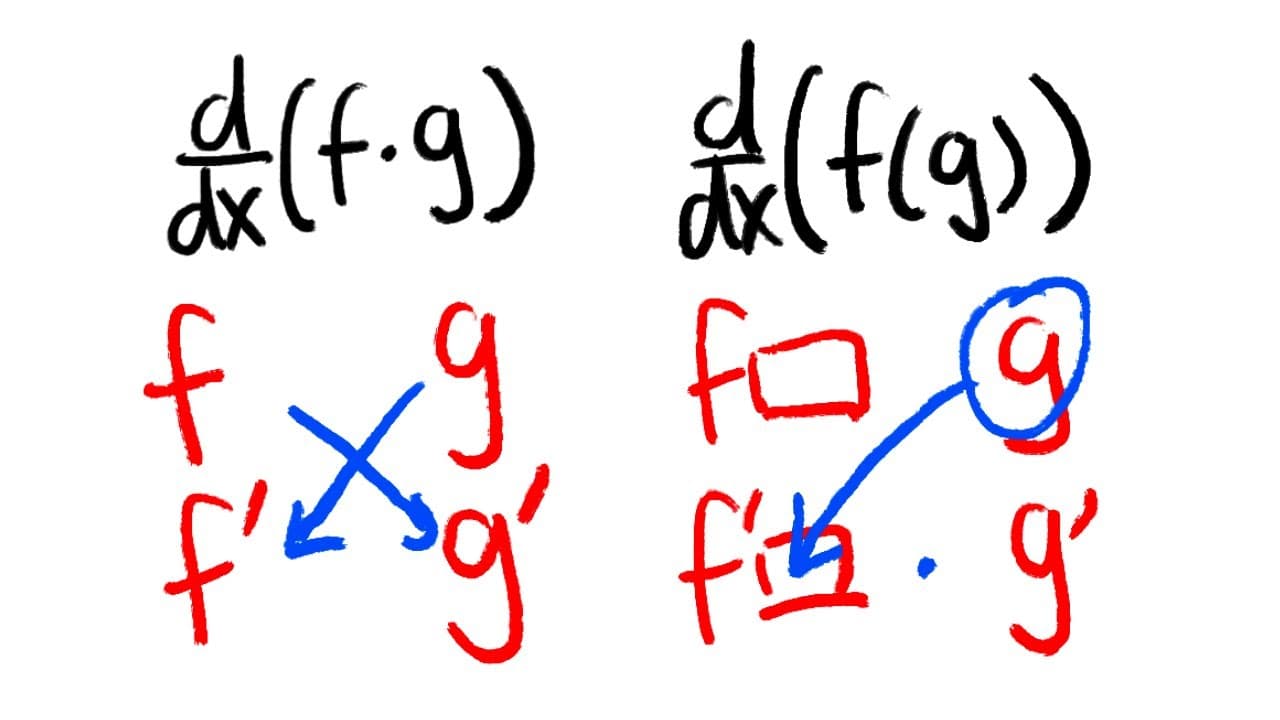
to take the derivative when we have to use the product rule quotient Rule and also the chain Rule and more importantly I will show you guys my memory devices when we have to differentiate with these rules and if you are study calculus for the first time maybe you will find the memory devices helpful because it will help you to remember how to const... Read More
Key Insights
- 🦻 Memory devices can aid in remembering the steps for differentiating using the product, quotient, and chain rules in calculus.
- 🏷️ For the product rule, visual labels and association can help differentiate the product of two functions.
- 🏷️ The quotient rule can be remembered by labeling and differentiating the numerator and denominator separately.
- 🍽️ The chain rule requires identifying the outer and inner functions and applying the respective derivatives.
- 🥺 Practice and familiarity with calculus will eventually lead to avoiding reliance on memory devices.
- ☠️ Differentiation involves applying specific rules and formulas to find the rate of change of a function.
- 🫥 Derivatives provide essential information about the slope, tangent lines, and optimization of functions.
Install to Summarize YouTube Videos and Get Transcripts
Explore YouTube Video Summarizer or Get YouTube Transcript Extractor
Questions & Answers
Q: What is the product rule memory device for differentiating x^3 * sin(x)?
To differentiate x^3 * sin(x), label x^3 as F and sin(x) as G. Apply the product rule by multiplying F' (3x^2) by G (sin(x)) and adding G' (cos(x)) multiplied by F (x^3), resulting in x^3 * cos(x) + 3x^2 * sin(x).
Q: How can the quotient rule be remembered using memory devices?
Label 1 + cos(x) as G and sin(x) as F. Differentiate G' (0 - sin(x)) and F' (cos(x)), resulting in -(1 + cos(x)) / sin(x)^2. To simplify, square the denominator, cancel out common factors, and write the derivative as 1 / (1 + cos(x)).
Q: What is the memory device for applying the chain rule to (sec(x))^3?
Identify the outer function as sec(x) and the inner function as x^3. Differentiate sec(x) to get sec(x) * tan(x) and multiply by 3(x^2) due to the power rule. Write the derivative as 3(x^2) * sec(x) * tan(x).
Q: When can memory devices for derivatives be helpful?
Memory devices can be helpful when first learning calculus and trying to remember the steps for differentiating using the product, quotient, and chain rules. However, with practice, one should aim to remember the steps directly without relying on memory devices.
Summary & Key Takeaways
-
The video teaches how to take derivatives using memory devices for the product, quotient, and chain rules in calculus.
-
For the product rule, the video suggests using visual labels and association to differentiate x^3 * sin(x), resulting in x^3 * cos(x) + 3x^2 * sin(x).
-
For the quotient rule, the video suggests labeling and differentiating 1 + cos(x) / sin(x), resulting in (1 + cos(x))^2 / (1 + cos(x))^2.
-
For the chain rule, the video suggests labeling and differentiating (sec(x))^3, resulting in 3(sec(x))^2 * sec(x) * tan(x).
Read in Other Languages (beta)
Share This Summary 📚
Summarize YouTube Videos and Get Video Transcripts with 1-Click
Try YouTube Summary with ChatGPT & Claude or YouTube Transcript Generator
Explore More Summaries from blackpenredpen 📚

Summarize YouTube Videos and Get Video Transcripts with 1-Click
Try YouTube Summary with ChatGPT & Claude or YouTube Transcript Generator