How to Compare Stocks - 3 Best Strategies
TL;DR
Learn the two ways to compare stocks and make informed investment decisions for a successful portfolio.
Transcript
hey bowtie nation Joseph's home here with the let's talk money Channel and welcome back to our special three video series on how to invest everything from from understanding how your goals are the most important part of investing to to creating a portfolio and this video how to tie it all together with buying the stocks that are going to give you t... Read More
Key Insights
- ❓ Comparing stocks within the same sector is crucial for a meaningful analysis of their performance.
- 🥳 Assessing a company's financial ratios against its own historical data helps identify trends and evaluate consistency over time.
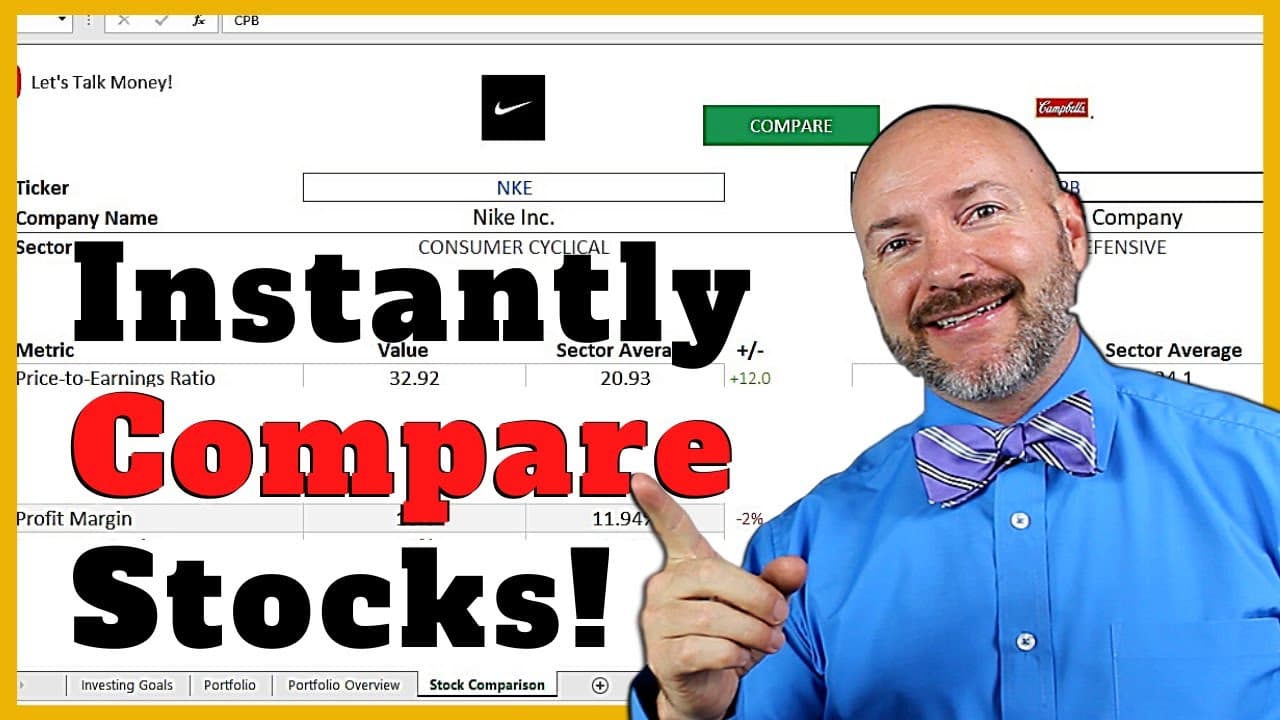
- 🥳 The presented spreadsheet simplifies the process of comparing stocks by automatically providing financial ratios and sector averages.
- 🧑🏭 Understanding a company's profitability, leverage, and growth potential are essential factors in comparing stocks.
- 🤩 Price-to-earnings ratio and operating margin are key metrics to consider when comparing stocks within the same sector.
- 🥳 Comparing a company's ratios against the sector average helps determine if the company is overvalued or undervalued.
- 🦻 Historical data analysis and sector comparisons aid in making well-informed investment decisions.
Install to Summarize YouTube Videos and Get Transcripts
Explore YouTube Video Summarizer or Get YouTube Transcript Extractor
Questions & Answers
Q: Why is it important to compare stocks within the same sector or industry?
Comparing stocks within the same sector allows for a more accurate assessment of their performance, as business fundamentals vary across sectors. It provides a clearer picture of how a company is performing relative to its peers.
Q: What are the three important questions to consider when comparing stocks?
First, analyze if most ratios are better or worse for one stock compared to the other. Second, assess if the advantage one company has is consistent over a long period, indicating a competitive advantage. Lastly, determine if the advantage is already reflected in the stock prices.
Q: How can historical data analysis help in comparing stocks?
Historical data analysis helps identify trends in a company's financial performance over time. By comparing ratios with the company's own history, investors can assess if the current performance is improving or deteriorating and how it compares to competitors.
Q: How can the presented spreadsheet be used to compare stocks?
The spreadsheet allows users to input stock symbols and automatically compares 10 financial ratios for each stock, including the average for their sectors. This provides a comprehensive overview of how the stocks perform against each other and the sector average.
Summary & Key Takeaways
-
There are two ways to compare stocks: by comparing financial ratios against others in the same sector or industry, and by comparing a company's ratios with its own historical data.
-
Comparing stocks within the same sector helps assess their performance relative to industry-specific factors.
-
Historical data analysis provides insights into a company's financial trends and helps determine if the advantage is consistent over time.
Read in Other Languages (beta)
Share This Summary 📚
Summarize YouTube Videos and Get Video Transcripts with 1-Click
Try YouTube Summary with ChatGPT & Claude or YouTube Transcript Generator
Explore More Summaries from Let's Talk Money! with Joseph Hogue, CFA 📚



Summarize YouTube Videos and Get Video Transcripts with 1-Click
Try YouTube Summary with ChatGPT & Claude or YouTube Transcript Generator