State model | Differential Equation | Example | CS | Control Systems | Lec-114
TL;DR
The session explains deriving state models from differential equations using a systematic approach.
Transcript
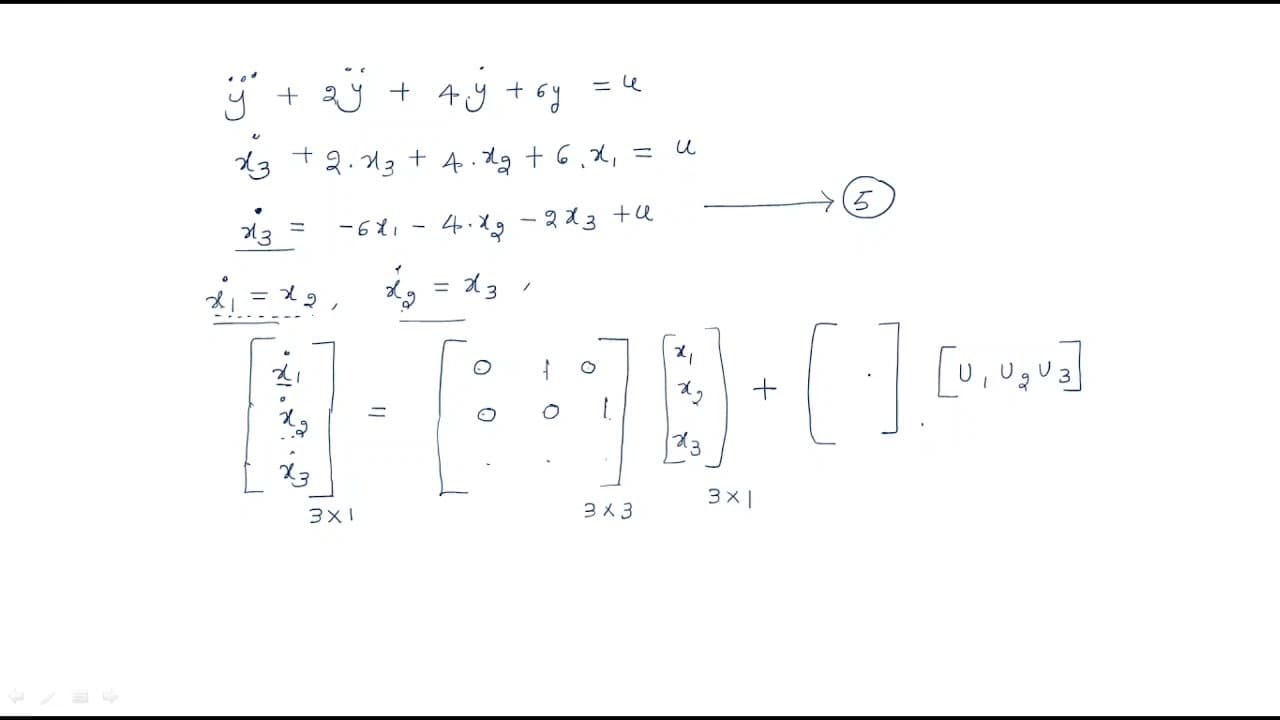
hello everyone in this session we will discuss the first problem regarding the previous topic state model analysis so in that question is find the state model for following differential equations so he is given the differential equation for that he is asking to find out the he's asking to find out the state model so you know that the state model si... Read More
Key Insights
- ✋ State variables correspond to the highest derivative order in the differential equation, establishing a foundation for dynamic analysis.
- 👾 The transformation from differential equations to state-space involves systematic replacements to form matrix representations.
- 😑 The output equation in state-space is typically expressed as a function of a single state variable, streamlining analysis and design.
- 👻 Recognizing the structure of differential equations aids in streamlined calculations, allowing quicker model derivation.
- ❓ Understanding the interrelationship between variables within a state model is crucial for stability and system performance assessments.
- 🫵 Matrix representations afford a clearer view of the system's behavior under different inputs, vital for control strategies.
- 👾 The state-space approach is particularly useful for complex systems where traditional methods falter, providing a framework for both linear and non-linear systems.
Install to Summarize YouTube Videos and Get Transcripts
Explore YouTube Video Summarizer or Get YouTube Transcript Extractor
Questions & Answers
Q: What is the importance of identifying state variables in a differential equation?
Identifying state variables is crucial because it helps in simplifying and analyzing a system's dynamics. The order of the differential equation indicates the number of state variables, which are used to express the system's behavior in a state-space model. This representation is essential for control design and system analysis.
Q: How do you derive the relationships between state variables using differential equations?
Relationships between state variables are derived by differentiating the output variable and substituting it with respective state variables. For example, if y is defined as x1, then y dot becomes x2, y double dot as x3, and so on. This systematic substitution creates a chain of relationships that defines how each state is connected to the others.
Q: What is the significance of the state transition matrix in system analysis?
The state transition matrix provides a linear representation of the system's dynamics and describes how the state of the system evolves over time. It contains information about stability, controllability, and observability, allowing engineers to analyze the system's response to inputs and initial conditions effectively.
Q: Can you describe the process of converting a differential equation into a state-space representation?
To convert a differential equation into a state-space representation, identify its order, define state variables corresponding to each derivative, and express the equations in matrix form. This involves constructing matrices A, B, C, and D based on the relationships defined by the original differential equation, enabling easier analytical approaches.
Q: What are the typical forms of the state-space equations?
The typical forms of state-space equations are x dot = Ax + Bu for the state equations, where A is the system matrix and B is the control input matrix, and y = Cx + Du for the output equations, where C is the output matrix, and D represents feedthrough. These forms help in modeling dynamic systems.
Q: How does the shortcut method simplify the derivation of state models?
The shortcut method simplifies the derivation of state models by providing a direct approach to constructing the state transition matrix. Instead of performing detailed substitutions, it allows engineers to quickly recognize patterns and create matrices based on the coefficients of the differential equation without extensive calculations.
Summary & Key Takeaways
-
The session focuses on finding a state model from given differential equations, explaining the transition from equations to matrix forms.
-
It illustrates the steps to identify state variables based on the order of the differential equation, emphasizing their relationships.
-
A shortcut method for quickly deriving the state transition matrix is introduced, aiding in the simplification of complex problems.
Read in Other Languages (beta)
Share This Summary 📚
Summarize YouTube Videos and Get Video Transcripts with 1-Click
Try YouTube Summary with ChatGPT & Claude or YouTube Transcript Generator