Torque equation | EMF | DC machines | Lec-45
TL;DR
Discussion on EMF generation and torque in DC machines.
Transcript
hello everyone in this session we will discuss the next topic of the EMF equation of the DC machine so in the DC machine how the EMF generation will be possible generally you know that the DC machines are two types one is the DC generator another one is the DC motor in these two cases we have EMF generation equation is required in the DC generator ... Read More
Key Insights
- 🧑🦼 EMF generation is critical in both DC generators and motors, with distinct formulas for calculation.
- 🖐️ Back EMF plays a crucial role in motor operation, influencing both efficiency and performance.
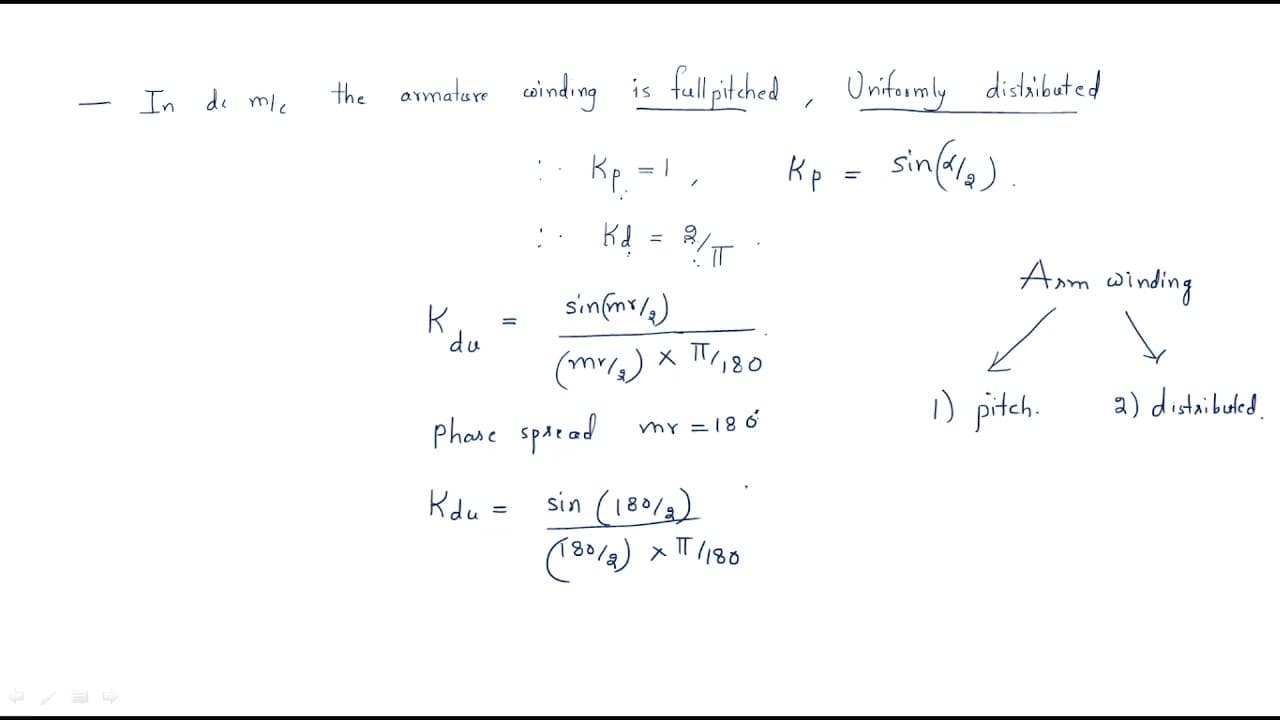
- 🎰 The design of armature windings, including pitch and distribution, directly impacts machine efficiency and output.
- 🧑🦼 Torque developed in a DC motor depends on both the armature current and the magnetic flux, establishing a fundamental relationship in motor design.
- 🧑🦼 The relationship between speed and torque is essential for understanding a DC motor's operational characteristics.
- 💈 Proper understanding of the number of poles and parallel paths is vital for calculating operational parameters of DC machines.
- 🥋 Uniform distribution of winding is preferred as it enhances performance and reduces potential issues in DC machine operation.
Install to Summarize YouTube Videos and Get Transcripts
Explore YouTube Video Summarizer or Get YouTube Transcript Extractor
Questions & Answers
Q: What are the main differences between the EMF in DC generators and DC motors?
DC generators aim to generate electrical EMF, while DC motors operate with a back EMF generated due to the motion of conductors in a magnetic field. The back EMF opposes the applied voltage, thus influencing the motor's performance and current draw.
Q: How do the number of parallel paths affect the current requirement in DC machines?
The number of parallel paths in a DC machine plays a critical role in determining its ability to handle higher current loads. When current requirements are higher, more parallel paths are needed to ensure efficient operation; conversely, fewer paths are necessary for lower current applications.
Q: What is the significance of the pitch factor (KP) in armature windings?
The pitch factor (KP) relates to the design of the winding in a DC machine, affecting its performance and efficiency. A full pitch winding has a KP of 1, optimizing torque and reducing harmonics, while short pitch or distributed windings can change the machine's overall efficiency.
Q: How is torque developed in a DC motor, and what factors influence it?
Torque in a DC motor is developed based on the relationship between mechanical power and speed. It is affected primarily by the armature current and the magnetic flux within the machine. Higher currents and stronger flux correlate to increased torque outputs.
Summary & Key Takeaways
-
The session focuses on the equations governing EMF generation in DC machines, emphasizing both DC generators and motors, and the differences in their EMFs.
-
Key formulas are provided for calculating generated EMF and back EMF, highlighting factors like speed, number of poles, and parallel paths in the machine’s design.
-
The torque equation is derived based on mechanical power and speed, with the relationship between torque, flux, and armature current clearly outlined.
Read in Other Languages (beta)
Share This Summary 📚
Summarize YouTube Videos and Get Video Transcripts with 1-Click
Try YouTube Summary with ChatGPT & Claude or YouTube Transcript Generator