Matched filter with Nonwhite noise | Frequency Response | Radar Systems | Lec-57
TL;DR
Discusses how non-white noise affects the matched filter's performance.
Transcript
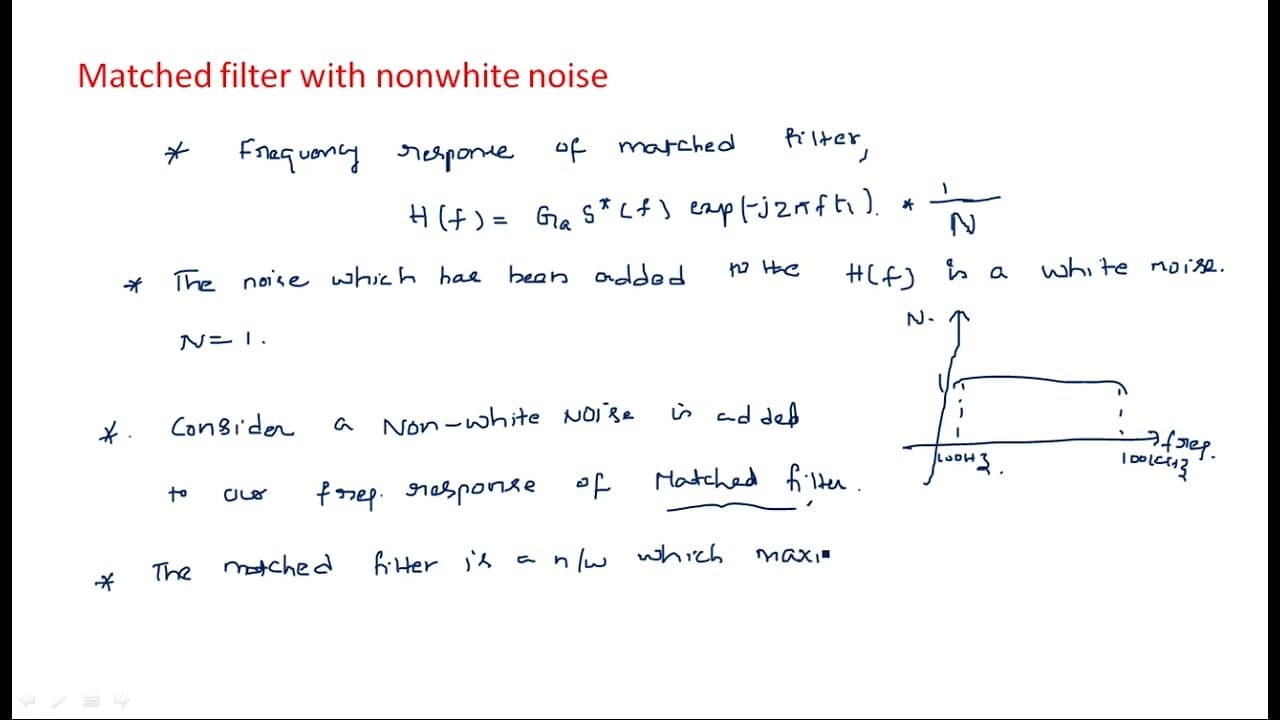
hi everyone in this video I am going to explain about the Matched filter with non-white noise so till now we have considered the frequency response of the Matched filter as h of f is equal to so what is that see this entire matched filter Concepts is completely related to that frequency response h of f so frequency response of frequency response of... Read More
Key Insights
- 🤍 A matched filter is primarily effective under the assumption of white noise, which has a constant power spectral density.
- 🤍 Non-white noise introduces complexities that can degrade the filter's efficiency, making it necessary to treat the filtering process differently.
- 🤍 To recover the signal in non-white noise conditions, a two-step cascading filter approach—whitening followed by matched filtering—can be implemented.
- 🤍 The fundamental equation for a matched filter must account for the noise characteristics, especially when dealing with non-white noise inputs.
- 💁 Understanding how noise affects signal processing is critical for optimizing communication systems and enhancing information retrieval in noisy environments.
- 😑 The introduction of rigorous definitions and mathematical expressions enhances clarity in discussing frequencies directly impacted by noise, aiding in better design and application of filters.
- ⚾ Awareness of the spectral densities involved is vital for tailoring filters that maximize performance based on real operating environments.
Install to Summarize YouTube Videos and Get Transcripts
Explore YouTube Video Summarizer or Get YouTube Transcript Extractor
Questions & Answers
Q: What is the fundamental purpose of a matched filter?
A matched filter is designed to maximize the peak signal-to-noise ratio (SNR). It achieves this by correlating a known signal with incoming data, thereby reinforcing the signal against any background noise, typically under conditions where white noise is present, which leads to optimal performance.
Q: How does white noise influence the frequency response of a matched filter?
White noise features uniform spectral density, which means that it does not vary with frequency. This characteristic allows the matched filter to be effective without additional adjustments. When white noise is present, it does not significantly alter the matched filter's frequency response, making its implementation straightforward and efficient.
Q: What challenges arise from the presence of non-white noise in a matched filter?
Non-white noise can have varying spectral densities, which complicates the performance of the matched filter. It may fail to maximize the peak SNR, making it behave like a non-matched filter. Consequently, additional techniques like cascading filters may be required to address these complexities effectively.
Q: What is the role of the whitening filter in the context of non-white noise?
The whitening filter transforms non-white noise into a white noise equivalent by flattening its spectral density, thereby making the noise characteristics uniform across frequencies. This process enables the subsequent matched filter to operate effectively, as it can then assume the advantageous conditions similar to when only white noise is present.
Summary & Key Takeaways
-
The matched filter enhances the peak signal-to-noise ratio (SNR), primarily with white noise due to its uniform spectral density, which simplifies noise analysis.
-
When non-white noise is introduced, it complicates the matched filter function, potentially degrading its effectiveness and shifting it from being a matched to a non-matched filter.
-
The approach to manage non-white noise involves creating a cascading filter setup where a whitening filter first converts noise to white, followed by a matched filter processing the signal.
Read in Other Languages (beta)
Share This Summary 📚
Summarize YouTube Videos and Get Video Transcripts with 1-Click
Try YouTube Summary with ChatGPT & Claude or YouTube Transcript Generator