Parity circuits | Digital Systems Design | Lec-73
TL;DR
Parity circuits generate parity bits to detect errors in binary data transmission.
Transcript
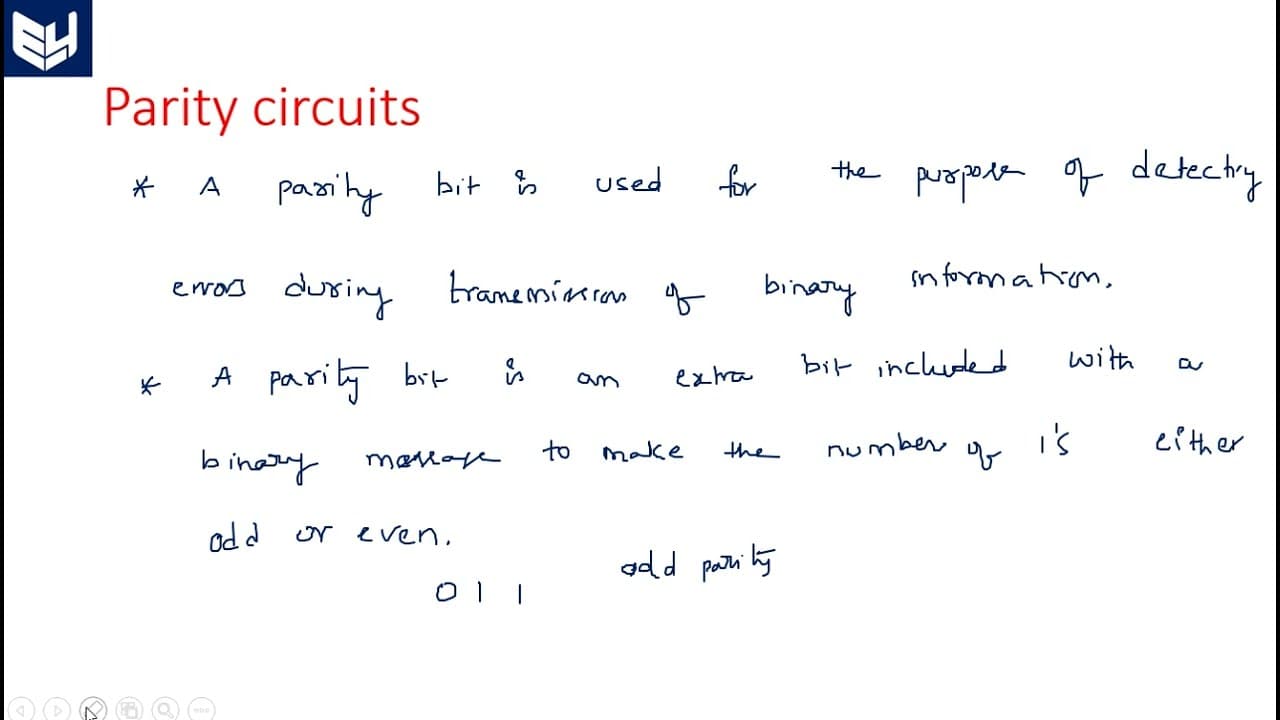
hi everyone in this video I'm going to explain about parity circuits parity circuits are nothing but which are used to produce parity bits parity bits so a parity bit is used for the purpose of detecting errors during transmission of binary information so I'm writing here a parity bit a parity bit is used for the purpose of detecting errors during ... Read More
Key Insights
- 🫦 Parity bits are essential for maintaining data integrity during digital communication and help identify errors in transmission.
- 👻 Odd and even parity methods allow systems to cater to different error detection requirements based on the application's needs.
- 🏁 Parity generators and checkers complement each other to ensure reliable data communication, enhancing overall system functionality.
- 🦻 Understanding the Boolean logic behind parity circuits aids in designing effective error detection systems in computer networks.
- 🦕 The relationship between odd and even parity provides engineers with valuable insight into error detection methodologies.
- ❓ Parity checking enhances overall system reliability and is widely implemented across various digital communication platforms.
- 🫦 The concept of parity bits extends beyond simple binary messages; similar principles apply in more complex data transmission protocols.
Install to Summarize YouTube Videos and Get Transcripts
Explore YouTube Video Summarizer or Get YouTube Transcript Extractor
Questions & Answers
Q: What is the primary purpose of a parity bit?
A parity bit is an additional bit added to a binary message to enable error detection during transmission. It helps ensure that the total number of ones in the data aligns with either an odd or even count, facilitating the identification of any errors that may occur during data transfer.
Q: How do odd and even parity differ in function?
Odd parity ensures that the total count of ones is odd after adding the parity bit, while even parity ensures the count is even. For instance, if a binary sequence has an odd number of ones, an even parity bit would be zero, whereas for odd parity, it would be one to maintain the required odd count.
Q: What role do parity generators and parity checkers play in data transmission?
Parity generators are used at the transmitter's end to create the parity bit and append it to the binary message. Parity checkers, located at the receiving end, verify the received message against the expected parity to check for possible transmission errors, enabling error detection.
Q: Can you explain how parity bits are appended to a binary message?
When transmitting a binary message, an additionalParity bit is appended to the original data. For an 8-bit message, the parity bit makes it a 9-bit sequence. This parity bit is determined by the desired parity type—odd or even—ensuring the total number of ones in the complete message meets the chosen specification.
Q: What is the Boolean expression for odd parity?
The odd parity Boolean expression can be represented as P_odd = A ⊕ B ⊕ C, which signifies the exclusive OR operation. This means that the output will be true if an odd number of the inputs are true. Conversely, even parity is the complement of this output.
Q: How is the parity checking process carried out at the receiver's end?
At the receiver's end, the parity checker retrieves the complete message, including the parity bit, and calculates the parity of the received bits. If the calculated parity matches the transmitted parity, the data is deemed error-free. Otherwise, an error is detected, indicating that the received data has been corrupted.
Q: What’s the significance of the relationship between odd and even parity?
Odd and even parity are complementary; they serve to represent the same data integrity concept but from opposite perspectives. The existence of one parity type implies that the other is not valid. This mutual exclusivity provides flexibility in error checking depending on the requirements of the transmitting and receiving systems.
Summary & Key Takeaways
-
Parity circuits are essential for error detection in binary data transmission, employing additional bits known as parity bits.
-
There are two types of parity systems: odd and even parity, which ensure that transmitted data contains a specific number of ones.
-
Parity generators create parity bits at the transmitter side, while parity checkers verify the integrity of received data.
Read in Other Languages (beta)
Share This Summary 📚
Summarize YouTube Videos and Get Video Transcripts with 1-Click
Try YouTube Summary with ChatGPT & Claude or YouTube Transcript Generator