What Are the Five Major Types of Chemical Reactions?
TL;DR
The five major types of chemical reactions are synthesis, decomposition, combustion, single replacement, and double replacement. Synthesis combines simpler materials into a complex compound, while decomposition breaks compounds into simpler substances. Combustion burns compounds containing carbon and hydrogen, single replacement replaces one element in a compound, and double replacement exchanges partners between two compounds.
Transcript
let's talk about these five major types of chemical reactions we'll look at examples of each and learn how to tell them apart so that you can look at a chemical reaction and classify it figure out what type it is the first reaction we're going to talk about is the synthesis reaction these are sometimes called combination reactions now synthesis is ... Read More
Key Insights
- ❓ Synthesis reactions involve the combination of simple materials to create a more complex compound.
- 🍳 Decomposition reactions break down compounds into simpler compounds or elements.
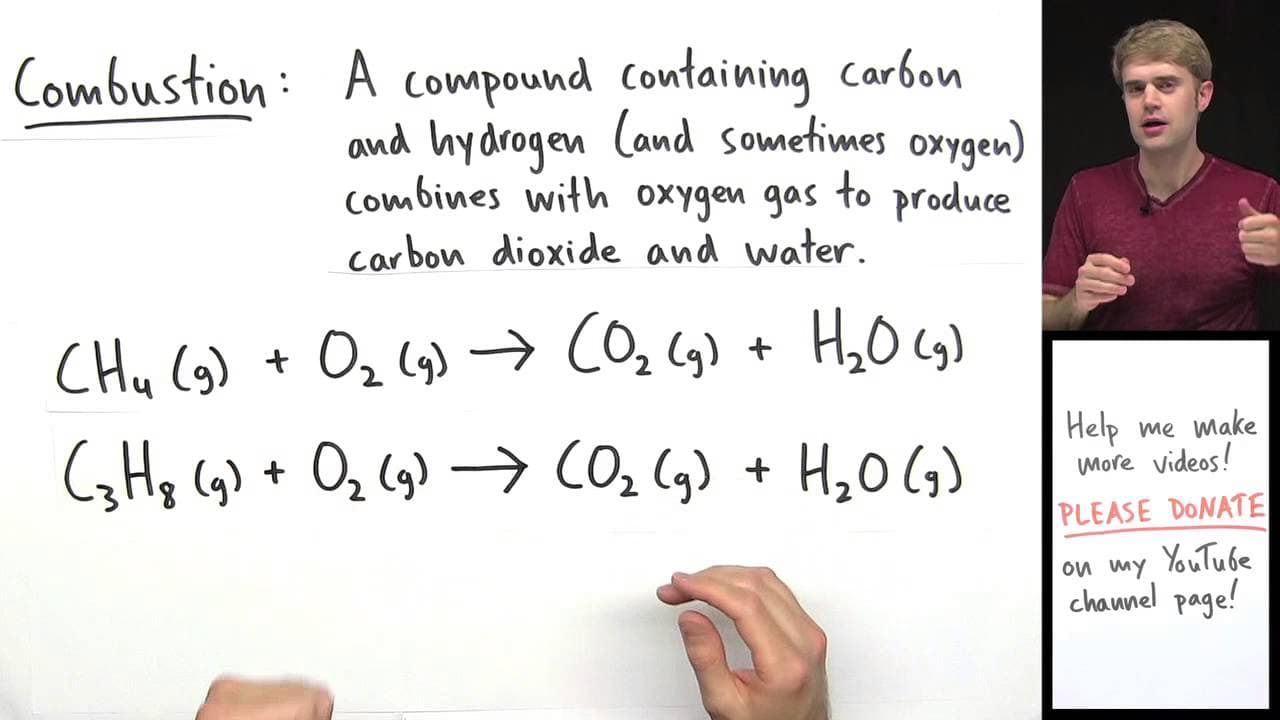
- ❓ Combustion reactions are characterized by the burning of a compound containing carbon and hydrogen.
- 🔂 Single replacement reactions occur when one element replaces another element in a compound.
- ⏫ Double replacement reactions involve the exchange of partners between two compounds.
- ⚖️ Balancing equations is important in chemical reactions, but for the purpose of learning the different types, balancing numbers can be disregarded.
- #️⃣ Many combustion reactions involve compounds with varying numbers of carbons and hydrogens.
Install to Summarize YouTube Videos and Get Transcripts
Explore YouTube Video Summarizer or Get YouTube Transcript Extractor
Questions & Answers
Q: What is a synthesis reaction?
A synthesis reaction involves combining simple materials to create a more complex compound. For example, carbon and oxygen gas combine to form carbon dioxide.
Q: How does a decomposition reaction occur?
In a decomposition reaction, a compound breaks down into simpler compounds or even down to the elements that make it up. For instance, water can break down into hydrogen and oxygen gas.
Q: What happens in a combustion reaction?
Combustion reactions occur when a compound containing carbon and hydrogen (and sometimes oxygen) combines with oxygen gas, producing carbon dioxide and water. It is essentially a burning process.
Q: Can you explain single replacement reactions?
Single replacement reactions occur when one element replaces another element in a compound. The element that gets replaced ends up by itself, while the replacing element pairs up with the other element in the compound.
Q: What is a double replacement reaction?
In a double replacement reaction, the positive and negative ions in two compounds switch places, resulting in two new compounds. This is like two dancing couples changing partners.
Summary & Key Takeaways
-
Synthesis reactions involve combining simple materials to create a more complex compound.
-
Decomposition reactions break down compounds into simpler compounds or elements.
-
Combustion reactions are the result of a compound containing carbon and hydrogen combining with oxygen to produce carbon dioxide and water.
-
Single replacement reactions occur when one element replaces another element in a compound.
-
Double replacement reactions involve the exchange of partners between two compounds.
Read in Other Languages (beta)
Share This Summary 📚
Summarize YouTube Videos and Get Video Transcripts with 1-Click
Try YouTube Summary with ChatGPT & Claude or YouTube Transcript Generator
Explore More Summaries from Tyler DeWitt 📚

Summarize YouTube Videos and Get Video Transcripts with 1-Click
Try YouTube Summary with ChatGPT & Claude or YouTube Transcript Generator