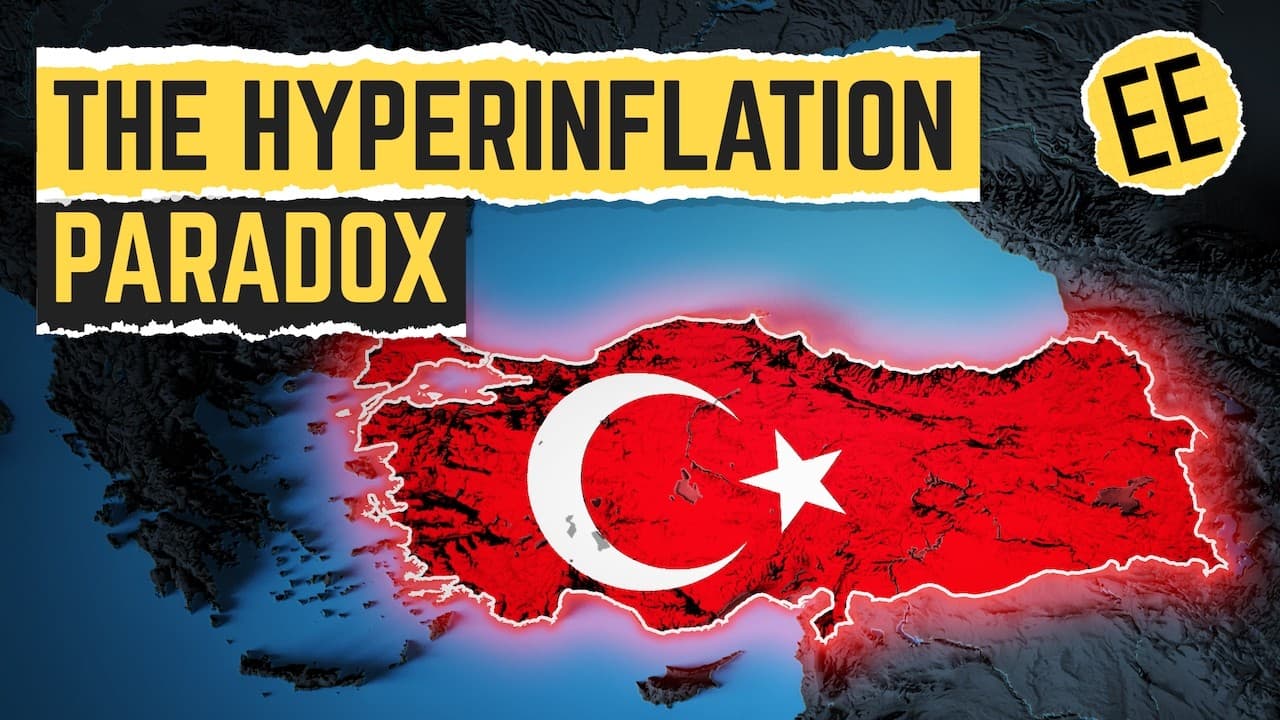
How Has Turkey Been Going?
TL;DR
Turkey faces severe inflation and currency devaluation despite recent policy changes.
Transcript
Turkey has been home to one of the most turbulent major economies in the world over the last two decades. When we last explored the country, we found an economy with incredibly strong fundamentals that were completely undermined by some unusual macroeconomic decisions. Inflation has been the headline issue in the country for the past five years, wi... Read More
Key Insights
- Turkey's economy has faced severe inflation, with the lira losing 96% of its value since 2005, undermining its strong fundamentals.
- Despite recent interest rate hikes, stabilization remains elusive due to a combination of late interventions and ongoing currency devaluation.
- Turkey's economic challenges are exacerbated by the population's lack of trust in the currency, leading to a preference for foreign currencies.
- Turkey has a promising economy with a large, talented workforce and a strategic geographic position, but internal instability hinders its potential.
- The country's past economic growth was driven by strategic investments and a strong central bank, but political changes have undermined these gains.
- Foreign borrowing in foreign currencies has increased Turkey's debt burden, further depreciating the lira and complicating economic recovery efforts.
- Turkey's attempt to control inflation through special savings accounts backfired, increasing the money supply and exacerbating inflation.
- A major political shift and a reset of the currency and its managing institutions are necessary for Turkey to stabilize its economy.
Install to Summarize YouTube Videos and Get Transcripts
Explore YouTube Video Summarizer or Get YouTube Transcript Extractor
Questions & Answers
Q: What has been the main issue with Turkey's economy over the past two decades?
The main issue with Turkey's economy has been severe inflation and the devaluation of its currency, the lira. Since 2005, the lira has lost 96% of its value, undermining the country's economic fundamentals. This has been exacerbated by unusual macroeconomic decisions, such as keeping interest rates low, which accelerated inflation.
Q: How has Turkey's government attempted to address inflation?
Turkey's government has attempted to address inflation by raising interest rates, a move that theoretically should stabilize the currency's value. However, these interventions may have been too late, and the ongoing devaluation of the lira continues to pose challenges. Additionally, past policies like special savings accounts to combat inflation have backfired, increasing the money supply.
Q: What are the economic strengths of Turkey?
Turkey has significant economic strengths, including a large, well-educated, and talented workforce. Its geographic position serves as a strategic bridge between Europe and the Middle East, offering potential for trade and economic growth. Turkey also has natural resources, tourism potential, and the ability to act as a global middleman.
Q: Why has foreign borrowing been problematic for Turkey?
Foreign borrowing has been problematic for Turkey because much of its private sector debt is denominated in foreign currencies. This requires repayment in foreign currencies, further devaluing the lira. The lack of international demand for the lira and the preference for foreign currencies have exacerbated Turkey's economic challenges.
Q: What role did political changes play in Turkey's economic decline?
Political changes, such as the 2016 coup attempt and subsequent constitutional amendments, increased the president's power over interest rate decisions. This undermined the independence of the central bank, leading to low interest rates and spiraling inflation. Political instability also deterred foreign investment, contributing to the economic decline.
Q: How did Turkey's past economic policies contribute to growth?
In the past, Turkey's economic growth was driven by strategic investments in industry, education, and international trade. The central bank's independence allowed for effective monetary policy, stabilizing inflation and encouraging foreign investment. Turkey's geographic position facilitated trade, and the currency reset in 2005 instilled confidence in the economy.
Q: What are the potential solutions for Turkey's economic challenges?
Potential solutions for Turkey's economic challenges include a major political shift and a reset of the currency and its managing institutions. Restoring the central bank's independence and implementing policies that build trust in the lira are crucial. Leveraging Turkey's strategic position and economic strengths can also drive growth and stability.
Q: What impact has currency devaluation had on Turkey's economy?
Currency devaluation has significantly impacted Turkey's economy by reducing the purchasing power of the lira and increasing the cost of imports. It has also led to inflation, eroded trust in the currency, and complicated foreign trade and investment. The devaluation has stifled domestic industries and increased the debt burden.
Summary & Key Takeaways
-
Turkey's economy has been plagued by severe inflation and currency devaluation, with the lira losing 96% of its value since 2005. Despite recent interest rate hikes, stabilization remains elusive, and the population's lack of trust in the currency exacerbates the issue.
-
Turkey's strategic geographic position and promising workforce offer significant economic potential. However, political instability and poor policy decisions have hindered growth, leading to increased foreign borrowing and a devalued currency.
-
To address its economic challenges, Turkey needs a political shift and a reset of its currency and financial institutions. The country's past successes highlight its potential, but current policies and instability continue to stifle progress.
Read in Other Languages (beta)
Share This Summary 📚
Summarize YouTube Videos and Get Video Transcripts with 1-Click
Try YouTube Summary with ChatGPT & Claude or YouTube Transcript Generator
Explore More Summaries from Economics Explained 📚





Summarize YouTube Videos and Get Video Transcripts with 1-Click
Try YouTube Summary with ChatGPT & Claude or YouTube Transcript Generator