Kaggle's 30 Days Of ML (Day-3): Python Functions
TL;DR
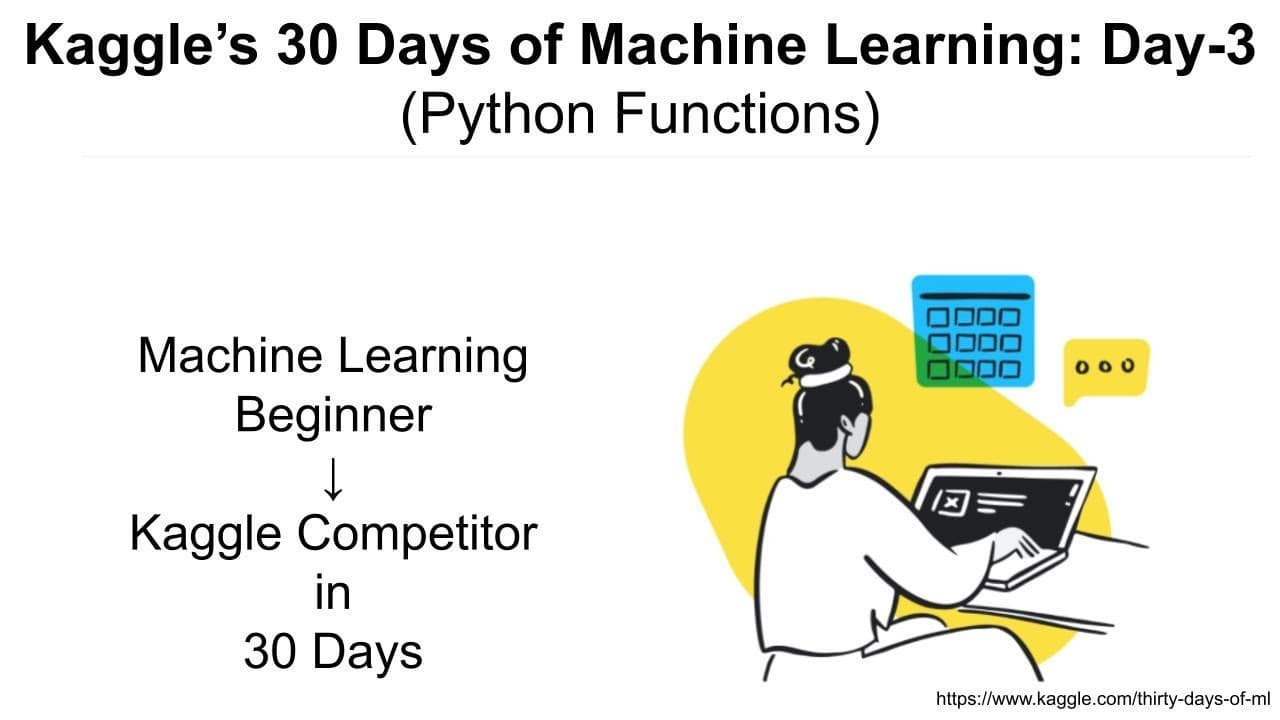
This video is an introduction to functions in Python, covering topics such as built-in functions, using the help function, writing your own functions, and applying functions to other functions.
Transcript
hello everyone and welcome to kaggle's 30 days of ml day 3. uh in day 2 we learned about some basics of faith and some really basics of python that will help you get started with python and it was about variables types some inbuilt functions like print type min max these kind of things some arithmetic operations so it was quite basic stuff and toda... Read More
Key Insights
- 👨💻 Functions in Python are blocks of reusable code used to perform specific tasks.
- 💁 The help function can be used to get information about built-in functions and their usage.
- ↩️ Writing your own functions requires defining arguments and using return statements.
Install to Summarize YouTube Videos and Get Transcripts
Explore YouTube Video Summarizer or Get YouTube Transcript Extractor
Questions & Answers
Q: How can the help function be used to get information about built-in functions?
To get help on a specific function, you can use the syntax "help(function_name)" or "function_name?" in Jupyter notebooks. This will provide a description and usage of the function.
Q: What is the purpose of writing comments and docstrings in functions?
Comments and docstrings are used to document the purpose, details, and usage of functions. They help other users understand the function and how to use it effectively.
Q: Can functions have optional arguments?
Yes, functions can have optional arguments by assigning a default value to the argument in the function definition. This allows the argument to be omitted when calling the function.
Q: What are higher-order functions?
Higher-order functions are functions that take other functions as arguments or return functions as results. They allow for more complex functionality and code reusability.
Summary & Key Takeaways
-
The video introduces the concept of functions in Python and explains that functions are blocks of reusable code used to perform specific tasks.
-
The video demonstrates using the help function to get information about built-in functions and how to use them.
-
The video explains how to write your own functions, including defining arguments and using return statements.
-
The video shows an example of applying functions to other functions, known as higher-order functions.
Read in Other Languages (beta)
Share This Summary 📚
Summarize YouTube Videos and Get Video Transcripts with 1-Click
Try YouTube Summary with ChatGPT & Claude or YouTube Transcript Generator
Explore More Summaries from Abhishek Thakur 📚


Summarize YouTube Videos and Get Video Transcripts with 1-Click
Try YouTube Summary with ChatGPT & Claude or YouTube Transcript Generator