What Have Superhero Space Telescopes Discovered About Exoplanets?
TL;DR
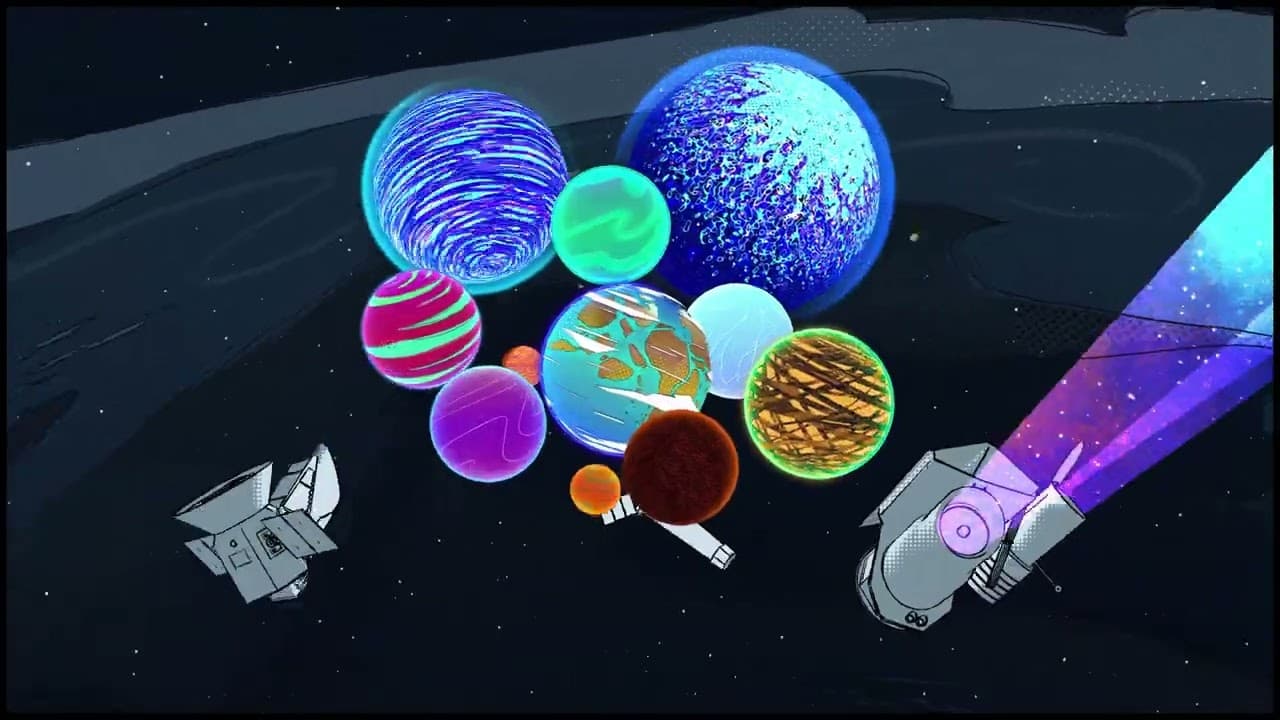
Superhero space telescopes have revolutionized our understanding of exoplanets, uncovering thousands of diverse worlds beyond our solar system. Ground-based telescopes pioneered the discoveries, but space giants like Hubble and the James Webb are crucial for deeper insights, particularly into exoplanet atmospheres like that of HD 189733b, known for its extreme conditions.
Transcript
(mellow music) - [Narrator] If you could put on a special pair of glasses and look up into the night sky, you would see something amazing, a sky full of exoplanets, planets orbiting stars beyond our own solar system. A team of superhero space telescopes, in a sense, has done just that. Using powerful technology, they peered into space, discovering ... Read More
Key Insights
- 🔭 Ground-based telescopes were the pioneers in discovering exoplanets, but space telescopes brought significant advancements in capturing clearer observations.
- 🧡 Exoplanets come in various sizes, compositions, and temperature ranges, with some displaying extraordinary features.
Install to Summarize YouTube Videos and Get Transcripts
Explore YouTube Video Summarizer or Get YouTube Transcript Extractor
Questions & Answers
Q: How did ground-based telescopes contribute to the discovery of exoplanets?
Ground-based telescopes pioneered new techniques and captured evidence of giant, scorchingly hot planets around other stars before space telescopes were launched.
Q: What advantages do space telescopes have over ground-based telescopes in observing exoplanets?
Space telescopes like Hubble, Chandra, Spitzer, Kepler, Tess, and the upcoming James Webb telescope are free from atmospheric interference, which allows for clearer observations of exoplanets.
Q: What makes HD 189733b an interesting exoplanet?
HD 189733b is a hot Jupiter with a temperature exceeding 1,700 degrees Fahrenheit and winds blowing at more than 5,400 miles per hour. Its deep-blue clouds are composed of raining glass or silicates.
Q: How will the James Webb space telescope contribute to our understanding of HD 189733b?
The James Webb telescope's infrared vision will penetrate deeper into HD 189733b's atmosphere compared to previous observations by Spitzer. It aims to reveal more about the exoplanet's composition and atmospheric characteristics.
Summary & Key Takeaways
-
Ground-based telescopes were the first to capture evidence of exoplanets, but space telescopes like Hubble, Chandra, Spitzer, Kepler, and Tess were launched to see them more clearly.
-
These telescopes unveiled a galaxy full of diverse exoplanets, from giant ones to small rocky worlds, and some with unusual attributes.
-
The James Webb space telescope, with its infrared vision, will deepen our understanding of exoplanet atmospheres, starting with the intriguing exoplanet HD 189733b.
Read in Other Languages (beta)
Share This Summary 📚
Summarize YouTube Videos and Get Video Transcripts with 1-Click
Try YouTube Summary with ChatGPT & Claude or YouTube Transcript Generator
Explore More Summaries from NASA 📚

Summarize YouTube Videos and Get Video Transcripts with 1-Click
Try YouTube Summary with ChatGPT & Claude or YouTube Transcript Generator