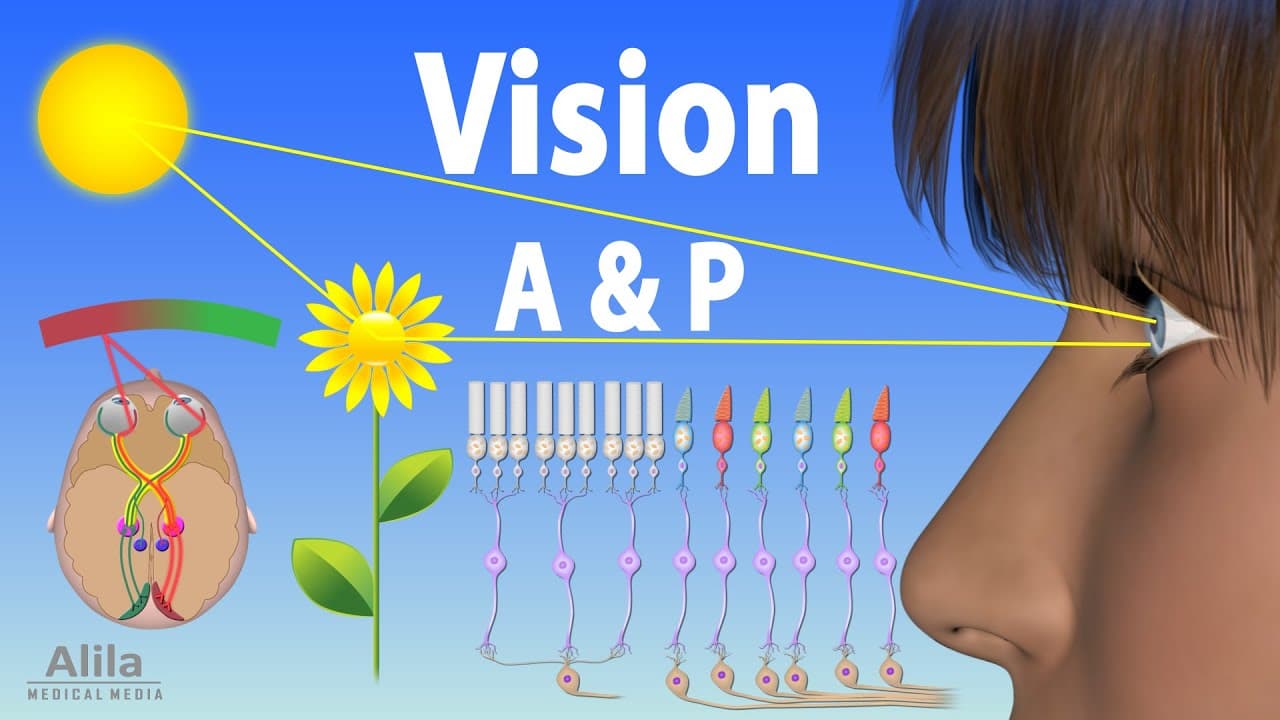
Vision: Anatomy and Physiology, Animation
TL;DR
Human vision is based on the perception of light, with optical and neural components working together to capture and process visual information.
Transcript
Vision is the perception of objects based on the light that they emit or reflect. Human eyes can only detect visible light - a narrow range of electromagnetic radiation, roughly from 400 to 750 nm in wavelengths. The eye consists of optical components, which work like a camera, capturing and focusing images; and neural components that con... Read More
Key Insights
- 🙂 Human vision is based on perceiving light within a specific range of wavelengths (400 to 750 nm).
- 😃 The eye has both optical and neural components that work together to capture, process, and transmit visual information to the brain.
- ⚡ Photoreceptor cells, such as rods and cones, play a crucial role in detecting light, providing color vision, and maintaining high sensitivity or resolution in specific areas of the retina.
- 🙈 The brain compensates for the blind spot in our vision by filling it in with visual information from surrounding areas.
- 💿 Different pathways, including the optic nerve and optic chiasm, transmit visual information to the visual cortex and other brain regions responsible for reflexes and coordination.
Install to Summarize YouTube Videos and Get Transcripts
Explore YouTube Video Summarizer or Get YouTube Transcript Extractor
Questions & Answers
Q: What are the main optical components of the eye, and how do they contribute to vision?
The main optical components of the eye are the cornea, lens, and iris. The cornea and lens refract light and focus the image on the retina, while the iris acts as an aperture to control the amount of light entering the eye.
Q: How does the retina convert optical information into nerve impulses?
The retina is a light-sensitive tissue that houses photoreceptor cells. When light is absorbed by these cells, it triggers a series of reactions that convert the information into action potentials. The impulses are then sent via the optic nerve to the brain.
Q: What is the function of the fovea and optic disk in vision?
The fovea is the central part of the retina responsible for sharp central vision. In contrast, the optic disk is the location where the optic nerve leaves the eye and has no photoreceptor cells. It corresponds to the blind spot in our visual field, but the brain fills in the missing information from surrounding areas.
Q: How do photoreceptor cells (rods and cones) differ in their function?
Rod cells are responsible for night vision, detecting dim light but providing low-resolution images and no color differentiation. Cones function in bright daylight, detect colors, and provide high-resolution details. They are named after the color they absorb best: red, green, and blue.
Key Insights:
- Human vision is based on perceiving light within a specific range of wavelengths (400 to 750 nm).
- The eye has both optical and neural components that work together to capture, process, and transmit visual information to the brain.
- Photoreceptor cells, such as rods and cones, play a crucial role in detecting light, providing color vision, and maintaining high sensitivity or resolution in specific areas of the retina.
- The brain compensates for the blind spot in our vision by filling it in with visual information from surrounding areas.
- Different pathways, including the optic nerve and optic chiasm, transmit visual information to the visual cortex and other brain regions responsible for reflexes and coordination.
- The perception of objects in the left visual field is processed by the right side of the brain, controlling motor responses on the left side of the body.
Summary & Key Takeaways
-
Human vision is limited to detecting visible light, with a range of wavelengths between 400 to 750 nm.
-
The eye consists of optical components (cornea, lens, iris) that capture and focus images, and neural components (retina, optic nerve) that convert images into nerve impulses.
-
Different photoreceptor cells (rods and cones) are responsible for night vision and color vision, respectively.
Read in Other Languages (beta)
Share This Summary 📚
Summarize YouTube Videos and Get Video Transcripts with 1-Click
Try YouTube Summary with ChatGPT & Claude or YouTube Transcript Generator
Explore More Summaries from Alila Medical Media 📚




Summarize YouTube Videos and Get Video Transcripts with 1-Click
Try YouTube Summary with ChatGPT & Claude or YouTube Transcript Generator