Class 5: Tessellations & Modulars
TL;DR
Learn about different origami techniques, including tessellations, modular structures, and connected cranes, as well as the use of alternative materials in origami art.
Transcript
PROFESSOR: All right. So today we resume efficient origami design. And we had our guest lecture from Jason Ku which was definitely a different style of lecture. More survey, lots of different artwork. And it had some practical hands-on experience with TreeMaker, which you're welcome to do more of on your problem set. And so there weren't a lot of q... Read More
Key Insights
- 🎨 TreeMaker software helps artists design origami models using the tree method of folding.
- 🎱 Origami can be made from various materials, including dollar bills, cardboard, and polypropylene.
- 🔁 Tessellations in origami involve repeated patterns of polygons and offer artistic and mathematical possibilities.
- 👻 Modular origami allows for the creation of larger and more complex structures by connecting multiple identical units.
Install to Summarize YouTube Videos and Get Transcripts
Explore YouTube Video Summarizer or Get YouTube Transcript Extractor
Questions & Answers
Q: What is the purpose of TreeMaker software in origami design?
TreeMaker is a software that aids in the design of origami models by generating crease patterns based on tree method folding techniques. It allows artists to create complex and precise designs easily.
Q: Can origami be made from materials other than paper?
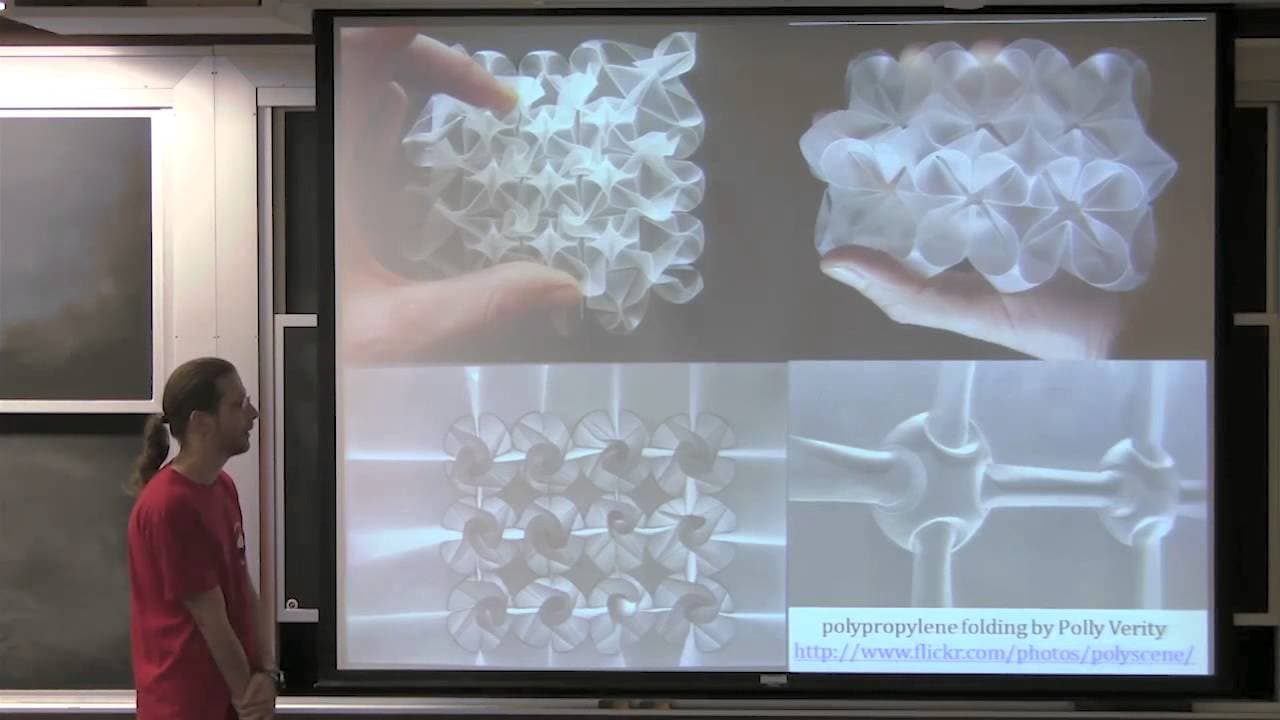
Yes, origami can be created from various materials. The lecture highlights examples of origami made from dollar bills, cardboard, polypropylene, stainless steel, and even inkjet-printed paper.
Q: What is a tessellation in origami?
A tessellation in origami refers to a repeated pattern of polygons created through folding. It can be periodic or aperiodic, and the crease pattern itself can represent the tessellation.
Q: What is the advantage of modular origami?
Modular origami allows for the creation of complex structures by combining multiple identical units together. It offers versatility and enables the construction of larger and more intricate designs.
Summary & Key Takeaways
-
The lecture begins with a recap of the guest lecture by Jason Ku, highlighting the use of TreeMaker software in origami design.
-
The professor showcases various artistic origami designs, including models by Jason Ku, the use of box pleating, and origami from unconventional materials such as dollar bills and cardboard.
-
The lecture also explores tessellations in origami, with examples of traditional flat tessellations, 3D tessellations, and computer-aided design tools.
-
The presentation then moves on to modular origami, featuring connected cranes, polypolyhedra, and cube modules made from business cards.
Read in Other Languages (beta)
Share This Summary 📚
Summarize YouTube Videos and Get Video Transcripts with 1-Click
Try YouTube Summary with ChatGPT & Claude or YouTube Transcript Generator
Explore More Summaries from MIT OpenCourseWare 📚



Summarize YouTube Videos and Get Video Transcripts with 1-Click
Try YouTube Summary with ChatGPT & Claude or YouTube Transcript Generator