Computer made with brain cells: BBC News Review
TL;DR
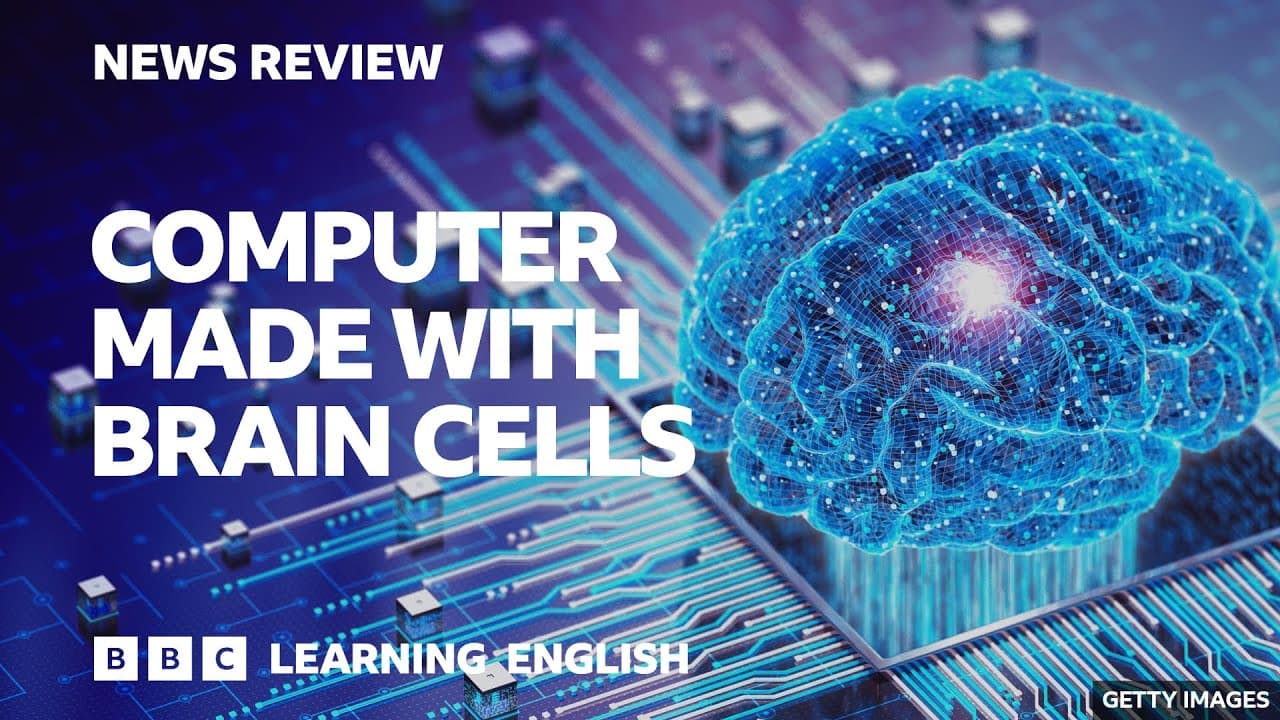
Scientists create computer using living brain cells.
Transcript
A computer made from living brain cells? This is News Review from BBC Learning English, where we help you understand news headlines in English. I'm Neil. I'm Georgie. Make sure you watch to the end to learn the words you need to talk about this story. Don't forget to subscribe to our channel to help you understand the world in English. Now, the sto... Read More
Key Insights
- Scientists have developed a computer system, named 'Brainoware', utilizing living brain cells to perform tasks like voice recognition and mathematical calculations.
- The term 'biocomputer' refers to a computer made from living tissue, combining electronic hardware with real brain cells.
- Lab-grown brain tissue, used in 'Brainoware', is created in a laboratory setting and not extracted from human brains.
- The 'brain-like' tissue used in this technology is similar to a real brain but not identical, enhancing AI's human-like capabilities.
- Biocomputers could potentially be more energy-efficient than traditional computers due to the use of real tissue.
- The prefix 'bio' in 'biocomputer' indicates the involvement of living organisms, as seen in terms like 'biodegradable' and 'biofuel'.
- Lab-grown products, such as meat and skincare ingredients, represent a sustainable alternative to traditional methods.
- The integration of living cells with electronics in biocomputers marks a significant advancement in AI technology, making it more human-like.
Install to Summarize YouTube Videos and Get Transcripts
Explore YouTube Video Summarizer or Get YouTube Transcript Extractor
Questions & Answers
Q: What is 'Brainoware' and what tasks can it perform?
'Brainoware' is a computer system developed using living brain cells. It is capable of performing tasks such as voice recognition and mathematical calculations. This innovation represents a significant step towards making artificial intelligence systems more human-like by incorporating biological elements into electronic hardware.
Q: What does the term 'biocomputer' mean?
The term 'biocomputer' refers to a computer system that integrates living tissue with electronic components. It combines the prefix 'bio', meaning life or living organisms, with the word 'computer', indicating a system that processes information. In this context, biocomputers use real brain cells to perform computational tasks.
Q: How is the brain tissue used in 'Brainoware' created?
The brain tissue used in 'Brainoware' is lab-grown, meaning it is created in a laboratory environment. Scientists use stem cells to develop this tissue, which is not harvested from human brains. This method allows for the creation of brain-like tissue that can be used in biocomputers without ethical concerns associated with using real human brain tissue.
Q: What does 'brain-like' tissue imply in the context of this technology?
'Brain-like' tissue refers to materials that resemble real brain tissue in function but are not identical to it. In the context of 'Brainoware', this term indicates that the tissue used can mimic some aspects of a human brain, such as processing information, without being a complete or real brain. This similarity enhances AI's ability to perform human-like tasks.
Q: Why might biocomputers be more energy-efficient than traditional computers?
Biocomputers might be more energy-efficient than traditional computers because they utilize living tissue, which can potentially process information in a more natural and efficient manner. Living cells might consume less energy compared to silicon-based components, leading to reduced power requirements and increased sustainability in computational processes.
Q: What are some examples of lab-grown products mentioned in the content?
The content mentions lab-grown meat and skincare ingredients as examples of lab-grown products. These items are created in laboratory settings without the need for traditional farming or extraction methods. Lab-grown products are considered more sustainable and environmentally friendly, providing alternatives to conventional production techniques.
Q: How does the prefix 'bio' relate to the concept of biocomputers?
The prefix 'bio' in 'biocomputer' signifies the involvement of living organisms or biological processes. It highlights the integration of living tissue, such as brain cells, with electronic hardware. This prefix is commonly used in terms like 'biodegradable' and 'biofuel', indicating a connection to life or living organisms in various contexts.
Q: What potential does the integration of living cells with electronics hold for AI technology?
The integration of living cells with electronics in AI technology holds significant potential for making AI systems more human-like. By incorporating biological elements, AI can mimic human behaviors and processes more closely. This advancement could lead to more efficient, adaptive, and intelligent systems, revolutionizing fields such as computing, robotics, and biotechnology.
Summary & Key Takeaways
-
Scientists have created a computer system called 'Brainoware' using living brain cells, capable of recognizing voices and performing calculations. This breakthrough could make AI more human-like, highlighting the potential of biocomputers, which combine living tissue with electronic hardware.
-
The development of 'Brainoware' involves lab-grown brain tissue, which is not extracted from humans but created using stem cells in a laboratory. This innovation emphasizes the growing trend of using lab-grown materials for sustainable alternatives in various fields.
-
The concept of 'brain-like' tissue is central to this technology, indicating a similarity to real brains without being identical. This advancement suggests a future where AI systems can mimic human behavior more closely, offering new possibilities for technology and sustainability.
Read in Other Languages (beta)
Share This Summary 📚
Summarize YouTube Videos and Get Video Transcripts with 1-Click
Try YouTube Summary with ChatGPT & Claude or YouTube Transcript Generator
Explore More Summaries from BBC Learning English 📚

Summarize YouTube Videos and Get Video Transcripts with 1-Click
Try YouTube Summary with ChatGPT & Claude or YouTube Transcript Generator