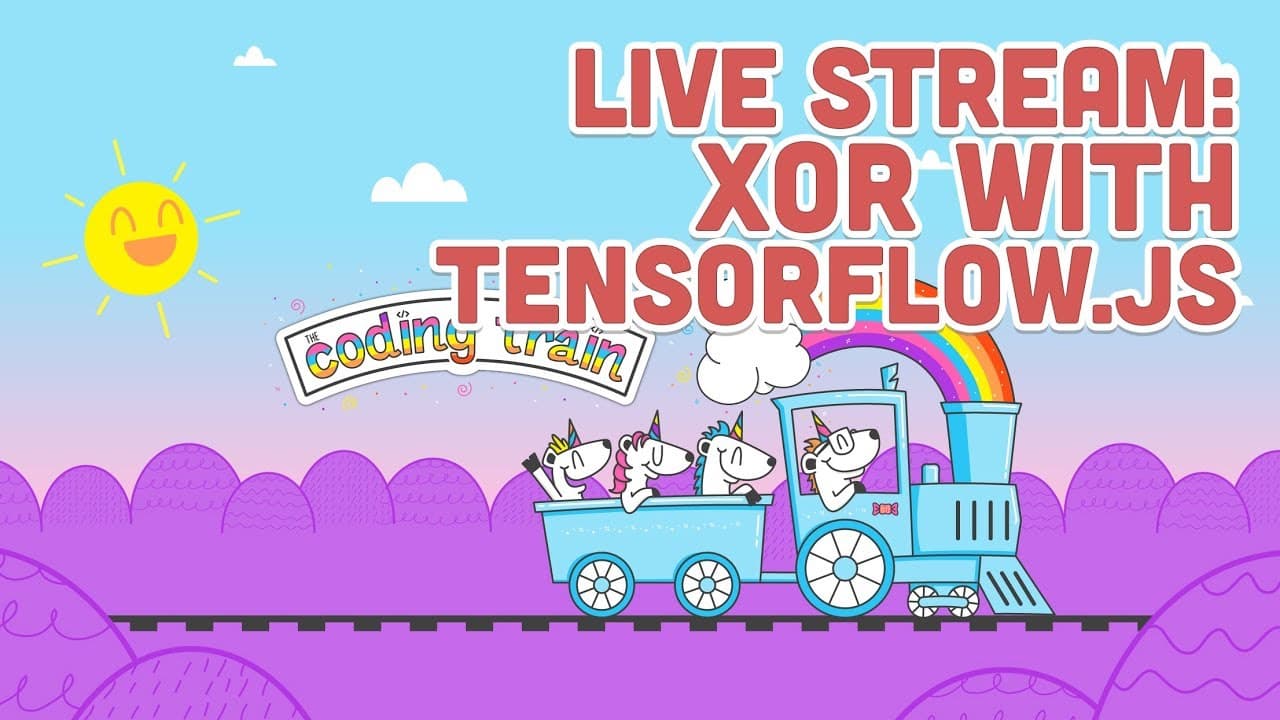
Coding Train Live 141: XOR with TensorFlow.js
TL;DR
Implementing XOR problem visualization using TensorFlow.js with data shuffling and model training.
Transcript
hello good evening this is not the evening at all this is the afternoon though welcome to the coding train on a Friday which is my usual day for the coding train but this summer it has not been my usual day I was just having a lot of trouble getting the start streaming button to start I had restricted mode enabled on this laptop for a variety of re... Read More
Key Insights
- 🎰 TensorFlow.js enables the visual representation and training of neural network models for machine learning tasks.
- 💐 Asynchronous functions and promises help manage data flow and model training operations effectively.
- 🔀 Data preprocessing techniques like data shuffling are crucial for enhancing model performance and preventing overfitting.
Install to Summarize YouTube Videos and Get Transcripts
Explore YouTube Video Summarizer or Get YouTube Transcript Extractor
Questions & Answers
Q: Why is the XOR problem significant in machine learning?
The XOR problem showcases the need for multi-layer perceptrons as a basic single neuron model cannot solve it due to non-linearity.
Q: How did the implementation of TensorFlow.js help in solving the XOR problem?
TensorFlow.js offers a convenient way to create neural network models, manage data tensors, and optimize training for machine learning tasks like XOR.
Q: How does the async function and await keyword enhance the training process?
Using async function and await in TensorFlow.js allows for asynchronous operations, making it easier to handle data processing and model training efficiently.
Q: What role does data shuffling play in improving the model's performance?
Data shuffling ensures that the model learns patterns effectively by presenting training data in a randomized order, reducing bias and enhancing generalization.
Summary & Key Takeaways
-
Took a step-by-step approach to visualize the XOR problem using TensorFlow.js and create a model for classification.
-
Demonstrated the process of creating training data, initializing model architecture, and training the model for better performance.
-
Addressed issues with asynchronous functions, data structure handling, and optimizer selection to optimize the neural network model.
Read in Other Languages (beta)
Share This Summary 📚
Summarize YouTube Videos and Get Video Transcripts with 1-Click
Try YouTube Summary with ChatGPT & Claude or YouTube Transcript Generator
Explore More Summaries from The Coding Train 📚




Summarize YouTube Videos and Get Video Transcripts with 1-Click
Try YouTube Summary with ChatGPT & Claude or YouTube Transcript Generator