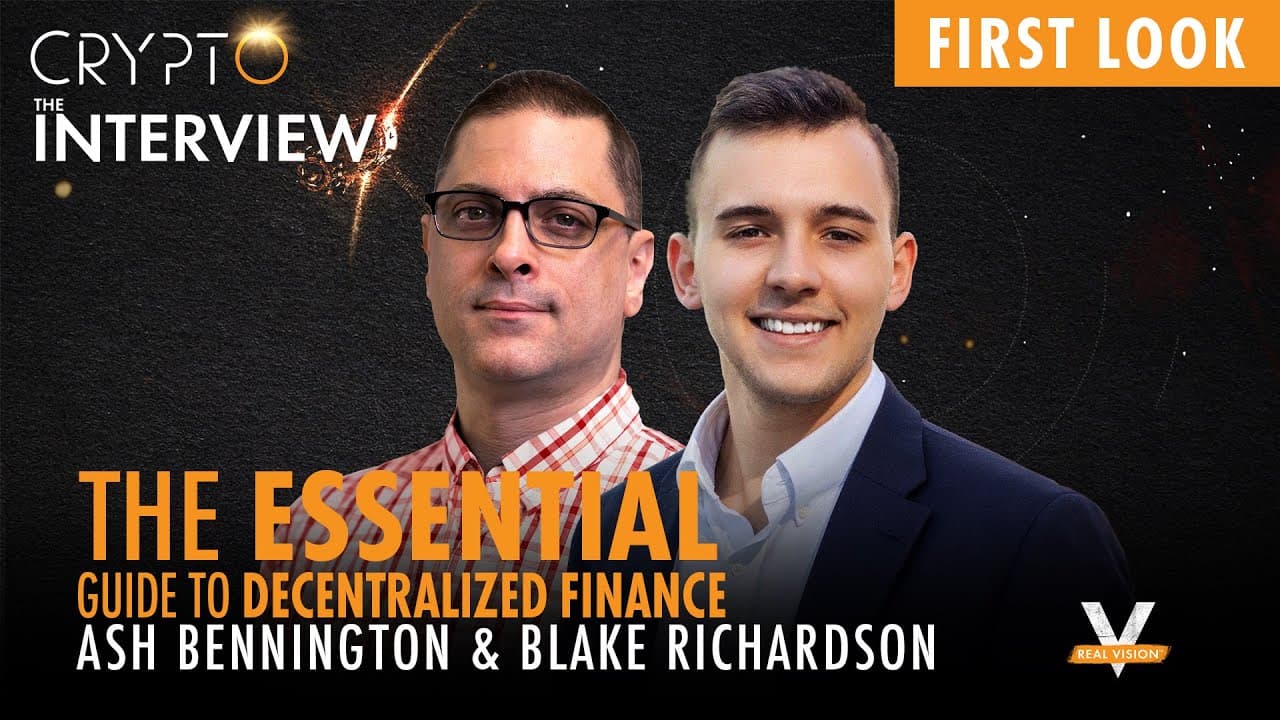
From DeFi to DEXs, Understanding Risks and Use Cases with Blake Richardson of BlockTower Capital
TL;DR
Decentralized finance (DeFi) refers to applications on blockchains that replicate traditional financial services, including decentralized exchanges, lending platforms, stablecoins, derivatives, and insurance. DeFi offers greater accessibility, trust, and transparency, although it is not without risks.
Transcript
blake richardson from block tower capital a multi-strategy hedge fund it's great to have you here to talk about defy welcome to real vision blake thank you ash great to be here well it's really a pleasure like before we get started let's talk a little bit about what defy is the term that gets thrown around a lot many people probably don't know the ... Read More
Key Insights
- 🐕🦺 DeFi refers to applications that replicate traditional financial services on blockchains, offering greater accessibility and transparency.
- 👻 Decentralized exchanges (DEXs) allow peer-to-peer asset trading without intermediaries, attracting various users, including hedge funds, retail investors, and VC investors.
- 🎱 Lending platforms provide capital pools for borrowing, stablecoins replicate the value of dollars, derivatives and synthetics replicate traditional financial instruments, and insurance offers protection against DeFi-related risks.
- 📪 Smart contract risks, including economic incentive and oracle risks, are the most significant dangers in DeFi, but the percentage of assets lost in hacks remains relatively low considering the industry's newness.
- 🤩 DeFi provides greater transparency and trust through real-time visibility of assets on blockchains and users' control of their private keys.
- 🥹 Stablecoins in DeFi can be dollar-backed or algorithmic, each with its mechanisms to maintain value stability.
Install to Summarize YouTube Videos and Get Transcripts
Explore YouTube Video Summarizer or Get YouTube Transcript Extractor
Questions & Answers
Q: What is the significance of decentralized exchanges like SushiSwap, PancakeSwap, and Uniswap?
Decentralized exchanges allow users to trade assets with counterparties they have no prior relationship with, eliminating the need for intermediaries. They offer liquidity on crypto assets, attracting various users, including hedge funds, retail investors, and VC investors. Users provide liquidity to automated market maker contracts, allowing others to trade against those assets.
Q: What are the risks associated with DeFi?
The most significant risk is smart contract risk, which encompasses economic incentive risk and oracle risk. Smart contracts are complex and can have vulnerabilities that may result in the loss of funds. However, the percentage of assets stolen in DeFi hacks remains relatively low compared to the industry's newness. It is crucial to review and test new contracts and prioritize platforms with a higher value locked and a longer operating time.
Q: How does DeFi offer greater transparency and trust?
DeFi protocols operate on blockchains, enabling real-time visibility of assets in contracts and their functionality. Users retain ownership of their assets through private keys, and solvency can be verified without relying on additional audits or financial reporting. This transparency enhances trust in the system.
Q: What are the different types of stablecoins in DeFi?
There are two primary types of stablecoins. The first type is backed by a one-to-one ratio of dollars held in a bank account, such as Tether (USDT) and USD Coin (USDC). The second type is algorithmic stablecoins, which are not backed by dollars but use algorithms to maintain stability. Algorithmic stablecoins are more complex and have different mechanisms to regulate their value.
Summary & Key Takeaways
-
DeFi encompasses various applications on blockchains that replicate traditional financial services like decentralized exchanges (DEXs), lending platforms, stablecoins, derivatives, and insurance.
-
DEXs enable peer-to-peer asset trading without intermediaries, allowing individuals from around the world to trade crypto assets 24/7.
-
Lending platforms provide pools of capital that users can borrow from, whereas stablecoins are dollar-backed or algorithmic assets built on smart contracts. Derivatives and synthetics replicate conventional financial instruments on blockchains, and insurance offers protection against smart contract hacks or custody failures.
Read in Other Languages (beta)
Share This Summary 📚
Summarize YouTube Videos and Get Video Transcripts with 1-Click
Try YouTube Summary with ChatGPT & Claude or YouTube Transcript Generator
Explore More Summaries from Real Vision 📚



Summarize YouTube Videos and Get Video Transcripts with 1-Click
Try YouTube Summary with ChatGPT & Claude or YouTube Transcript Generator