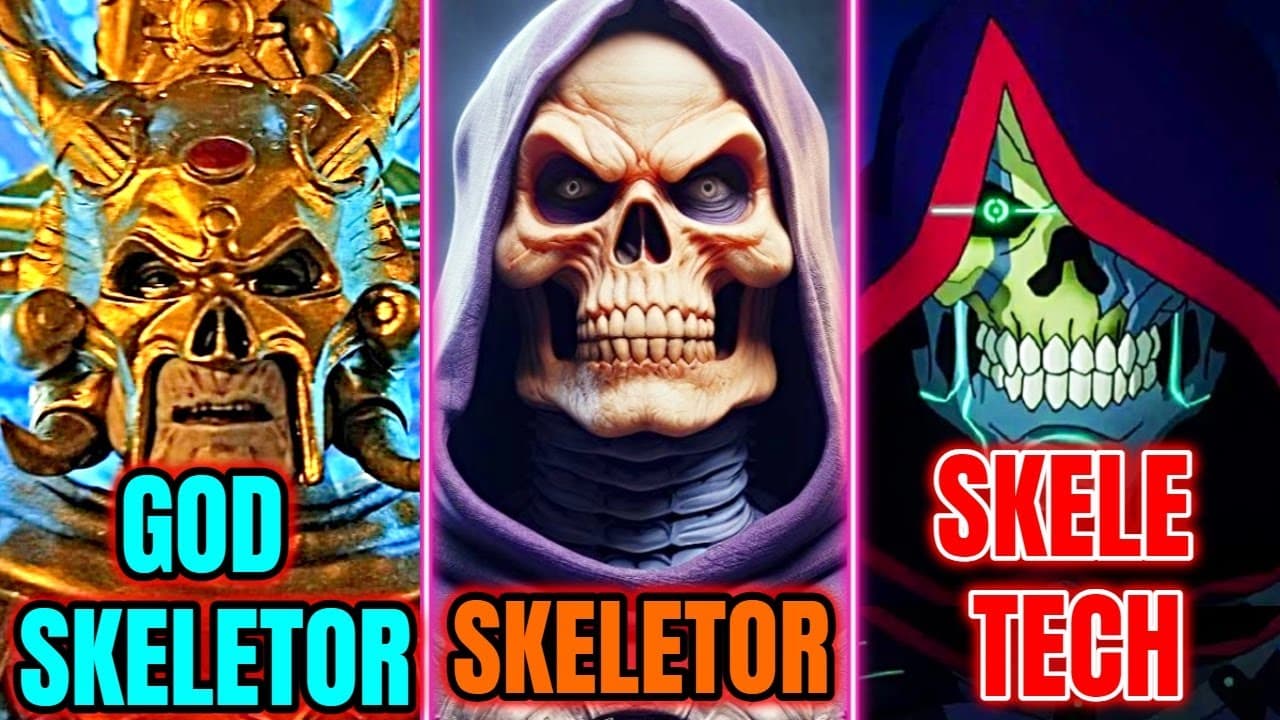
10 (Every) Terrifying Skeletor Versions From He-Man Franchise - Explored - Masters Of The Universe
TL;DR
Skeletor has evolved from a toy villain to an iconic character across various media.
Transcript
and master of the Skeletor the Blu skinned sorcerer with a skull for a head who discharges bolts of Mystic Force from his magic scepter the Havoc staff and wants to conquer the planet Eternia has evolved to become an iconic super villain since his first appearance as a toy released by Mattel in 1981 the main antagonist of the Masters of the Univers... Read More
Key Insights
- 🤬 Skeletor, introduced as a toy in 1981, has become a symbol of villainy in pop culture, evolving through diverse media.
- 💁 His character has taken on various forms, reflecting changes in storytelling techniques and deeper character development over the decades.
- 😃 In different adaptations, Skeletor's personality blends cruelty, sarcasm, and wit, making him a memorable antagonist.
- 🇮🇲 The complexity of Skeletor's backstory as Keldor impacts the narrative landscape of the franchise, creating a unique dynamic with He-Man.
- ❓ Skeletor's henchmen contribute to both his villainous schemes and comedic moments, reinforcing his role as a tyrant and leader.
- 💄 Recent iterations have expanded his magical abilities, making him a more formidable threat and enriching the overall plot dynamics.
- 💯 The exploration of interdimensional travel and technological enhancements showcases how the franchise adapts to modern themes while preserving core elements.
Install to Summarize YouTube Videos and Get Transcripts
Explore YouTube Video Summarizer or Get YouTube Transcript Extractor
Questions & Answers
Q: What sparked Skeletor's initial conflict with He-Man?
Skeletor's conflict with He-Man began with his ambition to conquer Eternia by using the secrets of Castle Grayskull. In early mini-comics, he kidnaps Teela to solidify his control, which puts him directly at odds with He-Man, the only hero capable of thwarting his plans. This rivalry became central to the storyline as Skeletor’s plots frequently ended in his foiled attempts and retreats from battle.
Q: How has Skeletor's character development reflected changing media trends?
Skeletor's character has adapted to various media forms, such as comics, animated series, and live-action films. His portrayal shifted from a straightforward villain to one with depth, wit, and evolving motivations, reflecting the increasing complexity in storytelling. This evolution has kept the character relevant and engaging for both new and longtime fans, mirroring broader shifts in audience expectations.
Q: What are some key traits of Skeletor across different adaptations?
Skeletor's traits include malevolence, cunning, and dark humor. Whether depicted as a ruthless tyrant in animated series or an intricately motivated character in modern adaptations, his iconic cackle and command over dark magic remain constant. Despite differing backstories, his unjust contempt for He-Man and tendency to underestimate his henchmen are also recurring themes.
Q: What role have his sidekicks played in Skeletor's narratives?
Skeletor's sidekicks, including Beast Man, Merman, and Evil-Lyn, have significantly impacted his plots, often serving as foils or sources of comedic relief. Their interactions highlight his domineering personality while showcasing the tension and weakness in his leadership style. These relationships add layers to stories, revealing Skeletor’s reliance on their fear and loyalty to execute his plans.
Q: How does Skeletor’s origin as Keldor add depth to his character?
Skeletor’s backstory as Keldor, King Randor's brother, adds layers of tragedy and complexity to his character. Initially positioned as a potential ruler, his transformation into Skeletor after being cursed deepens the narrative of loss and ambition gone awry. This origin creates a dynamic of familial conflict that resonates with themes of betrayal and the quest for power, enhancing audience engagement.
Q: What modern adaptations have refined Skeletor's powers and abilities?
In modern adaptations, such as Netflix's "Masters of the Universe: Revelation," Skeletor receives more elaborate powers and a visually engaging presence. These adaptations explore his capacity for necromancy and mind control, enriching his character with multidimensional abilities. They portray him as not only a villain but a formidable force capable of threatening the fabric of Eternia itself.
Summary & Key Takeaways
-
Skeletor, originally a toy and comic character, evolved into an iconic supervillain in the Masters of the Universe franchise, facing off against He-Man.
-
Over time, Skeletor's backstory has changed through comics, cartoons, and films, introducing elements like his origins as Keldor and his quest for power.
-
Adaptations have reflected contemporary storytelling techniques, maintaining Skeletor's essence while expanding on his character and motivations across different series.
Read in Other Languages (beta)
Share This Summary 📚
Summarize YouTube Videos and Get Video Transcripts with 1-Click
Try YouTube Summary with ChatGPT & Claude or YouTube Transcript Generator
Explore More Summaries from Marvelous Videos 📚


Summarize YouTube Videos and Get Video Transcripts with 1-Click
Try YouTube Summary with ChatGPT & Claude or YouTube Transcript Generator