Data Operators | Verilog | Part-4/4 | Shift & Conditional | Digital Systems Design | Lec-28
TL;DR
This video explains shift, conditional, and concatenation operators in programming.
Transcript
hi everyone in this video I'm continuing the data operators we are left with three three more operators those are shift operators conditional operators and concatenation operators okay so first let us start with shift operators shift operator so names of all these operators are clearly saying that it is Shifting operation it shifts the data dependi... Read More
Key Insights
- 🗯️ Shift operators can either shift bits left or right, directly affecting the representation of data.
- 👻 Conditional operators simplify code by allowing inline condition checks, reducing the need for lengthy if-else statements.
- 👷 Concatenation operators enable the merging of multiple binary strings or data units, crucial for constructing complex data pathways in programming.
- 😒 Proper use of shift operators can enhance data efficiency, but incorrect usage may result in data truncation and loss.
- 👨💻 Nested conditional operators increase code flexibility, allowing for multiple conditions to be checked sequentially with minimal code.
- 🎏 Concatenation can be employed to concatenate multiple variable values efficiently, making it easier to manage extensive data streams.
- ❓ Understanding the implications of each operator is vital for effective programming and data manipulation.
Install to Summarize YouTube Videos and Get Transcripts
Explore YouTube Video Summarizer or Get YouTube Transcript Extractor
Questions & Answers
Q: What are shift operators and how do they function?
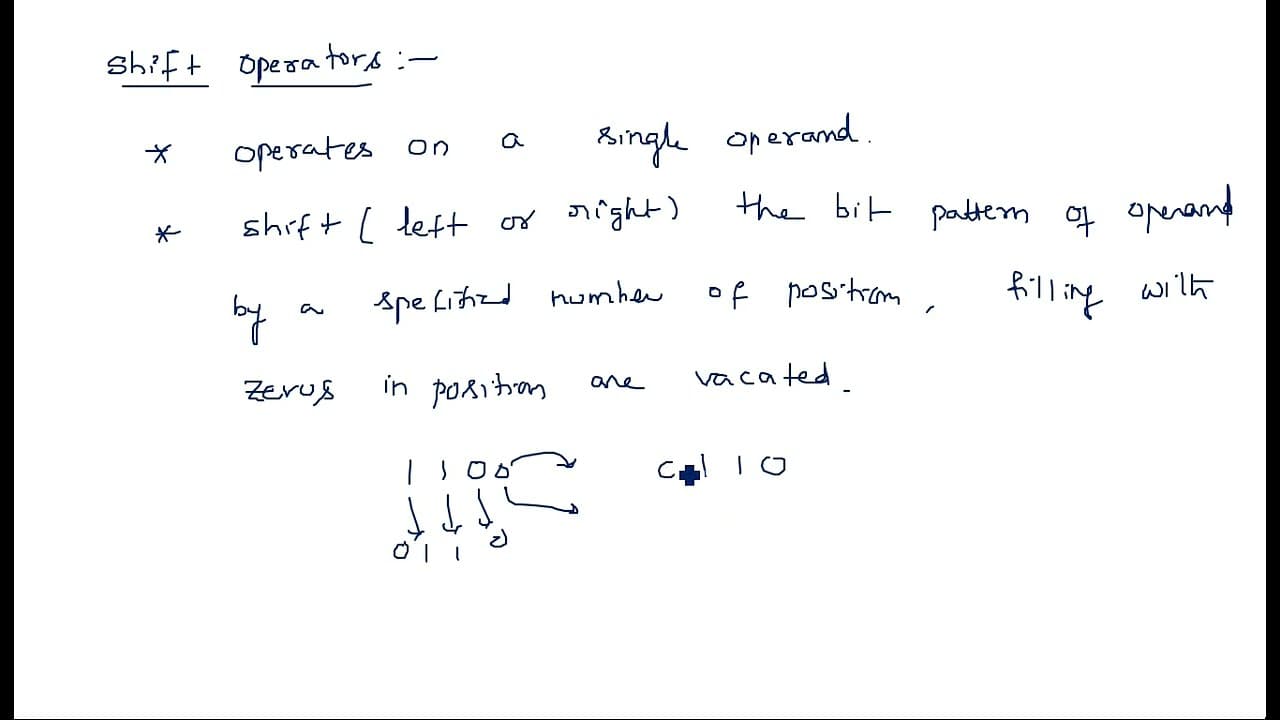
Shift operators are used to manipulate binary data by shifting bits to the left or right. Each bit moves to a new position while filling empty spaces with zeros. For example, a right shift of three bits on '1100' results in '0001,' demonstrating how data can be effectively modified.
Q: Can you explain how conditional operators work in programming?
Conditional operators evaluate a specific expression and choose between two outcomes, akin to an 'if-else' statement but in a more concise form. For instance, the expression "Y = (A == B) ? A : B" assigns Y the value of A if A equals B, otherwise assigns it B, allowing for straightforward conditional logic in code.
Q: What is the significance of the concatenation operator?
The concatenation operator allows programmers to join multiple pieces of data into a single unit, enhancing code readability and functionality. This is essential in digital logic design, enabling operations on bits to create complex data structures, such as buses combining several binary inputs.
Q: How can conditional operators be nested in programming?
Conditional operators can be nested to evaluate multiple conditions sequentially. This means you can chain expressions together, allowing complex decisions to be made in a single concise line. However, careful consideration is necessary to maintain readability and avoid confusion in your code.
Q: Are there any limitations to using shift operators?
While shift operators are powerful, they can lead to data loss if not used carefully. For instance, shifting bits too far may eliminate significant data when the shifted bits fall off the end of the binary representation. Thus, knowing the size of your operands is crucial when applying these operations.
Q: How does concatenation relate to logical buses in programming?
Concatenation is essential in forming logical buses because it allows the merging of separate data streams into a cohesive unit. This process is vital in hardware design and digital systems, where multiple bits must interact and communicate effectively within a circuit or data structure.
Q: Can multiple shift operations be combined in one statement?
Yes, multiple shift operations can be combined in one statement to manipulate data effectively. For example, a variable can be shifted left and then right in a single expression, providing more versatility in managing data bits. However, this should be done with caution to avoid unintended results.
Q: What programming languages commonly use these operators?
Many programming languages, including C, C++, Java, and Python, implement shift, conditional, and concatenation operators. These operators are integral to bit manipulation, control flow, and data handling, making them commonplace across various programming paradigms and applications.
Summary & Key Takeaways
-
The video covers shift operators, describing how they manipulate data by shifting bits to the left or right, filling new positions with zeros, and includes practical examples.
-
Conditional operators are introduced as a way to evaluate expressions based on conditions, allowing streamlined code with shorthand syntax for conditional assignments.
-
The concatenation operator is explained as a method to join multiple operands into a single word, useful for creating logical buses in data processing with illustrative examples.
Read in Other Languages (beta)
Share This Summary 📚
Summarize YouTube Videos and Get Video Transcripts with 1-Click
Try YouTube Summary with ChatGPT & Claude or YouTube Transcript Generator