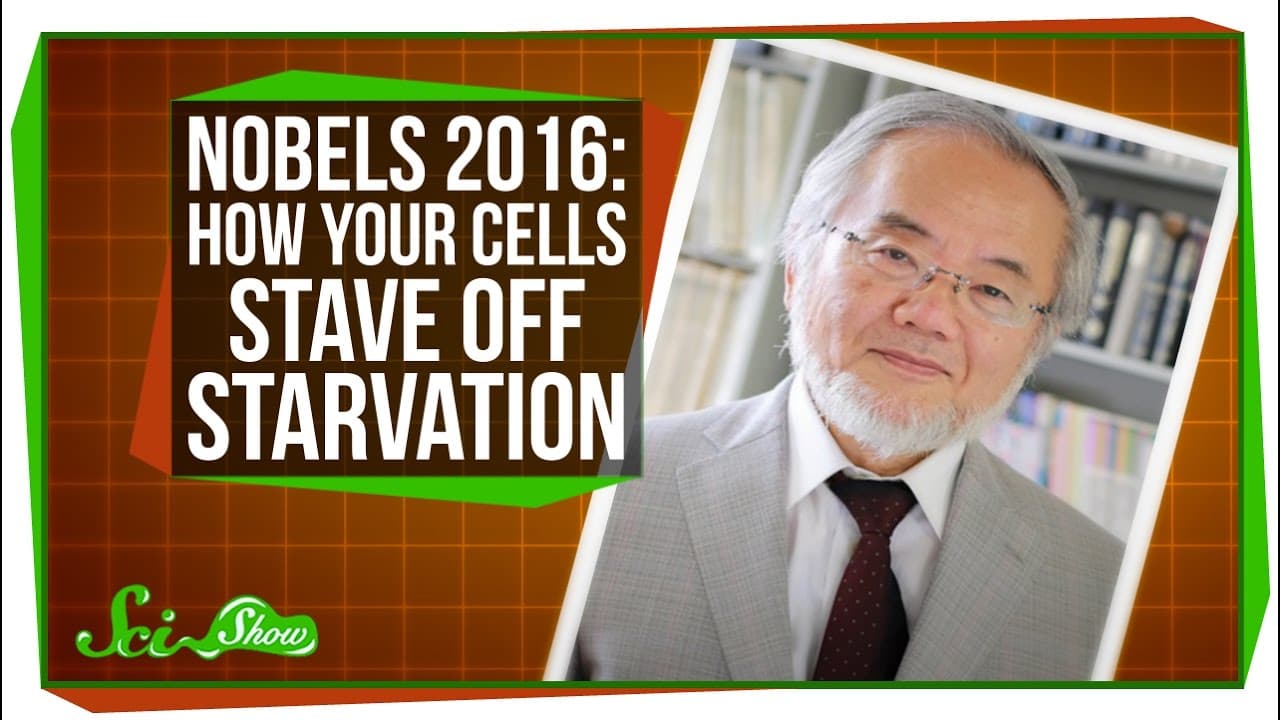
Nobels 2016: How Your Cells Stave Off Starvation
TL;DR
Yoshinori Ohsumi wins the 2016 Nobel Prize in physiology or medicine for his discovery of the genetic basis for autophagy, a process that cells use to recycle their worn-out parts.
Transcript
It’s Nobel Prize week 2016, which means it’s basically science Christmas! And as I’m standing here, we know the winner of the prize that arguably has the most to do with your body, and how it works: the Nobel Prize in physiology or medicine. This year’s prize has gone to cell biologist Yoshinori Ohsumi for his work on the phenomenon known as autoph... Read More
Key Insights
- 😩 Autophagy is a process in which cells recycle their worn-out components to conserve nutrients.
- 😉 Yoshinori Ohsumi won the Nobel Prize in physiology or medicine for his discovery of the genetic basis for autophagy in baker's yeast.
- ♋ Autophagy is crucial for normal cellular function in all organisms, and defects in this process are associated with diseases such as diabetes and cancer.
- 💦 Ohsumi's work has provided a foundation for studying autophagy in more complex organisms and developing treatments that target autophagy for various diseases.
- 🖐️ Autophagy is a highly conserved process and plays a crucial role in maintaining cellular homeostasis.
- 🧠 The teenage brain is better adapted to learn from reinforcement and rewards compared to adults.
- ❓ Teenagers are more sensitive to rewards and have a better ability to retain details when unexpected events occur.
Install to Summarize YouTube Videos and Get Transcripts
Explore YouTube Video Summarizer or Get YouTube Transcript Extractor
Questions & Answers
Q: What is autophagy and why is it important?
Autophagy is a process in which cells recycle their worn-out components to conserve nutrients. It is essential for normal cellular function in all organisms, including humans, and problems in autophagy have been linked to diseases such as diabetes and cancer.
Q: How did Yoshinori Ohsumi discover the genetic basis for autophagy?
Ohsumi used baker's yeast as a model organism and modified its genes to understand the autophagy process. By disabling certain genes, he observed a buildup of worn-out components, which allowed him to identify the genes responsible for sending the parts for recycling.
Q: What are the implications of Ohsumi's work on autophagy?
Ohsumi's discovery of the genetic basis for autophagy has provided a foundation for studying this process in more complex organisms. Researchers can now develop treatments for diseases such as diabetes and cancer that target autophagy.
Q: How does autophagy contribute to the recycling of cellular components?
During autophagy, a cell transports its broken-down components to a certain area, such as the vacuole in yeast. These components are then broken apart, and their chemical constituents are reused by the cell.
Summary & Key Takeaways
-
Yoshinori Ohsumi has won the Nobel Prize in physiology or medicine for his work on autophagy, the process by which cells recycle their worn-out components to conserve nutrients.
-
Autophagy is crucial for normal cellular function in all organisms, including humans, and problems in this process have been linked to diseases such as diabetes and cancer.
-
Ohsumi discovered the genetic basis for autophagy in baker's yeast and identified 15 genes that are crucial for this process.
Read in Other Languages (beta)
Share This Summary 📚
Summarize YouTube Videos and Get Video Transcripts with 1-Click
Try YouTube Summary with ChatGPT & Claude or YouTube Transcript Generator
Explore More Summaries from SciShow 📚
Summarize YouTube Videos and Get Video Transcripts with 1-Click
Try YouTube Summary with ChatGPT & Claude or YouTube Transcript Generator