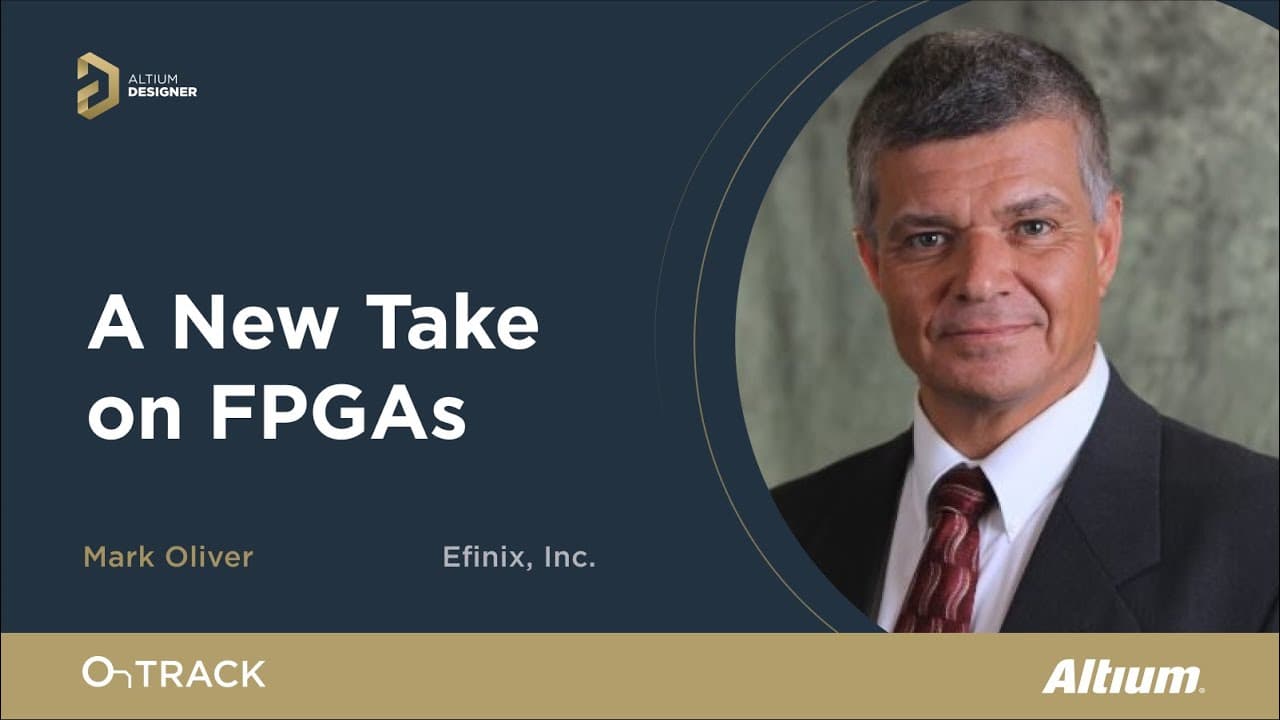
FPGAs Moving Beyond Prototyping: Mark Oliver, VP of Marketing @ Efinix
TL;DR
FNX has developed innovative and efficient FPGA solutions that are smaller, lower power, and denser, making them more cost-effective and suitable for a wide range of markets.
Transcript
you always end up with the the perfect combination of logic to routing for your design so it's always 100 efficient you do away with all that power hungry routing up in the metal layers and you end up with a chip that's smaller lower power denser and in doing so is cheaper and cheap enough to be able to go from a prototyping area in the lab straigh... Read More
Key Insights
- 😘 FNX has developed innovative FPGA solutions that are smaller, lower power, and denser than traditional FPGAs.
- ⏳ FPGA adoption is growing in edge computing applications where low latency and real-time processing are needed.
- 😮 Custom silicon solutions are becoming less viable due to rising costs and the complexity of diverse data being produced at the edge.
- ⌛ FPGAs offer the advantage of easy integration, flexibility, and the ability to upgrade hardware over time.
- 🈸 FNX's risk-5 processor, which is highly configurable, provides a scalable solution for AI applications.
- 💗 The integration of FPGA blocks with other traditional components in a single package is a growing trend in heterogeneous integration.
- 🎨 FNX's approach focuses on providing design tools and an ecosystem that enables software engineers to leverage FPGA technology without extensive hardware expertise.
Install to Summarize YouTube Videos and Get Transcripts
Explore YouTube Video Summarizer or Get YouTube Transcript Extractor
Questions & Answers
Q: How has FNX improved FPGA technology?
FNX has reinvented the FPGA architecture to create a more efficient logic cell that can be used as both logic and routing. This ensures 100% efficiency in designs and eliminates power-hungry routing in metal layers.
Q: What are the advantages of FNX's FPGAs over traditional FPGAs?
FNX's FPGAs are smaller, lower power, and denser, making them more cost-effective. They can be used from prototyping to high-volume manufacturing, revolutionizing the way systems are designed.
Q: In which applications are FPGAs being used more extensively?
FPGAs are being adopted in a range of markets, particularly in edge computing applications where low latency and real-time processing are essential. They are also ideal for AI applications, which require high compute power.
Q: Can FPGAs be integrated into custom silicon solutions?
While it is possible to integrate FPGAs into ASICs in certain cases, FPGAs offer the advantage of being able to address a broad range of applications and markets with a single die. This makes them more cost-effective and lowers the risk of development compared to custom silicon.
Key Insights:
- FNX has developed innovative FPGA solutions that are smaller, lower power, and denser than traditional FPGAs.
- FPGA adoption is growing in edge computing applications where low latency and real-time processing are needed.
- Custom silicon solutions are becoming less viable due to rising costs and the complexity of diverse data being produced at the edge.
- FPGAs offer the advantage of easy integration, flexibility, and the ability to upgrade hardware over time.
- FNX's risk-5 processor, which is highly configurable, provides a scalable solution for AI applications.
- The integration of FPGA blocks with other traditional components in a single package is a growing trend in heterogeneous integration.
- FNX's approach focuses on providing design tools and an ecosystem that enables software engineers to leverage FPGA technology without extensive hardware expertise.
- The future of FPGA technology lies in its ability to offer cost-effective, low-power, and efficient solutions for a wide range of applications and markets.
Summary & Key Takeaways
-
FNX is a smaller FPGA company that has reimagined FPGA technology to be more efficient, smaller, and lower power.
-
By reinventing the FPGA from the ground up, FNX has created some of the most efficient and densest FPGAs on the market.
-
Their FPGA solutions have a significant impact on the adoption of FPGAs in various markets and the way systems are designed.
Read in Other Languages (beta)
Share This Summary 📚
Summarize YouTube Videos and Get Video Transcripts with 1-Click
Try YouTube Summary with ChatGPT & Claude or YouTube Transcript Generator
Explore More Summaries from Altium Academy 📚
Summarize YouTube Videos and Get Video Transcripts with 1-Click
Try YouTube Summary with ChatGPT & Claude or YouTube Transcript Generator