Ohm's Law
TL;DR
Ohm's law describes the relationship between voltage, current, and resistance in a circuit, while Kirchhoff's laws explain how voltage and current behave in series and parallel circuits.
Transcript
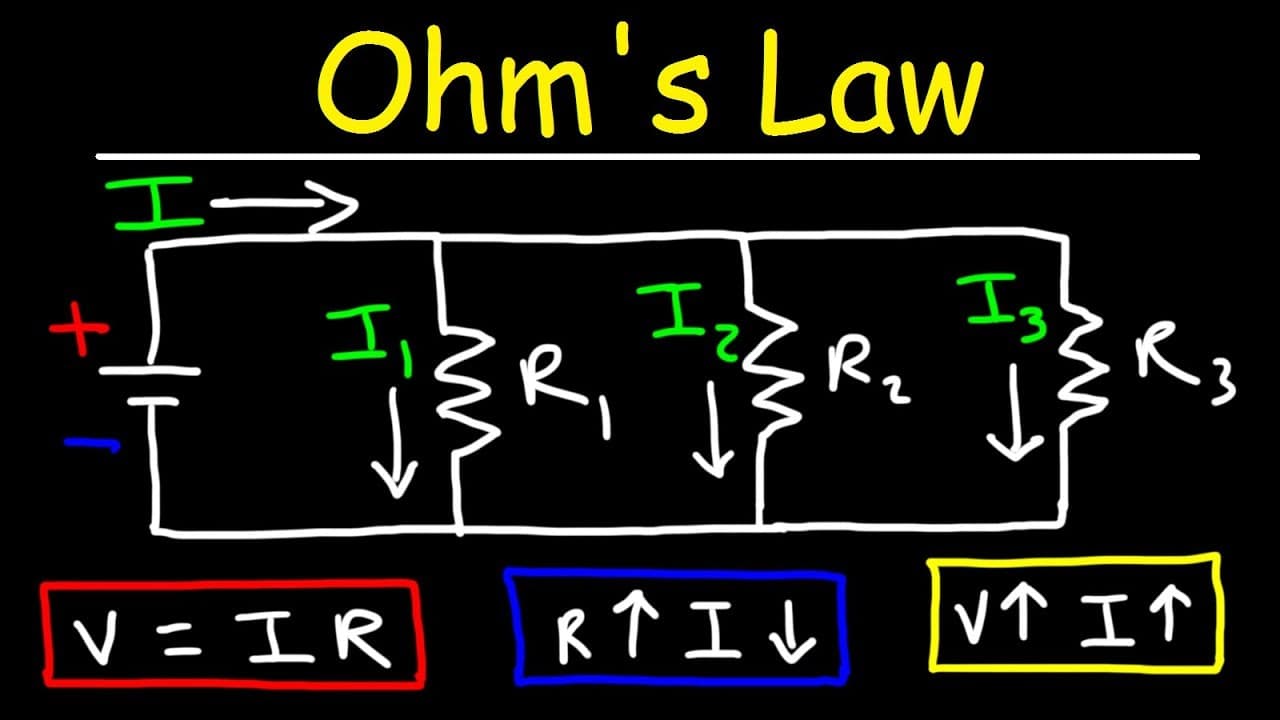
in this video we're gonna talk about Ohm's law so what is Ohm's law Ohm's law describes the relationship between voltage current and resistance perhaps you've seen this equation V is equal to I times R V stands for voltage I stands for the current r is resistance voltage is measured in the units of volts I which represents the current is measured i... Read More
Key Insights
- ⚡ Ohm's law states that voltage, current, and resistance are related by the equation V = I * R.
- 🍹 In a series circuit, the total resistance is the sum of individual resistances, and the current is the same throughout the circuit.
- 🍹 In a parallel circuit, the voltage across each resistor is the same, while the total current is the sum of individual branch currents.
- 👮 Ohm's law can be used to calculate current, voltage, or resistance when the other two values are known.
- 🌂 Kirchhoff's voltage law states that the sum of voltage drops and increases in a closed loop is zero.
- 💐 Kirchhoff's current law states that the total current flowing into a junction is equal to the total current flowing out of the junction.
- 👮 Kirchhoff's laws are fundamental principles used in circuit analysis to solve complex circuits.
Install to Summarize YouTube Videos and Get Transcripts
Explore YouTube Video Summarizer or Get YouTube Transcript Extractor
Questions & Answers
Q: What does Ohm's law describe?
Ohm's law describes the relationship between voltage, current, and resistance in a circuit. It states that voltage is equal to the product of current and resistance (V = I * R).
Q: How does resistance affect current in a circuit, according to Ohm's law?
According to Ohm's law, if resistance increases while voltage is constant, the current in the circuit will decrease. Conversely, if resistance decreases, the current will increase, as long as voltage remains the same.
Q: What is Kirchhoff's voltage law?
Kirchhoff's voltage law states that the sum of voltage drops and increases around a closed loop in a circuit is equal to zero. It means that the energy supplied by the voltage source is equal to the energy consumed by the resistors in the circuit.
Q: How does Kirchhoff's current law apply in a circuit?
Kirchhoff's current law states that the total current flowing into a junction in a circuit is equal to the total current flowing out of the junction. It ensures that charge is conserved in a circuit.
Summary & Key Takeaways
-
Ohm's law states that voltage is equal to the product of current and resistance (V = I * R). Voltage and current are directly proportional, while resistance and current are inversely related.
-
In a series circuit, the total resistance is the sum of individual resistances, and the current is the same throughout the circuit.
-
In a parallel circuit, the voltage across each resistor is the same, while the total current is the sum of individual branch currents.
Read in Other Languages (beta)
Share This Summary 📚
Summarize YouTube Videos and Get Video Transcripts with 1-Click
Try YouTube Summary with ChatGPT & Claude or YouTube Transcript Generator
Explore More Summaries from The Organic Chemistry Tutor 📚



Summarize YouTube Videos and Get Video Transcripts with 1-Click
Try YouTube Summary with ChatGPT & Claude or YouTube Transcript Generator