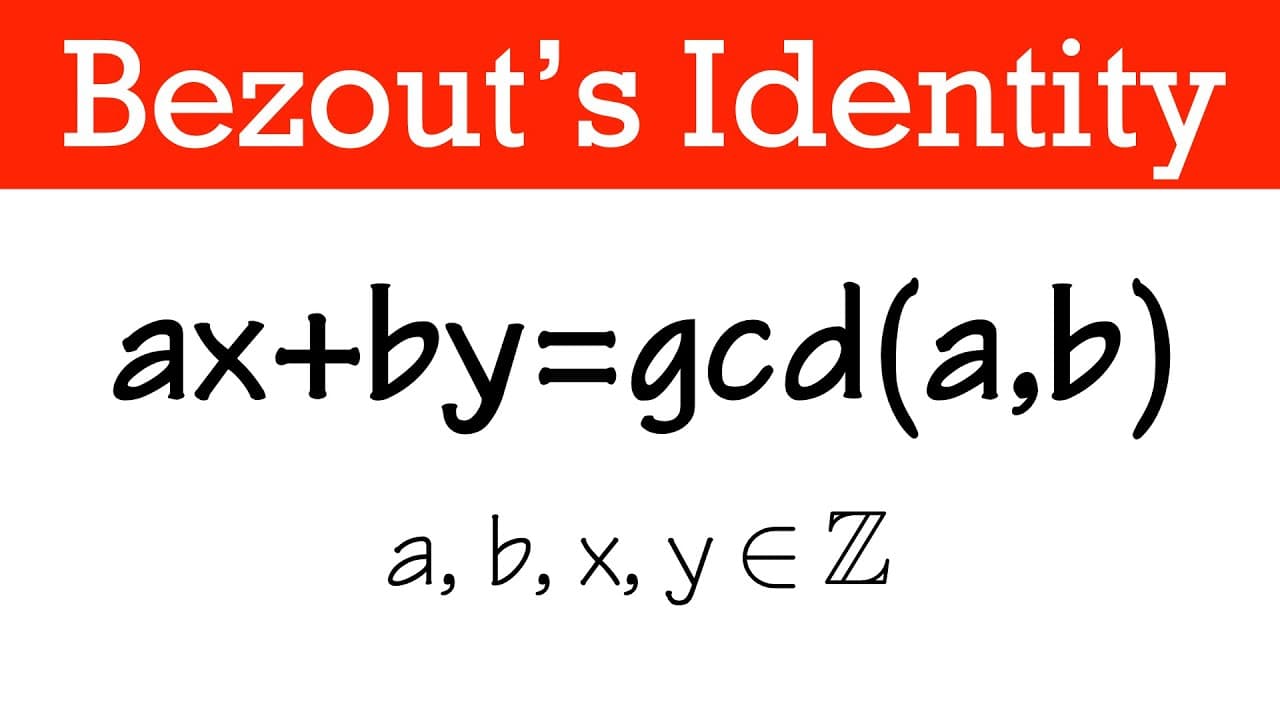
Bézout's identity: ax+by=gcd(a,b)
TL;DR
Euclid's Algorithm is an efficient way to find the greatest common divisor of two integers and express it as a linear combination of those integers.
Transcript
okay in this video I'm gonna demonstrate one of the most useful facts in number theory nice well give me any two integers and let's just go ahead and call them to be am B we are always able to find X&Y and they are also integers such that ax plus B Y it's equal to the greatest common divisor of a and B in another word when you give me the integers ... Read More
Key Insights
- 🔨 Euclid's Algorithm is a powerful tool for finding the greatest common divisor efficiently.
- 😑 Reversing the steps of Euclid's Algorithm allows us to express the greatest common divisor as a linear combination of the original integers.
- 😘 The lowest common multiple of the original integers helps determine the coefficients for the linear combination.
Install to Summarize YouTube Videos and Get Transcripts
Explore YouTube Video Summarizer or Get YouTube Transcript Extractor
Questions & Answers
Q: What is Euclid's Algorithm?
Euclid's Algorithm is a method for finding the greatest common divisor of two integers by performing a series of divisions and subtractions.
Q: How does Euclid's Algorithm work?
Euclid's Algorithm starts with two integers and repeatedly divides the larger number by the smaller number, then subtracts the product of the quotient and the smaller number from the larger number. This process is repeated until the remainder becomes zero, and the last non-zero remainder is the greatest common divisor.
Q: How do you express the greatest common divisor as a linear combination?
By reversing the steps of Euclid's Algorithm, we can express the greatest common divisor as a linear combination of the two original integers. We start with the last equation derived from Euclid's Algorithm and work our way back, substituting the remainders from each step until we reach the original numbers.
Q: Can Euclid's Algorithm be used for any two integers?
Yes, Euclid's Algorithm can be used for any two integers. Even if the integers are negative or zero, the algorithm will still work. This makes it a versatile and widely applicable method for finding the greatest common divisor.
Summary & Key Takeaways
-
Euclid's Algorithm allows us to find the greatest common divisor of two integers by using a series of divisions and subtractions.
-
By reversing the steps of Euclid's Algorithm, we can find the coefficients (x and y) that allow us to express the greatest common divisor as a linear combination of the two integers.
-
The process involves finding the lowest common multiple of the two integers and systematically subtracting multiples of one integer from the other to eventually reach the greatest common divisor.
Read in Other Languages (beta)
Share This Summary 📚
Summarize YouTube Videos and Get Video Transcripts with 1-Click
Try YouTube Summary with ChatGPT & Claude or YouTube Transcript Generator
Explore More Summaries from blackpenredpen 📚


Summarize YouTube Videos and Get Video Transcripts with 1-Click
Try YouTube Summary with ChatGPT & Claude or YouTube Transcript Generator