What Are the Weight Sensations in an Elevator?
TL;DR
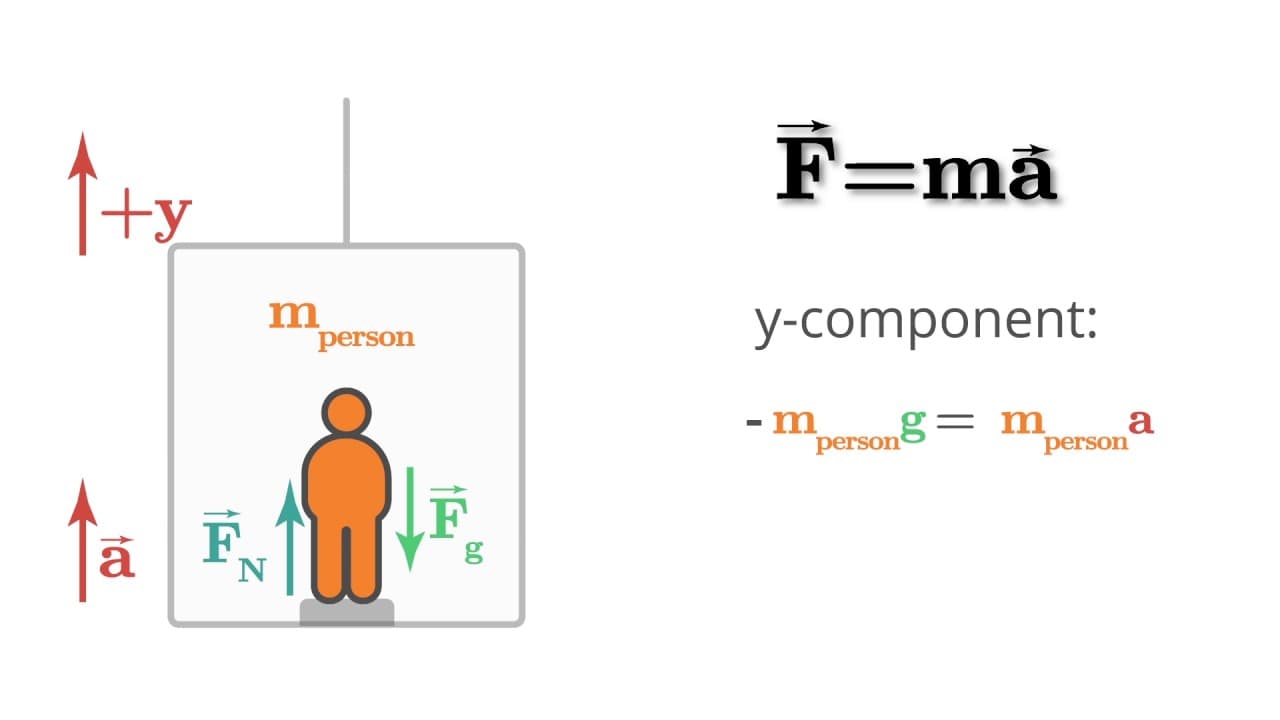
Riding in an elevator creates sensations of weightlessness or heaviness depending on its acceleration direction. When accelerating upwards, the normal force increases, making you feel heavier, while deceleration results in a lighter sensation. Newton's second law explains these changes by relating the normal force to both the gravitational force and the acceleration of the elevator.
Transcript
Let's do an example of using Newton's second law in problem solving. In this example, we'll figure out why riding in an elevator can give you a weird sensation of weightlessness or extra weight, depending on which way you're accelerating. So, let's say there's a person standing on a scale in the elevator that's accelerating upwards with some accele... Read More
Key Insights
- 👰♀️ Riding in an elevator can create sensations of weightlessness or extra weight based on the direction of acceleration.
- 🏋️ The scale in an elevator measures the normal force exerted by a person, which is related to their weight.
- 👮 Newton's second law is used to calculate the normal force in an elevator and understand the physical sensations.
- 🛗 The gravitational force in an elevator does not depend on the elevator's acceleration.
- 🥺 The normal force and gravitational force in an accelerating elevator do not cancel out, leading to the sensations felt by occupants.
- 🛗 Changing the direction of acceleration in an elevator affects the magnitude of the normal force and can explain the feeling of lightness or heaviness.
- 🌍 Checking the answers obtained through calculations against physical intuition is important to ensure they align with real-world observations.
Install to Summarize YouTube Videos and Get Transcripts
Explore YouTube Video Summarizer or Get YouTube Transcript Extractor
Questions & Answers
Q: Why does riding in an elevator sometimes feel weightless?
Riding in an elevator can feel weightless if the elevator is accelerating downwards, causing the normal force to be less than the person's weight according to Newton's second law.
Q: How does Newton's second law explain the feeling of extra weight in elevators?
When the elevator is accelerating upwards, Newton's second law shows that the normal force is greater than the person's weight, resulting in the feeling of extra weight.
Q: Does the gravitational force in an elevator depend on the elevator's acceleration?
No, the gravitational force exerted on a person in an elevator is constant and does not depend on the elevator's acceleration.
Q: How can Newton's second law be used to calculate the normal force in an elevator?
By setting up the equation with the known mass of the person, the acceleration of the elevator, and the gravitational force, the normal force can be calculated as the person's mass multiplied by the sum of the acceleration and gravitational acceleration.
Summary & Key Takeaways
-
Riding in an elevator can give the sensation of weightlessness or extra weight depending on the direction of acceleration.
-
The scale in an elevator measures the normal force exerted by the person, which is related to their weight.
-
Newton's second law can be used to calculate the normal force and understand the sensations felt in elevators.
Read in Other Languages (beta)
Share This Summary 📚
Summarize YouTube Videos and Get Video Transcripts with 1-Click
Try YouTube Summary with ChatGPT & Claude or YouTube Transcript Generator
Explore More Summaries from MIT OpenCourseWare 📚



Summarize YouTube Videos and Get Video Transcripts with 1-Click
Try YouTube Summary with ChatGPT & Claude or YouTube Transcript Generator