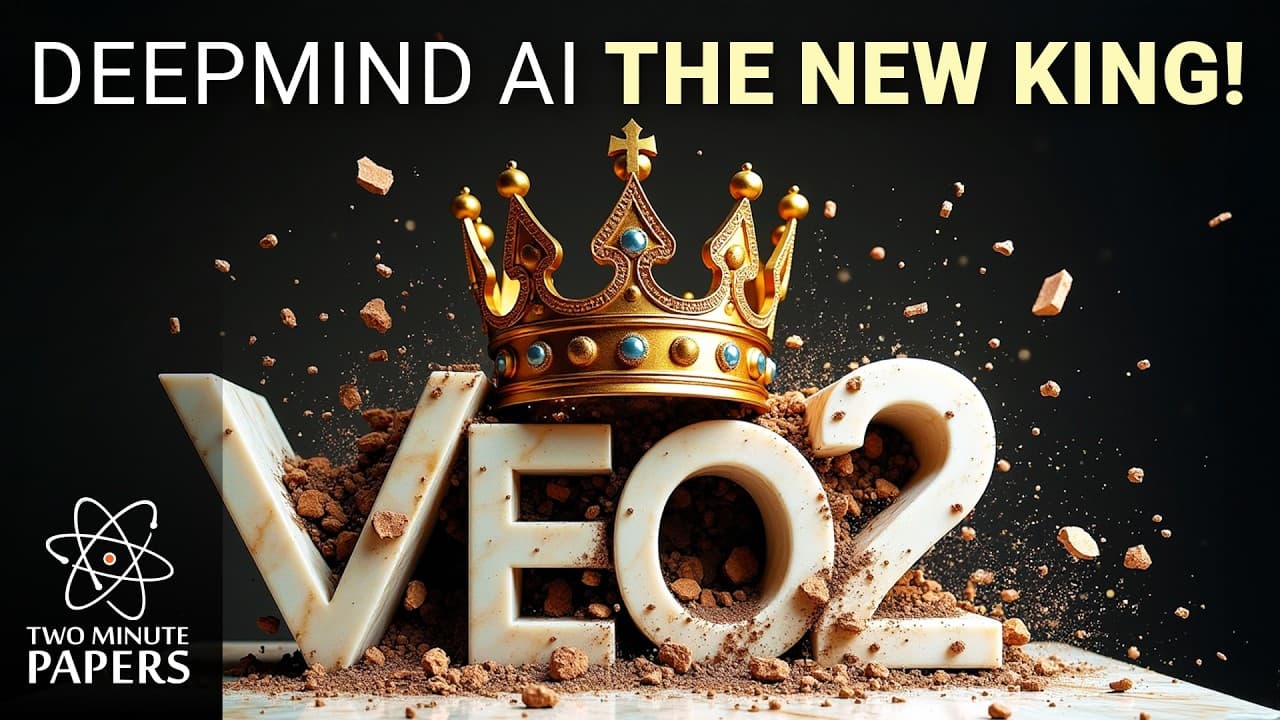
What Makes DeepMind's Veo 2 the Best AI Video Generator?
TL;DR
DeepMind's Veo 2 is the leading AI video generator, capable of producing stunning 4K videos with lifelike quality. While it excels in many areas, it struggles with high-motion sequences, sometimes resulting in flickering issues. The innovative diffusion transformer model enhances temporal coherence, making it better at adhering to text prompts compared to its competitors.
Transcript
Okay, due to popular request from you Fellow Scholars, let’s talk about Google DeepMind’s new AI video generator called Veo 2. Now look at this. Is this Veo 2? It is not. So what is this then? This is called VideoPoet, which was one of the state of the art AI video generators back in the day. Now, what do I mean by back in the day? Like ... Read More
Key Insights
- 💋 Veo 2 marks a significant leap in AI video generation, showcasing capabilities like 4K resolution and improved lifelike quality.
- 😀 Despite its advancements, Veo 2 faces challenges with high-motion sequences, often resulting in flickering or poor temporal coherence.
- 😒 The use of a diffusion transformer model allows Veo 2 to process and refine multiple video frames simultaneously, improving consistency.
- ❓ Quality measures reveal Veo 2's ability to adhere closely to text prompts, crucial for effective content generation.
- 🙈 This technology showcases the rapid evolution of AI tools, with just under a year seeing drastic improvements in video generation capabilities.
- 👤 As AI video generation improves, the potential for creative applications expands, encouraging users to experiment with imaginative concepts.
- 👨🔬 The results from Veo 2 highlight the importance of ongoing research and development in AI, emphasizing a promising future for interactive media.
Install to Summarize YouTube Videos and Get Transcripts
Explore YouTube Video Summarizer or Get YouTube Transcript Extractor
Questions & Answers
Q: What differentiates Veo 2 from older AI video generators like VideoPoet?
Veo 2 showcases remarkable improvements in video quality and resolution, capable of creating lifelike 4K videos. In contrast, VideoPoet, though advanced for its time, pales in comparison to the realism and coherence that Veo 2 achieves, demonstrating just how quickly AI video generation technology is progressing.
Q: What are the main limitations of the Veo 2 AI video generator?
Veo 2 struggles with high-frequency motion, leading to issues like flickering and temporal coherence. For example, while it showcases robust performance with less dynamic scenes, rapid movements, such as skateboarding or swarm dynamics, reveal inconsistencies and resolution drops, particularly in human subjects.
Q: How does the diffusion transformer model work in Veo 2?
The diffusion transformer model employed by Veo 2 starts with a noisy image and gradually refines it in alignment with a text prompt. Unlike single-image generation, video generation involves refining multiple noise batches concurrently to maintain coherence across frames, reducing chance of flickering and inconsistencies by accounting for neighboring frames.
Q: How does Veo 2 compare with competitors like OpenAI’s Sora?
Veo 2 significantly outperforms competitors like Sora in both overall quality and adherence to text prompts. The results indicate that Veo 2 not only produces visually superior videos but also closely follows the user-defined parameters, setting a new standard in AI-generated video technology.
Q: What factors contribute to the realism seen in Veo 2’s generated videos?
Several elements contribute to the realism of videos generated by Veo 2, including high-resolution output, advanced image processing techniques, and superior temporal coherence that minimizes flickering. Additionally, its ability to create detailed human figures and complex animations enhances the overall lifelike quality.
Q: Why is prompt adherence critical in AI video generation?
Prompt adherence is crucial because it ensures the output of the AI aligns closely with the user's original request, enhancing user satisfaction and practical applications. An impressive visual without adherence means the video fails to meet expectations, making adherence a key measure of effectiveness in AI-generated content.
Summary & Key Takeaways
-
Google DeepMind's Veo 2 represents a significant advancement in AI video generation, capable of producing high-quality 4K videos that are lifelike and coherent, a leap from older technologies like VideoPoet.
-
While Veo 2 excels in many areas, it does have limitations, especially in handling high-frequency motion, where it may exhibit flickering and coherence issues, particularly with complex scenes involving human figures.
-
The underlying technology for Veo 2 relies on a diffusion transformer model that improves temporal coherence by processing multiple noise batches simultaneously, enhancing video quality while addressing prompt adherence effectively.
Read in Other Languages (beta)
Share This Summary 📚
Summarize YouTube Videos and Get Video Transcripts with 1-Click
Try YouTube Summary with ChatGPT & Claude or YouTube Transcript Generator
Explore More Summaries from Two Minute Papers 📚


Summarize YouTube Videos and Get Video Transcripts with 1-Click
Try YouTube Summary with ChatGPT & Claude or YouTube Transcript Generator