Number Systems | No of ways | Aptitude | Part- 07 | Bharath Kumar
TL;DR
The session explains how to calculate the number of ways to express a number as a product of factors.
Transcript
hi everyone welcome to the session in this session i am going to explaining about the topic number systems in this session we are going to discussing about the concept number of ways number of ways how can you calculate number of ways for any number number of ways is nothing but basically how the question is asked is in how many ways you can repres... Read More
Key Insights
- #️⃣ The fundamental concept of number systems includes understanding factorization and the number of ways a number can be expressed as a product of its factors.
- #️⃣ The number of ways for smaller numbers can be calculated through direct observation of factor pairs, which is efficient and accurate.
- #️⃣ For larger numbers, the first step is determining the total number of factors, which is essential for applying the correct formulas.
- #️⃣ The formulas for calculating the number of ways depend on whether the number of factors is odd or even, demonstrating an important mathematical principle.
- 😑 Perfect squares are unique in that they provide an odd number of factors due to their symmetrical nature, impacting the ways they can be expressed.
- #️⃣ Understanding these foundational concepts can significantly enhance mathematical problem-solving skills, particularly in number theory.
- 🧑🏭 The distinction between identical and different factors must be carefully made to ensure accurate calculations, emphasizing the need for clarity in mathematical definitions.
Install to Summarize YouTube Videos and Get Transcripts
Explore YouTube Video Summarizer or Get YouTube Transcript Extractor
Questions & Answers
Q: Why is it easier to determine the number of ways for smaller numbers, like 24?
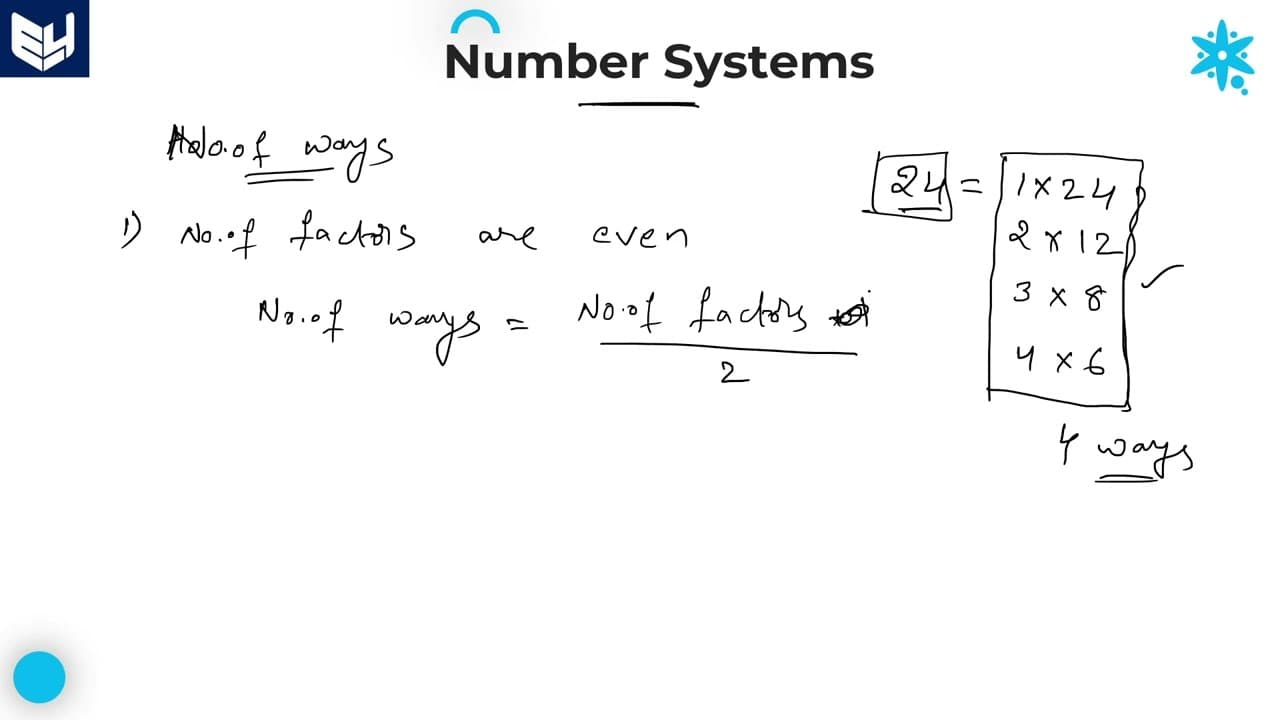
Smaller numbers have a limited set of factors, which makes it straightforward to list all possible factorizations quickly. For example, 24 can be expressed as 1x24, 2x12, 3x8, and 4x6, allowing for an easy count of four ways. Larger numbers typically have many more factors, which complicates the process of identifying all possible products.
Q: What initial step is necessary before calculating the number of ways for larger numbers?
Before calculating the number of ways for larger numbers, it is crucial to determine the total number of factors. Understanding the total number of factors allows you to apply appropriate formulas based on whether this quantity is even or odd, impacting the final calculations for the number of ways.
Q: What is the formula for calculating the number of ways when the total number of factors is even?
If the total number of factors is even, the number of ways to express the number as a product of two factors is calculated using the formula: number of factors divided by 2. This straightforward calculation takes into account the symmetry of factor pairs in even factor scenarios.
Q: How does the odd number of factors change the calculation of number of ways?
For an odd number of factors, the number of ways is determined by using two different formulas based on how the product is stated: for products of two factors, you use (number of factors + 1) / 2; for products of two different factors, you use (number of factors - 1) / 2. This distinction accounts for repeated factors in the former case.
Q: Why do perfect squares always have an odd number of factors?
Perfect squares always have an odd number of factors due to the presence of a repeated mid-factor. For instance, in perfect squares like 36, one of the factor pairs (6x6) is identical. The inclusion of this repeated factor means that factors cannot completely pair up, resulting in an odd count.
Q: What is the difference between two cases when calculating "products of two different factors"?
The difference arises in whether identical factors are counted. When obtaining "products of two different factors," the number of identical pairs must be excluded to avoid redundancy, leading to a calculation that adjusts the total number accordingly by subtracting one from the number of factors in this case.
Summary & Key Takeaways
-
The session focuses on the concept of calculating the number of ways to represent a number, such as 24, as a product of two factors. It highlights that for small numbers, all ways can be easily identified.
-
For larger numbers, it is crucial to first determine the number of factors. The calculation methodology depends on whether the number of factors is even or odd.
-
The session also details specific formulas for both conditions, explaining how to differentiate between two types of factor products, emphasizing the distinction in resulting calculations.
Read in Other Languages (beta)
Share This Summary 📚
Summarize YouTube Videos and Get Video Transcripts with 1-Click
Try YouTube Summary with ChatGPT & Claude or YouTube Transcript Generator