How did humans evolve | Nick Lane and Lex Fridman
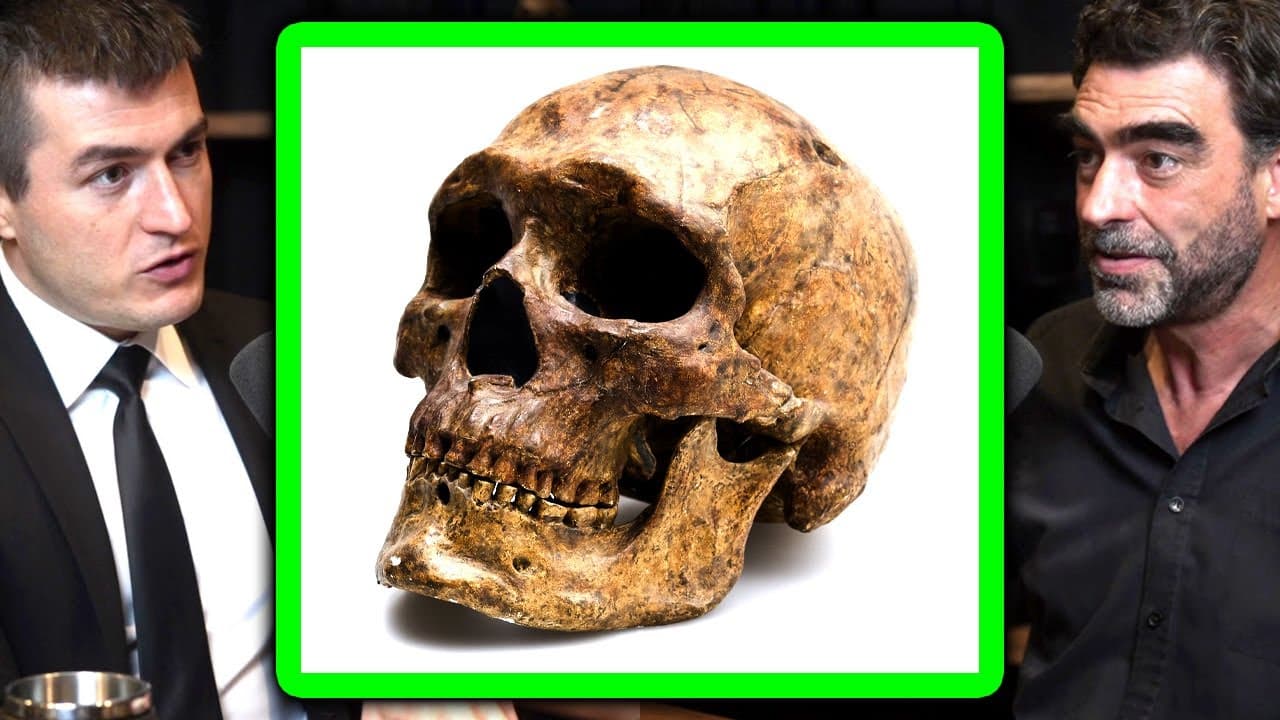
TL;DR
The evolution of humans is influenced by population density, interactions between groups, and the development of complex societies.
Transcript
how did homo sapiens evolve if we think about the invention of early invention of sex and early invention of predation what was the thing invented to make humans well what would you say i mean i suppose a couple of things i'd say number one is you don't have to wind the clock back very far five six million years or so and and and let it run forward... Read More
Key Insights
- 😘 The likelihood of humans evolving as we know them today is relatively low, considering the vastness of the universe and the desire for intelligent, space-faring civilizations.
- 👥 Human evolution, particularly the development of complex societies, is heavily influenced by population density and interactions between different groups.
- ❤️🔥 Factors like fire, tools, and language do not align well with the known trajectory of human evolution, highlighting the significance of population density and cultural interactions.
- 🫷 Humans possess both deeply social and selfish tendencies, which result in the constant push and pull between capitalism and communism.
- 🥺 Violence and conflict between groups have driven the cleverness and ingenuity of humans to resist and protect themselves, leading to the development of various strategies and structures.
- 🕵️♀️ Our society shares similarities with both chimpanzees, which have an aggressive alpha male structure, and bonobos, who predominantly have a female-led society.
Install to Summarize YouTube Videos and Get Transcripts
Explore YouTube Video Summarizer or Get YouTube Transcript Extractor
Questions & Answers
Q: What are the factors driving the evolution of humans as we know them today?
The evolution of humans is not solely dependent on specific factors like fire, tools, or language. Instead, it is influenced by population density and the interactions between different groups, which promote the development and maintenance of expertise and cultural complexity.
Q: How does population density affect human evolution?
Population density increases the number of interactions between groups, allowing for the transfer of information and expertise. This leads to the development of more complex societies and cultural advancements.
Q: Were there specific inventions or developments that led to the emergence of Homo sapiens?
While inventions like fire and tools are important in human history, they do not align well with the known trajectory of human evolution. Instead, population density and the increased interactions between groups appear to be the driving forces behind the emergence of humans as we know them today.
Q: How did collaboration and social structures play a role in human evolution?
Early humans learned to collaborate and form social structures to minimize violence within tribes. This led to the development of a democratic system that allowed for the strength of the tribe and reduced conflict between tribes.
Summary & Key Takeaways
-
Homo sapiens evolved from large complex mammals through a series of evolutionary steps, primarily driven by brain development and group interactions.
-
Population density plays a significant role in the transfer of information and expertise between groups, leading to the development of culturally complex societies.
-
Factors such as fire, tools, and language do not correlate well with the known trajectory of human evolution, highlighting the importance of population density and human interactions.
Read in Other Languages (beta)
Share This Summary 📚
Summarize YouTube Videos and Get Video Transcripts with 1-Click
Try YouTube Summary with ChatGPT & Claude or YouTube Transcript Generator
Explore More Summaries from Lex Clips 📚




Summarize YouTube Videos and Get Video Transcripts with 1-Click
Try YouTube Summary with ChatGPT & Claude or YouTube Transcript Generator