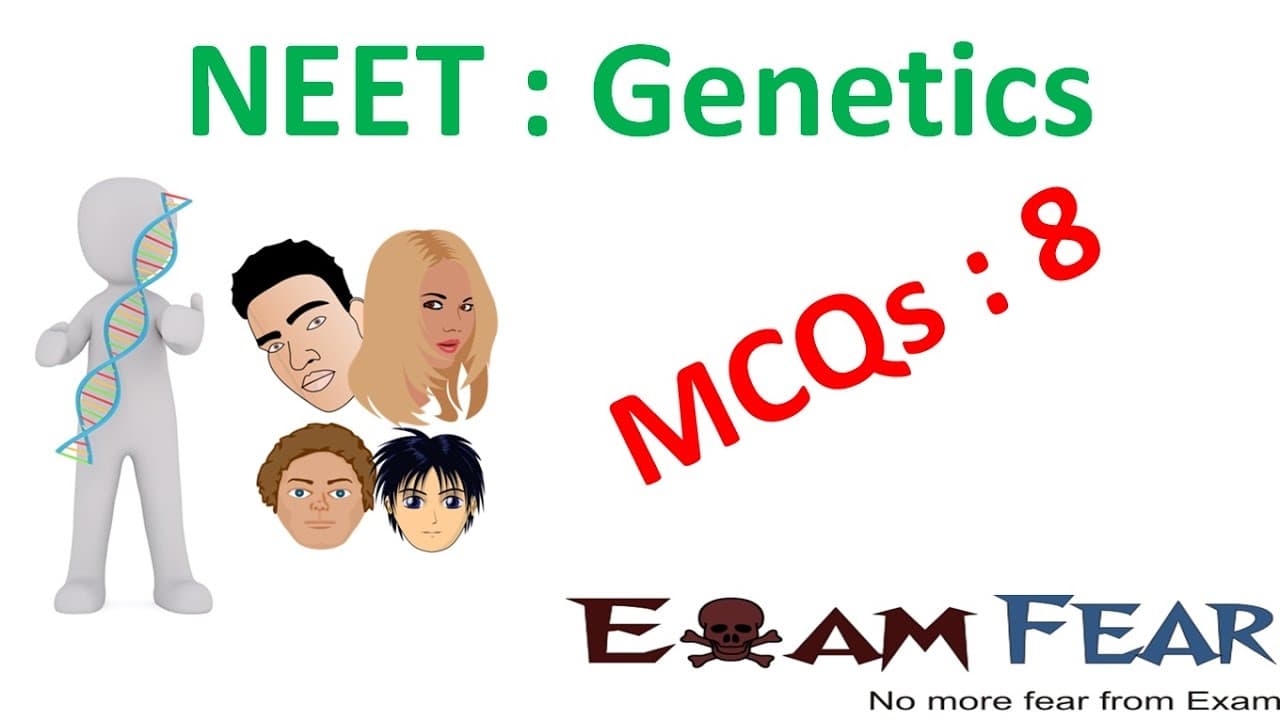
NEET Biology Genetics : Multiple Choice Previous Years Questions MCQs 8
TL;DR
This video provides a study guide on genetics and DNA transcription, covering topics such as determining the probability of having a son or daughter, the process of DNA transcription, complementary RNA strand sequences, nucleosomes in chromosomes, and palindromic sequences in DNA.
Transcript
hello friends this video on need genetics is brought to you by a vampire calm no more fear from exam question number 25 a family of five daughters only is expecting sixth issue the chance of it being the son is okay so the family already has five daughters now the stick challenge is going to arise how do we know whether it will be a son or a daught... Read More
Key Insights
- 💀 The probability of having a son or daughter is always 50%, regardless of the number of existing children.
- 🧬 DNA transcription involves three major steps: initiation, elongation, and termination.
- 🎅 Complementary RNA strand sequences are determined by following base pairing rules: A pairs with U and C pairs with G.
- 🫵 Nucleosomes in chromosomes give an appearance of beads on a string when viewed under an electron microscope.
- 💇 Palindromic sequences in DNA can be easily cut by specific restriction enzymes.
- ❓ Matching codons with their corresponding amino acids is crucial for understanding genetic coding.
- 🧬 Understanding genetics and DNA transcription is essential for comprehending inheritance patterns and protein synthesis.
Install to Summarize YouTube Videos and Get Transcripts
Explore YouTube Video Summarizer or Get YouTube Transcript Extractor
Questions & Answers
Q: Why is the probability of having a son or daughter always 50%?
The probability is always 50% because the male can contribute either an X or Y chromosome, which determines the sex of the child. If the male contributes an X chromosome, it results in a girl, while a Y chromosome results in a boy.
Q: What are the three major steps involved in DNA transcription?
The three major steps in DNA transcription are initiation, elongation, and termination. Initiation involves the binding of RNA polymerase to the DNA, elongation results in the synthesis of RNA from the DNA template, and termination occurs when the RNA polymerase is released from the DNA.
Q: How can complementary RNA strand sequences be determined?
Complementary RNA strand sequences can be determined by following the base pairing rules. Adenine (A) pairs with uracil (U), cytosine (C) pairs with guanine (G), and thymine (T) pairs with adenine (A) in RNA.
Q: What are nucleosomes in chromosomes?
Nucleosomes are structures formed when DNA is wrapped around histone proteins to form a bead-like structure. These nucleosomes give an appearance of beads on a string when viewed under an electron microscope.
Q: How can palindromic sequences in DNA be recognized?
Palindromic sequences in DNA can be recognized by sequences that read the same forward and backward. These sequences are important as they can be easily cut by specific restriction enzymes.
Q: Why is matching codons with their corresponding amino acids important?
Matching codons with their corresponding amino acids is crucial for understanding genetic coding. This relationship helps determine the exact sequence of amino acids in a polypeptide chain during protein synthesis.
Summary & Key Takeaways
-
The probability of having a son or daughter is always 50%, regardless of the number of existing children.
-
DNA transcription is the process of RNA synthesis from DNA templates, with three major steps: initiation, elongation, and termination.
-
Complementary RNA strand sequences can be determined by following the base pairing rules, where A pairs with U and C pairs with G.
-
Nucleosomes in chromosomes appear as beads on a string when viewed under an electron microscope.
-
Palindromic sequences in DNA can be easily cut by specific restriction enzymes.
-
Matching specific codons with their corresponding amino acids is crucial in understanding genetic coding.
Read in Other Languages (beta)
Share This Summary 📚
Summarize YouTube Videos and Get Video Transcripts with 1-Click
Try YouTube Summary with ChatGPT & Claude or YouTube Transcript Generator
Explore More Summaries from LearnoHub - Class 11, 12 📚

Summarize YouTube Videos and Get Video Transcripts with 1-Click
Try YouTube Summary with ChatGPT & Claude or YouTube Transcript Generator