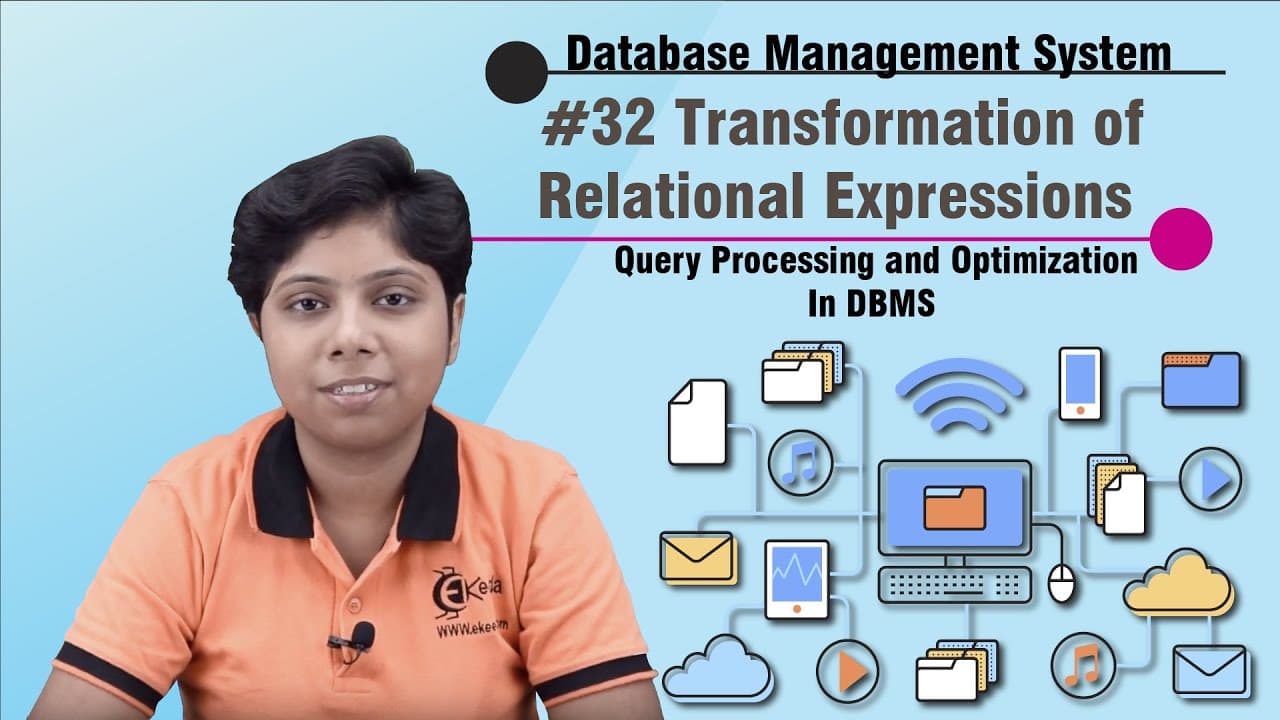
Transformation of Relational Expressions - Database Management System
TL;DR
Learn how to transform relational expressions to optimize query processing and create more efficient database queries.
Transcript
click the Bell icon to get latest videos from akira hello friends today we will talk about the transformation of relational expression that is how we can translate and relational expression into an equivalent expression for that we say the equivalence rule then we will look about the transformation and then we will solve about different different p... Read More
Key Insights
- 😑 Transforming relational expressions is crucial for optimizing query processing and improving database query performance.
- 😑 Equivalence rules help determine if two relational expressions are equivalent and can be transformed into each other.
- 🖐️ Joint ordering and attribute ordering within a query play a significant role in the transformation process.
Install to Summarize YouTube Videos and Get Transcripts
Explore YouTube Video Summarizer or Get YouTube Transcript Extractor
Questions & Answers
Q: What is the purpose of transforming relational expressions in database queries?
Transforming relational expressions helps optimize query processing and create more efficient database queries for user-oriented and practical use.
Q: How are two relational expressions determined to be equivalent?
Two relational expressions are determined to be equivalent if they follow the rules of equivalence, which include projection, selection, commutative, associativity, and distribution rules.
Q: How does joint ordering in a query impact the transformation process?
Joint ordering in a query determines the order in which relations are joined, and it influences the overall performance and efficiency of the query.
Q: Why is attribute ordering important in a query?
Attribute ordering impacts the ordering of attributes within a query, and it can affect the efficiency and optimization of the query processing.
Q: How can the enumeration of equivalent expressions be performed?
The enumeration of equivalent expressions can be done using an algorithm that matches each expression with equivalence rules and creates equivalent expressions by transforming sub-expressions.
Summary & Key Takeaways
-
Relational expressions can be transformed to make them more applicable and user-oriented for solving queries in a database.
-
Equivalence rules determine if two relational expressions are equivalent, allowing for easy transformation.
-
Projection, selection, commutative, associativity, and distribution rules can be applied to transform relational expressions.
-
Joint ordering and attribute ordering within a query also impact the transformation process.
-
Enumeration of equivalent expressions can be done using a step-by-step algorithm.
Read in Other Languages (beta)
Share This Summary 📚
Summarize YouTube Videos and Get Video Transcripts with 1-Click
Try YouTube Summary with ChatGPT & Claude or YouTube Transcript Generator
Explore More Summaries from Ekeeda 📚

Summarize YouTube Videos and Get Video Transcripts with 1-Click
Try YouTube Summary with ChatGPT & Claude or YouTube Transcript Generator