Digital IC | Characteristics | PDC | Lec-102
TL;DR
Understanding key digital IC specifications like threshold voltage and propagation delay.
Transcript
hi everyone in this video I am going to explain about digital IC specification terminology here the digital IC specification terminology is a part of logic families actually from this video onwards I am going to start the logic family so logic families are nothing but TTL logic family physiology family cmosphology family Mass logic family okay logi... Read More
Key Insights
- 😋 Understanding digital IC specifications is critical for designing effective and efficient circuits in modern electronics.
- 🤩 The threshold voltage is key for determining state changes in logic circuits, impacting their functionality.
- 🚄 Propagation delay highlights the time constraints that engineers must consider when designing high-speed digital systems.
- ✊ Power dissipation affects energy efficiency and must be optimized for sustainable circuit design.
- 🪭 Fan in and fan out metrics are crucial for configuring logic gates without compromising performance and reliability.
- ⚡ Noise margins ensure robustness against unintended voltage variations, enhancing circuit dependability in noisy environments.
- 🐎 The speed power product helps balance trade-offs between circuit speed and energy consumption for optimal performance.
Install to Summarize YouTube Videos and Get Transcripts
Explore YouTube Video Summarizer or Get YouTube Transcript Extractor
Questions & Answers
Q: What is threshold voltage in digital ICs?
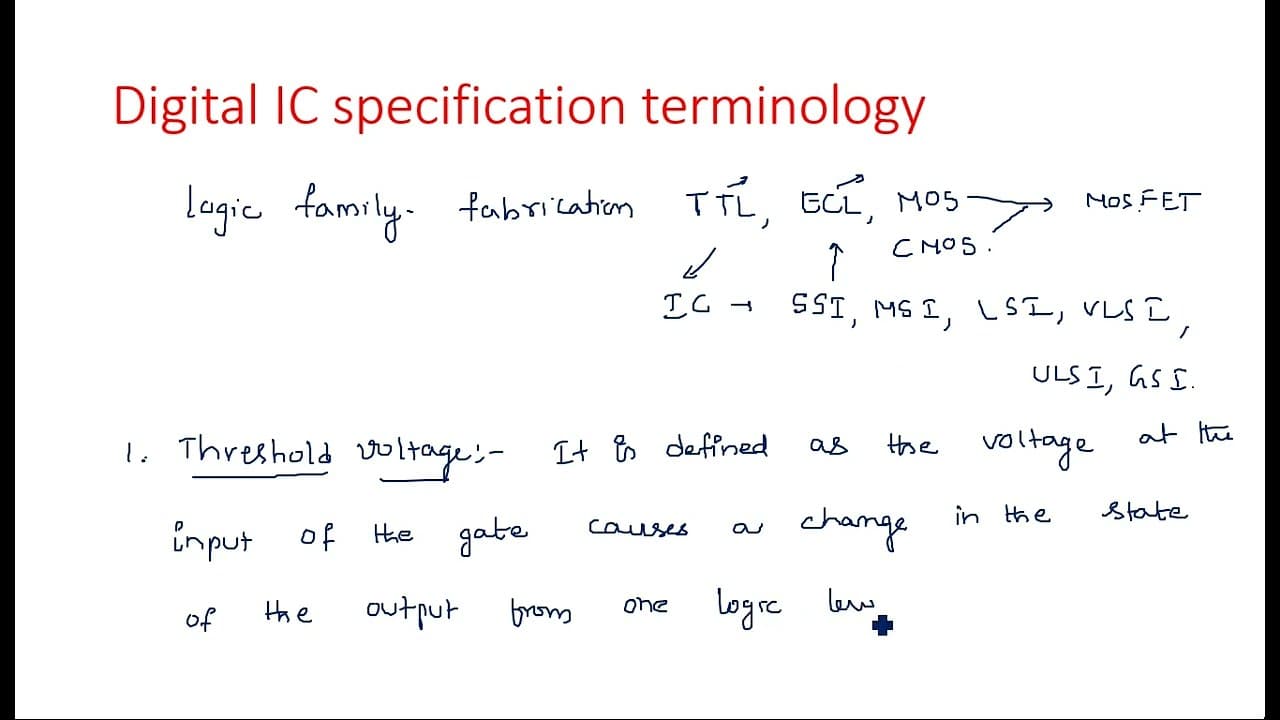
Threshold voltage is defined as the minimum voltage required at the input of a logic gate for the output to change state. Specifically, it determines the transition between logic levels, such as from logical 0 to logical 1, and vice versa. Understanding threshold voltage is vital for designing circuits that can reliably interpret input signals.
Q: How is propagation delay significant in digital circuits?
Propagation delay refers to the time it takes for an input signal change to affect the output of a logic gate. This metric, measured in nanoseconds, is crucial for designing fast circuits. Knowing the propagation delay helps engineers ensure that signals are properly synchronized, so digital operations can occur efficiently without errors.
Q: What does power dissipation refer to in digital ICs?
Power dissipation indicates the amount of power consumed by a logic gate while it operates at a standard duty cycle. Expressed in milliwatts, this metric is essential for understanding the energy efficiency and thermal management of ICs. Lower power dissipation enhances circuit lifespan and sustainability, which is increasingly important in modern electronics.
Q: Can you explain the concept of 'fan in' and its importance?
Fan in refers to the maximum number of inputs that a logic gate can handle. This metric is significant because it dictates the complexity and design constraints of digital circuits. A higher fan in may lead to more complex logic gates, but can also induce problems like increased delay and reduced reliability if exceeded.
Q: What is fan out and how does it affect circuit design?
Fan out is the maximum number of similar gates that can be driven by the output of a single logic gate. It is essential for ensuring that outputs can effectively control multiple inputs without degrading the quality of logic levels. Understanding fan out is critical for avoiding signal integrity issues in circuit designs.
Q: Define noise margin and its relevance in digital electronics.
Noise margin is the maximum noise voltage that can be added to an input signal without affecting the output. This metric is vital for resilience against voltage fluctuations and ensuring reliability in digital circuits. A higher noise margin contributes to a circuit's robustness in real-world applications where signal integrity is paramount.
Q: What is the speed power product, and why is it important?
The speed power product is the multiplication of average propagation delay and average power dissipation, representing a figure of merit for logic families. This metric is crucial for optimizing the performance of digital ICs, as it provides insight into the trade-offs between speed and power consumption, helping engineers make informed design choices.
Q: How do various logic families differ in terms of specifications?
Different logic families such as TTL, ECL, and CMOS vary in their specifications, including propagation delays, power dissipation, and noise margins. Each family has distinct characteristics that affect performance, applications, and energy consumption, making it vital for engineers to choose the appropriate family based on specific circuit requirements.
Summary & Key Takeaways
-
This video introduces key terminologies related to digital integrated circuit specifications, including threshold voltage, propagation delay, power dissipation, fan in, fan out, noise margin, and speed power product.
-
It explains how these specifications affect the performance and design of logic families, including TTL, ECL, and CMOS technologies, etc.
-
Each term plays a crucial role in understanding the characteristics and behavior of digital circuits, influencing factors such as the number of transistors and power consumption.
Read in Other Languages (beta)
Share This Summary 📚
Summarize YouTube Videos and Get Video Transcripts with 1-Click
Try YouTube Summary with ChatGPT & Claude or YouTube Transcript Generator