Safety guideline for COVID-19: Transient aerosol buildup
TL;DR
This analysis discusses the transient and steady state transmission rates in a room, with a focus on the effects of aerosol particles and their buildup.
Transcript
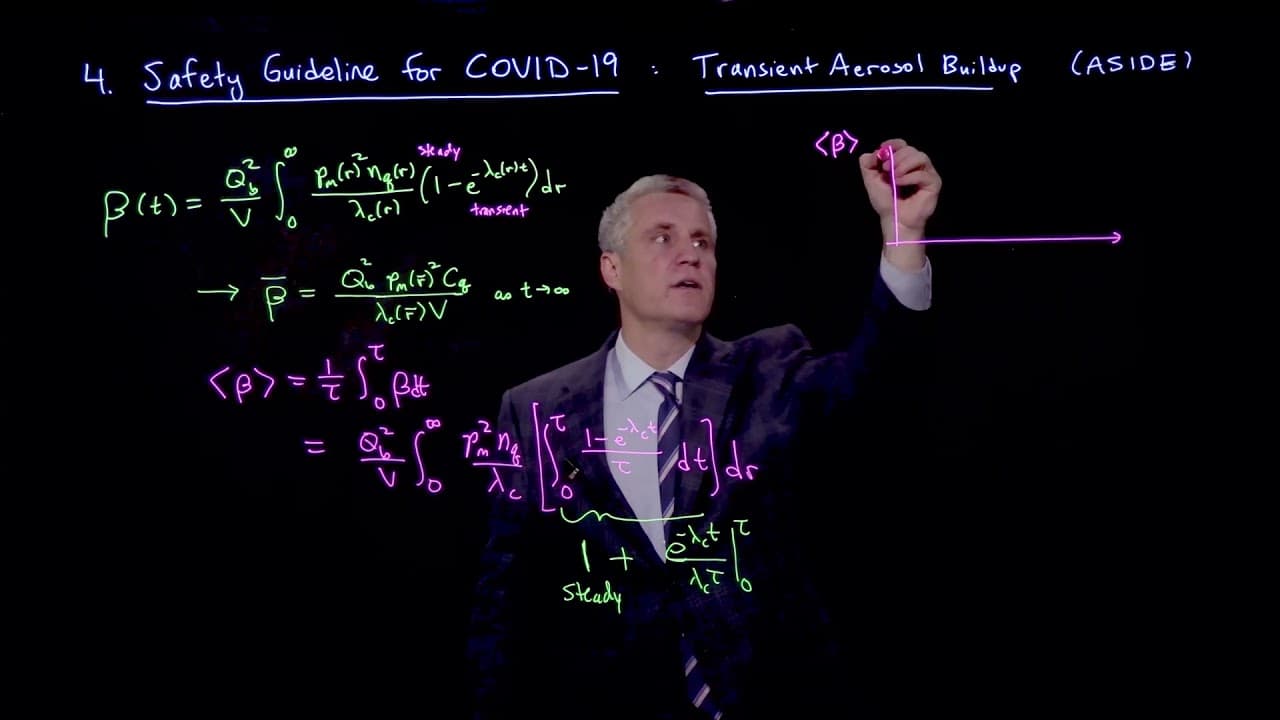
PROFESSOR: In most of our calculations of safety, we're going to be interested in the steady state average transmission rate between individuals in a room, after the aerosol particles have built up to a steady state. But let's briefly talk about the transient buildup, and how to take that into account, just as an aside in this board here. So here i... Read More
Key Insights
- ☠️ The steady state transmission rate is a more conservative approach, assuming immediate maximum transmission upon entering a room.
- 👻 Including the transient term accounts for the time needed for transmission to occur, allowing for a more realistic assessment.
- ☠️ The effective radius helps in evaluating and comparing transmission rates in different scenarios.
- ☠️ Factors such as breathing rate, room volume, and aerosol droplet size significantly impact the transmission rate.
- ❓ The analysis introduces approximations to simplify calculations and obtain simple analytical results.
- ⌛ The transient term diverges at shorter times, capturing the intuition that transmission requires some time to occur.
- ☠️ Considering both steady state and transient transmission rates provides a comprehensive understanding of the risks involved.
Install to Summarize YouTube Videos and Get Transcripts
Explore YouTube Video Summarizer or Get YouTube Transcript Extractor
Questions & Answers
Q: What is the difference between steady state and transient transmission rates?
The steady state transmission rate refers to the average transmission rate between individuals in a room after aerosol particles have reached a stable concentration. The transient transmission rate, on the other hand, accounts for the initial buildup of aerosol concentration and the time it takes for the transmission rate to stabilize.
Q: How is the transmission rate influenced by factors such as breathing rate, room volume, and aerosol droplet size?
The transmission rate is directly influenced by the breathing rate, with higher breathing rates leading to increased transmission. The room volume also plays a role, as a larger volume allows for more dispersion of aerosol particles. Additionally, the size of the aerosol droplets affects the transmission rate, with smaller droplets being more easily transmitted.
Q: What is the significance of the effective radius in determining the transmission rate?
The effective radius is the radius at which the mass transmission factor and the relaxation rate are equal. It helps in evaluating and comparing the transmission rates in different scenarios. By considering the effective radius, one can calculate the average transmission rate and assess the effectiveness of safety measures.
Q: Why is it important to consider the transient term in calculating the transmission rate?
Considering the transient term allows for a more realistic assessment of the transmission rate. It captures the fact that transmission does not immediately reach its maximum value when an infected person enters the room. By including the transient term, the analysis accounts for the time needed for transmission to occur and provides a more accurate understanding of the risks involved.
Summary & Key Takeaways
-
The analysis discusses the general expression for transmission rate, which depends on breathing rate, room volume, and various factors related to aerosol droplets.
-
It introduces the concept of steady state and transient transmission rates, with the transient term referring to the initial buildup of aerosol concentration in the air.
-
The analysis presents formulas and approximations to calculate the average transmission rate and introduces the concept of an effective radius.
Read in Other Languages (beta)
Share This Summary 📚
Summarize YouTube Videos and Get Video Transcripts with 1-Click
Try YouTube Summary with ChatGPT & Claude or YouTube Transcript Generator
Explore More Summaries from MIT OpenCourseWare 📚



Summarize YouTube Videos and Get Video Transcripts with 1-Click
Try YouTube Summary with ChatGPT & Claude or YouTube Transcript Generator