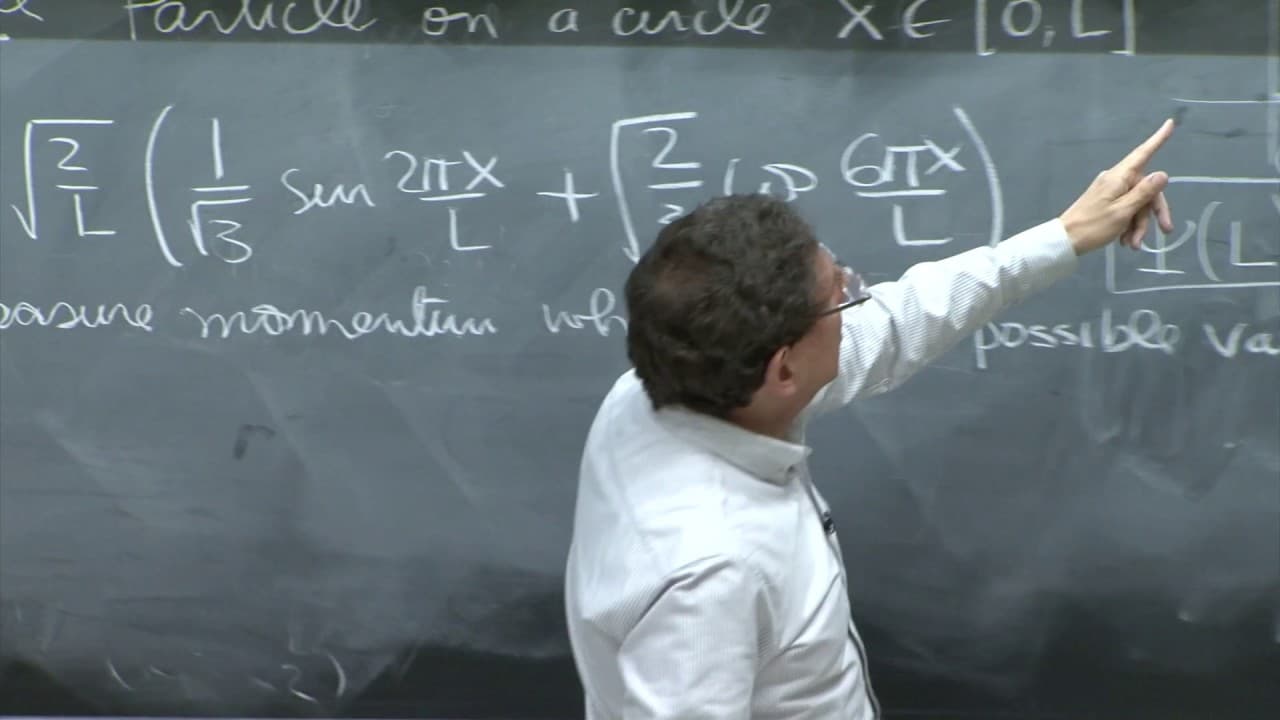
Consistency condition. Particle on a circle
TL;DR
Quantum mechanics explains the calculation of expectation values and momentum measurement in a particle on a circle system.
Transcript
PROFESSOR: Let me do a little exercise using still this manipulation. And I'll confirm the way we think about expectations values. So, suppose exercise. Suppose you have indeed that psi is equal to alpha i psi i. Compute the expectation value of Q in the state of psi. Precisely, the expectation value of this operator we've been talking about on the... Read More
Key Insights
- 👋 Expectation values in quantum mechanics are calculated by integrating the product of the wave function and the operator.
- 🍹 The measurement postulate states that expectation values are the sum of possible values multiplied by their probabilities.
- 😑 Wave functions of particles on a circle system can be expressed as a superposition of momentum eigenstates.
- ⭕ Momentum eigenstates for a particle on a circle system are exponential functions with specific coefficients.
- 😑 The Fourier theorem plays a significant role in expressing wave functions as a superposition of momentum eigenstates.
- 👋 Probabilities of obtaining specific momentum values are determined by the squared coefficients in the wave function.
Install to Summarize YouTube Videos and Get Transcripts
Explore YouTube Video Summarizer or Get YouTube Transcript Extractor
Questions & Answers
Q: How is the expectation value of a quantum operator calculated in a quantum state?
The expectation value of an operator is found by taking the integral of the product of the complex conjugate of the wave function, the operator, and the wave function, summed over all possible values of the wave function.
Q: What is the significance of the measurement postulate in the calculation of expectation values?
The measurement postulate states that the expectation value of a physical quantity should be the sum of the possible values multiplied by their probabilities. This postulate is crucial in determining the expectation values in quantum mechanics.
Q: What is the wave function of a particle on a circle system?
The wave function of a particle on a circle system is a superposition of sine and cosine functions with specific coefficients, satisfying the periodicity condition at the endpoints of the circle.
Q: How are momentum eigenstates calculated in a particle on a circle system?
Momentum eigenstates are found by considering exponential functions of the form e^(ikx) with a constant factor. These eigenstates satisfy the periodicity condition of the wave function on a circle.
Summary & Key Takeaways
-
The professor demonstrates an exercise to calculate the expectation value of an operator in a quantum state using the manipulation of equations.
-
The concept of expectation values is explained as the sum of possible values multiplied by their corresponding probabilities.
-
An example of a particle on a circle system is explored, discussing the wave function and its momentum eigenstates.
Read in Other Languages (beta)
Share This Summary 📚
Summarize YouTube Videos and Get Video Transcripts with 1-Click
Try YouTube Summary with ChatGPT & Claude or YouTube Transcript Generator
Explore More Summaries from MIT OpenCourseWare 📚



Summarize YouTube Videos and Get Video Transcripts with 1-Click
Try YouTube Summary with ChatGPT & Claude or YouTube Transcript Generator