19. Spectroscopy: Probing Molecules with Light
TL;DR
The lecture introduces time-dependent quantum mechanics and its application in understanding the interaction between molecules and electromagnetic radiation in spectroscopy.
Transcript
The following content is provided under a Creative Commons license. Your support will help MIT OpenCourseware continue to offer high-quality educational resources for free. To make a donation or view additional materials from hundreds of MIT courses, visit MIT OpenCourseware at ocw.mit.edu. ROBERT FIELD: This lecture is not relevant to this exam or... Read More
Key Insights
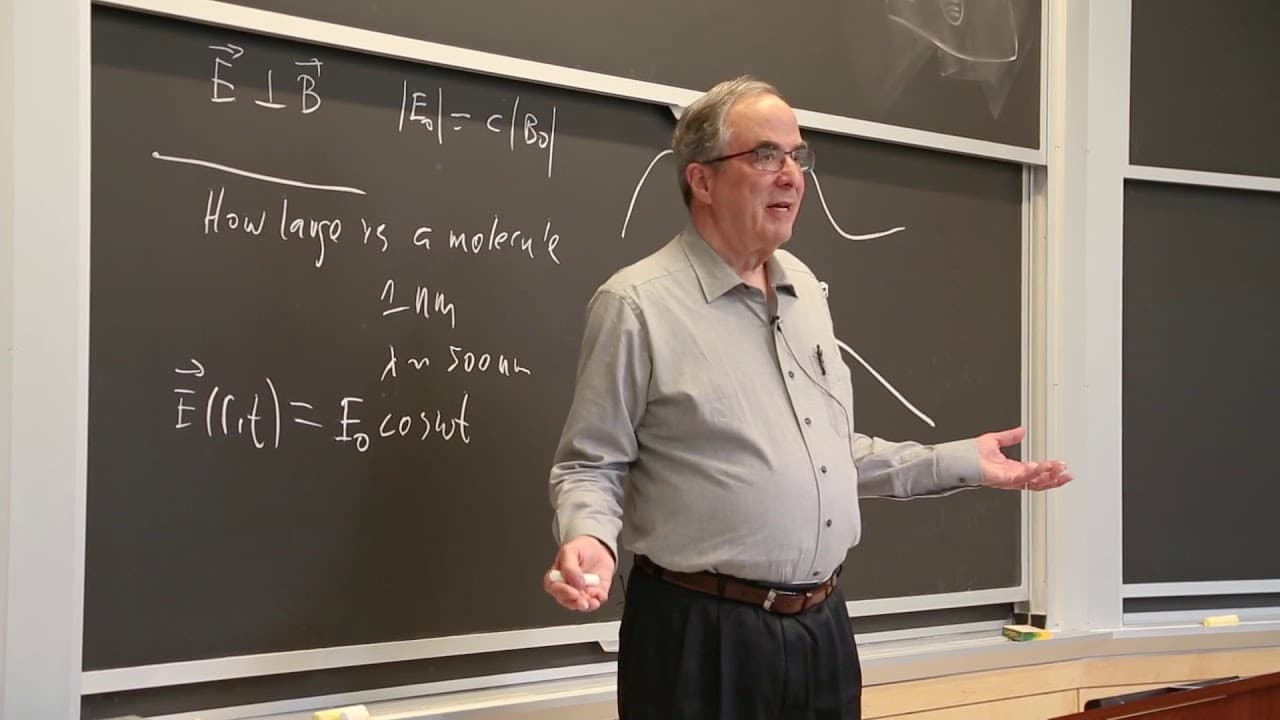
- 🏑 The dipole approximation simplifies the interaction between molecules and electromagnetic radiation by assuming a constant electric field over the molecule.
- ⌛ Time-dependent perturbation theory allows the study of transitions caused by a time-dependent perturbation, leading to eigenstate expressions and linear response.
- 🏑 The assumptions of weak and continuous electromagnetic fields, single eigenstate initial conditions, and neglecting uncorrelated eigenstates simplify calculations.
Install to Summarize YouTube Videos and Get Transcripts
Explore YouTube Video Summarizer or Get YouTube Transcript Extractor
Questions & Answers
Q: What is the dipole approximation and how does it simplify the interaction between molecules and electromagnetic radiation?
The dipole approximation simplifies the interaction by assuming that the electric field is constant over the molecule, allowing the electric field to be represented as E0 cosine omega t. This simplifies calculations by removing spatial complexity.
Q: What are the crucial assumptions made in time-dependent quantum mechanics for spectroscopy?
The assumptions are that the electromagnetic field is weak and continuous, the system starts in a single eigenstate, and the experiments involve time-dependent interactions with short or intense pulses.
Q: What is linear response and why is it important in understanding spectroscopy?
Linear response refers to the response of a system to a weak perturbation. Understanding linear response is essential for comprehending Fermi's golden rule and the rate at which transitions occur between initial and final states.
Q: What is Fermi's golden rule and its significance in spectroscopy?
Fermi's golden rule explains the rate at which transitions occur between initial and final states in quantum systems. It provides insights into the intensities and allowed transitions in spectroscopy.
Summary & Key Takeaways
-
The lecture covers the dipole approximation and its simplification of the interaction between molecules and electromagnetic radiation.
-
Transitions caused by time-dependent perturbation and the expression of the problem in terms of eigenstates.
-
The assumptions of weak and continuous electromagnetic fields and starting the system in a single eigenstate.
-
Introduction to linear response and Fermi's golden rule for understanding transition rates.
Read in Other Languages (beta)
Share This Summary 📚
Summarize YouTube Videos and Get Video Transcripts with 1-Click
Try YouTube Summary with ChatGPT & Claude or YouTube Transcript Generator
Explore More Summaries from MIT OpenCourseWare 📚



Summarize YouTube Videos and Get Video Transcripts with 1-Click
Try YouTube Summary with ChatGPT & Claude or YouTube Transcript Generator