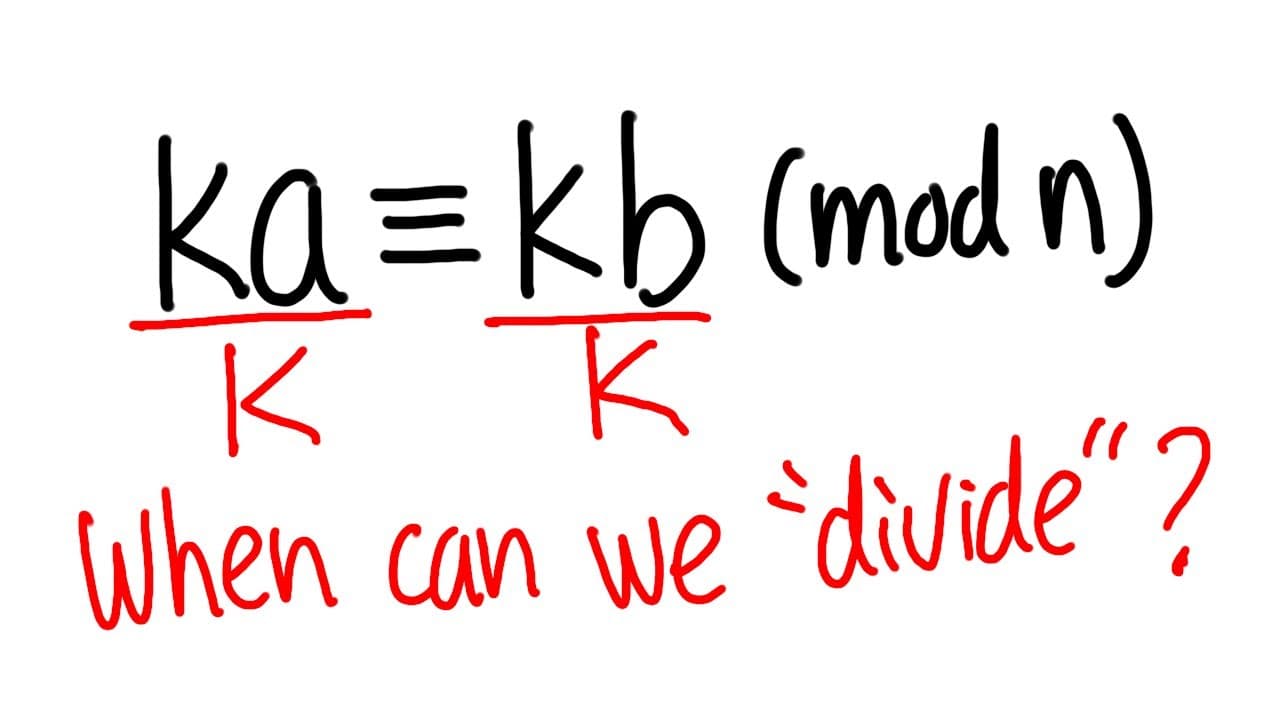
When can we divide in a congruence?
TL;DR
Be cautious when dividing both sides of a congruence by the same number, as it can affect the validity of the congruence.
Transcript
if you want to learn some cool math introduction to prove to abstract algebra go down to link and subscribe to my channel ok this video I'm going to show you guess why we have to be careful whenever were trying to divide both sides of Congress by a same number and let's take a look of 30 congruent 242 Matt whoa first as an example and first of all ... Read More
Key Insights
- 🙃 Dividing both sides of a congruence may lead to different remainders if the GCD is not equal to 1.
- 🙃 The GCD of two numbers determines whether dividing both sides of a congruence is valid.
- 🙃 If the GCD is equal to 1, dividing both sides is allowed, and the congruence remains true.
- 🍉 The term "divide" in congruence refers to multiplying by the multiplicative inverse.
- ✅ Checking the GCD is crucial to ensure the accuracy and validity of divided congruences.
- ❓ The Euclidean algorithm and prime factorization are methods to find the GCD.
- 🙃 Relatively prime numbers have a GCD of 1 and allow for dividing both sides of a congruence.
Install to Summarize YouTube Videos and Get Transcripts
Explore YouTube Video Summarizer or Get YouTube Transcript Extractor
Questions & Answers
Q: Why do we need to be cautious when dividing both sides of a congruence?
Dividing both sides by the same number can alter the congruence, as it can lead to different remainders if the GCD is not equal to 1. It is essential to check the GCD before dividing.
Q: How can we determine the GCD of two numbers?
The GCD is the largest positive integer that divides both numbers without leaving a remainder. It can be found using various methods, such as the Euclidean algorithm or prime factorization.
Q: Can we always divide both sides of a congruence if the GCD is 1?
Yes, if the GCD of the numbers being divided is 1, it means they are relatively prime. In this case, dividing both sides by the same number is allowed.
Q: Why is it incorrect to use the term "divide" in congruence, as mentioned in the video?
Technically, the correct term is "multiply by the multiplicative inverse." In congruence, we are considering multiplication rather than division. However, it is common to use the term "divide" for simplicity and ease of understanding.
Summary & Key Takeaways
-
Dividing both sides of a congruence by the same number can lead to different remainders, impacting the congruence.
-
It is crucial to check the greatest common divisor (GCD) of the numbers being divided to ensure the validity of the congruence.
-
When the GCD is not equal to 1, dividing both sides is not allowed.
Read in Other Languages (beta)
Share This Summary 📚
Summarize YouTube Videos and Get Video Transcripts with 1-Click
Try YouTube Summary with ChatGPT & Claude or YouTube Transcript Generator
Explore More Summaries from blackpenredpen 📚
Summarize YouTube Videos and Get Video Transcripts with 1-Click
Try YouTube Summary with ChatGPT & Claude or YouTube Transcript Generator