Normal Shock Problem 1 - Compressible Fluid Flow - Fluid Mechanics 1
TL;DR
The video explains the concept of normal shock, where a fluid changes abruptly from supersonic flow to subsonic flow, and demonstrates how to calculate downstream conditions.
Transcript
hello students as we have seen in the previous sections what is normal shock a normal shock is produced when a fluid travels from a supersonic flow and abruptly changes to a subsonic flow due to which there is a formation of a shock wave this shock wave is called as normal shock now this normal shock is in perpendicular to the direction of the flui... Read More
Key Insights
- 🫢 A normal shock occurs when a fluid transitions from supersonic to subsonic flow, and a shock wave is formed.
- #️⃣ The downstream pressure, temperature, and Mach number can be calculated using specific formulas.
- 🫢 The shock strength, defined as P2/P1 - 1, can be determined as a measure of the shock's intensity.
- 💐 The equations and calculations demonstrated in this video are applicable to understanding and analyzing fluid flow behavior in various scenarios.
- 🫢 The video emphasizes the importance of accurately determining the downstream conditions after a normal shock for engineering and design purposes.
- 🫢 The downstream temperature is affected by the shock, and its value may differ from the upstream temperature.
- 💐 The downstream Mach number can be lower than the upstream Mach number due to the shock-induced flow change.
Install to Summarize YouTube Videos and Get Transcripts
Explore YouTube Video Summarizer or Get YouTube Transcript Extractor
Questions & Answers
Q: What is a normal shock?
A normal shock occurs when a fluid abruptly changes from supersonic to subsonic flow, resulting in the formation of a shock wave perpendicular to the fluid's direction.
Q: How do you calculate the downstream pressure?
The downstream pressure (P2) can be calculated using the formula P2/P1 = 2γM1^2 - (γ-1)/(γ+1), where P1 is the upstream pressure, γ is the adiabatic constant, and M1 is the Mach number.
Q: How is the downstream temperature calculated?
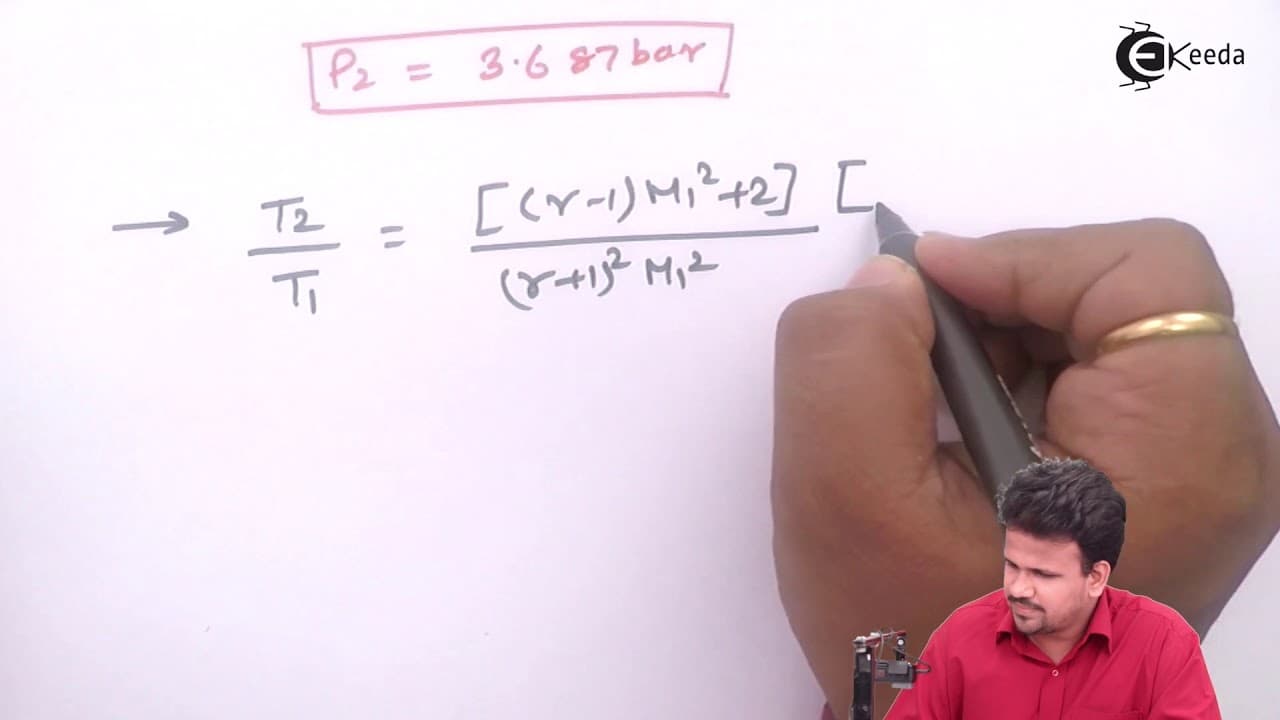
The formula for calculating the downstream temperature (T2) is T2/T1 = (γ-1)M1^2/2(γ+1)^2(M1^2) - (γ-1), where T1 is the upstream temperature.
Q: What is the relationship between the upstream and downstream Mach numbers?
The relationship between the upstream Mach number (M1) and downstream Mach number (M2) is given by the formula M2^2 = 2(γ-1)M1^2/(2γM1^2 - γ-1), indicating the change in Mach number created by the normal shock.
Summary & Key Takeaways
-
A normal shock occurs when a fluid transitions from supersonic to subsonic flow, resulting in the formation of a shock wave perpendicular to the fluid's direction.
-
The video presents a problem where air flows through a duct with a Mach number of 1.5 and provides upstream conditions (pressure and temperature).
-
The task is to calculate the downstream pressure, temperature, Mach number, and shock strength using relevant formulas.
Read in Other Languages (beta)
Share This Summary 📚
Summarize YouTube Videos and Get Video Transcripts with 1-Click
Try YouTube Summary with ChatGPT & Claude or YouTube Transcript Generator
Explore More Summaries from Ekeeda 📚






Summarize YouTube Videos and Get Video Transcripts with 1-Click
Try YouTube Summary with ChatGPT & Claude or YouTube Transcript Generator