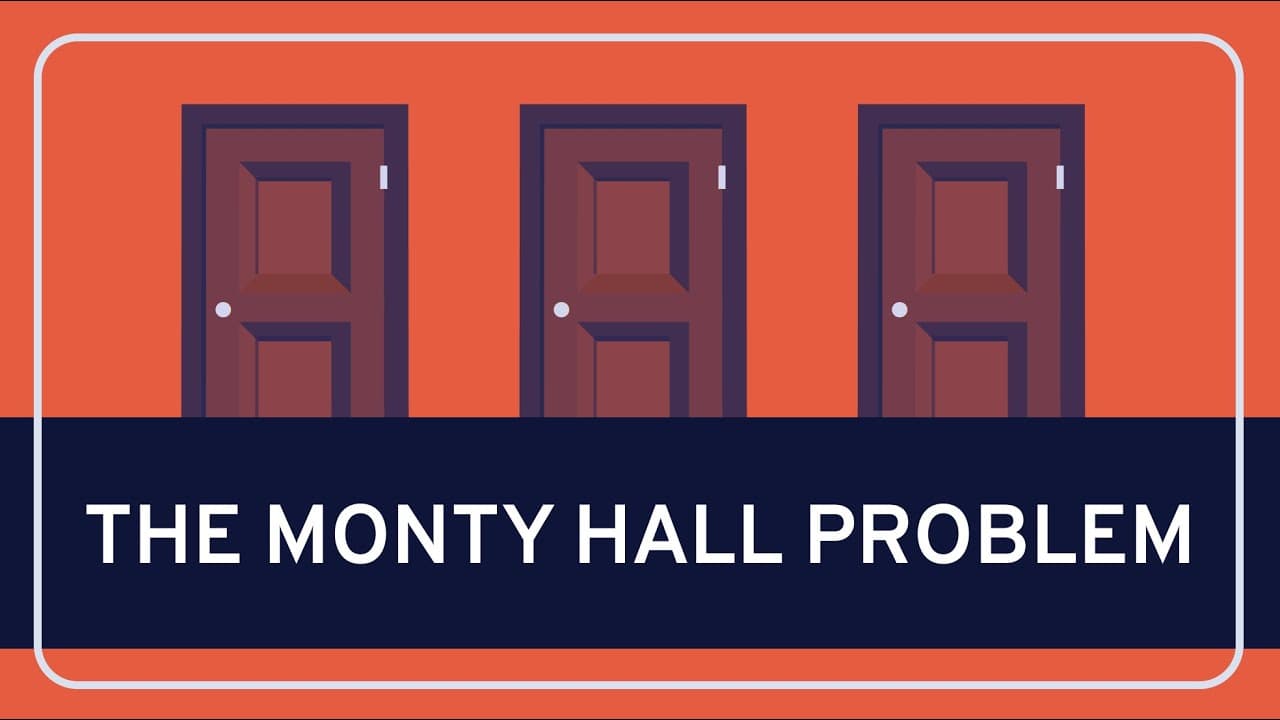
PHILOSOPHY - Probability: The Monty Hall Problem [HD]
TL;DR
Switching doors increases winning chances in the Monty Hall problem.
Transcript
(intro music) Hi! My name is Bryce Gessell, and I'm a philosophy graduate student at Duke University. In this video, I'll be explaining the Monty Hall Problem. Imagine that you're in the final round of a game show, and you're just one step away from winning the grand prize. The prize is behind one of three different doors. All you have to do to win... Read More
Key Insights
- The Monty Hall problem involves choosing the correct door out of three to win a prize, with a twist after the initial choice.
- After selecting a door, the host opens another door, revealing no prize, and offers the contestant a chance to switch doors.
- Initially, the probability of choosing the correct door is one-in-three, but switching increases the probability to two-in-three.
- The common misconception is that once a door is opened, the odds become fifty-fifty, but this is incorrect.
- The probability of winning doubles if the contestant switches doors after the host reveals an empty door.
- The Monty Hall problem illustrates how additional information can affect probability and decision-making.
- The problem is counterintuitive because people often assume equal probability between two remaining options.
- Understanding the problem requires recognizing the distribution of probabilities between the contestant's initial choice and the remaining options.
Install to Summarize YouTube Videos and Get Transcripts
Explore YouTube Video Summarizer or Get YouTube Transcript Extractor
Questions & Answers
Q: What is the Monty Hall problem about?
The Monty Hall problem is a probability puzzle based on a game show scenario. A contestant chooses one of three doors, behind one of which is a prize. After the initial choice, the host opens one of the other two doors, revealing no prize, and offers the contestant the chance to switch doors. The problem explores whether switching increases the chances of winning.
Q: Why does switching doors increase the chances of winning?
Switching doors increases the chances of winning because the initial choice has a one-in-three probability of being correct. When the host opens a door with no prize, it provides additional information, shifting the probability. The remaining unchosen door now has a two-in-three chance of having the prize, making switching the better strategy.
Q: What is the common misconception about the Monty Hall problem?
The common misconception is that after the host reveals an empty door, the odds of the prize being behind either of the two remaining doors become fifty-fifty. However, this ignores the initial probabilities and the effect of the host's action, which actually increases the probability of winning by switching to two-in-three.
Q: How does the host's action affect the probabilities in the Monty Hall problem?
The host's action of revealing an empty door affects the probabilities by redistributing the initial probabilities. The one-in-three chance of the initially chosen door remains unchanged, whereas the probability of the prize being behind the remaining unchosen door increases to two-in-three, making switching advantageous.
Q: Why is the Monty Hall problem considered counterintuitive?
The Monty Hall problem is considered counterintuitive because it defies the natural assumption that the remaining options are equally likely. People tend to think that once one option is eliminated, the remaining options have equal chances, overlooking the impact of the initial probabilities and the host's strategic action.
Q: What role does probability distribution play in the Monty Hall problem?
Probability distribution plays a crucial role in the Monty Hall problem by determining the likelihood of the prize being behind each door. Initially, each door has an equal chance, but the host's action of revealing an empty door shifts the probability, making the unchosen door more likely to have the prize, thus favoring the switching strategy.
Q: How does the Monty Hall problem illustrate decision-making under uncertainty?
The Monty Hall problem illustrates decision-making under uncertainty by showing how additional information can change the optimal choice. Initially, the decision is based on equal probabilities, but the host's action provides new information that alters the odds, demonstrating the importance of reassessing decisions when faced with new data.
Q: What is the significance of dividing the doors into groups in the Monty Hall problem?
Dividing the doors into groups—'Yours' (the initially chosen door) and 'Others' (the remaining two doors)—helps clarify the probability distribution. Initially, 'Yours' has a one-in-three chance, and 'Others' has a two-in-three chance. When the host reveals an empty door, the probability shifts, highlighting why the unchosen door in 'Others' becomes more likely to have the prize.
Summary & Key Takeaways
-
The Monty Hall problem is a probability puzzle that demonstrates how switching choices can increase the odds of winning. Initially, the contestant picks one of three doors, and the host reveals an empty door among the remaining two. Switching doors doubles the contestant's chances of winning.
-
This problem challenges the intuition that the odds become fifty-fifty after one door is revealed. By switching, the contestant leverages the higher probability associated with the group of doors not initially chosen. This counterintuitive result highlights the importance of understanding probability distribution.
-
The explanation involves dividing the doors into two groups: the initially chosen door and the other two doors. When one of the other doors is revealed to be empty, the probability of winning shifts to the remaining unchosen door, making switching the optimal strategy.
Read in Other Languages (beta)
Share This Summary 📚
Summarize YouTube Videos and Get Video Transcripts with 1-Click
Try YouTube Summary with ChatGPT & Claude or YouTube Transcript Generator
Explore More Summaries from Wireless Philosophy 📚
Summarize YouTube Videos and Get Video Transcripts with 1-Click
Try YouTube Summary with ChatGPT & Claude or YouTube Transcript Generator