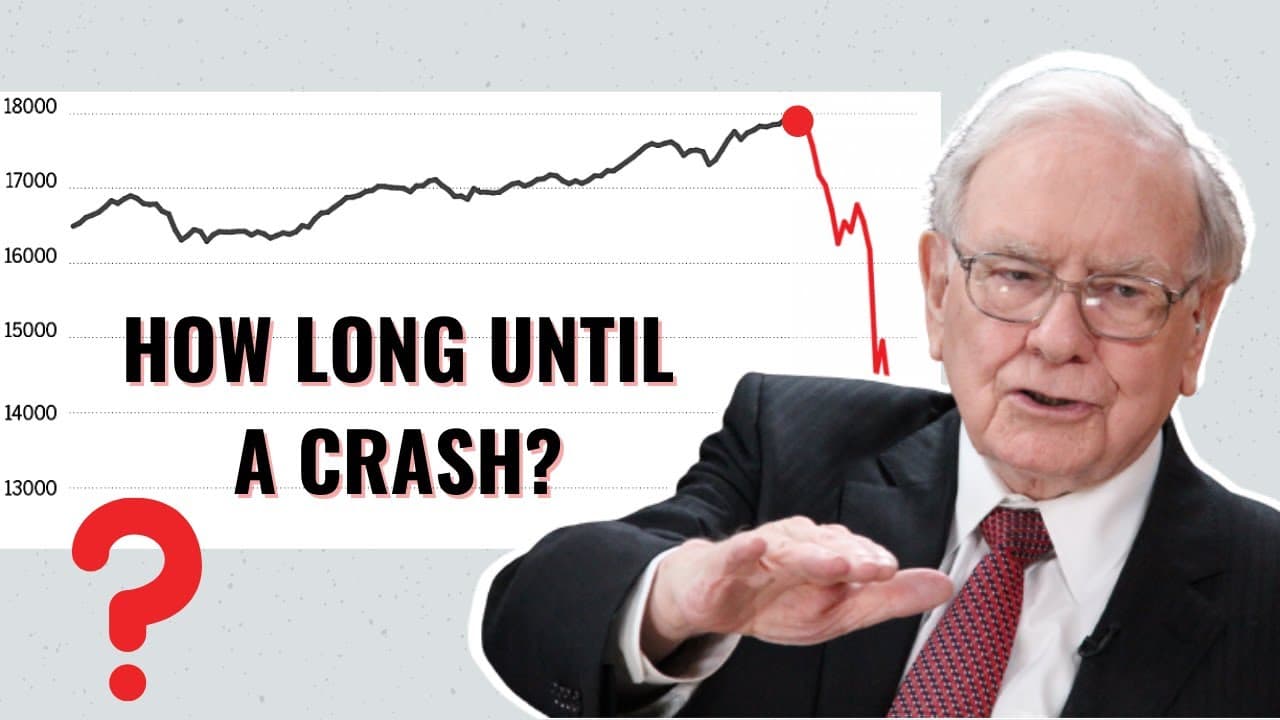
Warren Buffett: How Long Can This Stock Bubble Last? (2021)
TL;DR
A stock bubble can last a long time, and high valuations alone do not mean a crash is imminent. Buffett illustrates how irrational markets can persist by noting that the Dow moved only one point from 1964 to 1981, while investors swung between greed and fear. His core advice is to stay objective, resist following recent gains, and judge whether you would buy the underlying business. Read on for the reasoning behind that approach.
Transcript
it's no secret that stock prices have continued to hit all-time highs all three major american stock market indices the s p 500 the dow jones industrial average and the nasdaq all are at record highs that has led to some very prominent and highly respected people in the financial community calling the stock market a bubble and predicting a stock ma... Read More
Key Insights
- ✋ Stock valuations are currently high, but that doesn't mean they can't go even higher.
- 🥺 Investor behavior during bull markets can lead to overvalued stock prices.
- 👁️🗨️ Bubbles in the stock market can last for a long time, making predictions challenging.
- 🤩 Timing the market is difficult, so long-term investing is key.
- 💐 Lower interest rates increase investor willingness to pay for future cash flows, driving up stock prices.
- 🥺 Trying to predict short-term market movements is risky and can lead to missed opportunities.
- 🍉 Dollar-cost averaging and staying focused on the long term are effective investment strategies.
Install to Summarize YouTube Videos and Get Transcripts
Explore YouTube Video Summarizer or Get YouTube Transcript Extractor
Questions & Answers
Q: How long can a stock market bubble last?
Buffett says market conditions that do not make sense can continue for a long time, although they eventually end. As an illustration of prolonged market behavior, he notes that the Dow closed at 864 in 1964 and 865 at the end of 1981, moving only one point in 17 years.
Q: Why do investors push stock prices higher during bull markets?
Investors look at recent gains and expect to make even more, sometimes borrowing or buying because their neighbors profited. Buffett says this excitement causes people to keep entering the market and pushing prices upward without focusing on the underlying businesses.
Q: Does a highly valued stock market mean a crash is imminent?
No. The transcript says valuations may be high relative to historical norms without requiring an immediate crash. Prices can rise further or remain elevated for a long time.
Q: How does Warren Buffett describe investor behavior during market cycles?
Buffett says investors become excited when others are excited, greedy when others are greedy, and fearful when others are fearful. They often judge stocks by recent price performance rather than by what is happening in the underlying business.
Q: What temperament does Buffett believe successful investing requires?
Buffett says investors must remain objective and detach themselves temperamentally from the crowd. In his view, investing success does not require extraordinary intelligence as much as the ability to stay composed through huge market waves.
Q: What should investors consider before buying a rising stock?
Buffett suggests thinking objectively about whether you would buy the entire underlying business. A stock's recent rise or a neighbor's profit is not, by itself, a sound reason to invest.
Q: What example does Buffett give of investors rejecting cheap stocks?
Buffett recalls finding decent businesses trading at two times earnings when he began in 1950, yet people would not buy them. He also describes Kansas City Life trading below three times earnings while its insurance policies assumed two percent interest, but even a long-serving local agent dismissed the stock.
Q: What does Buffett identify as a clear example of a bubble?
He points to internet companies valued at many billions of dollars despite having, in his assessment, no real prospects of making money. He uses that example to show that unsustainable market conditions eventually come to an end.
Summary & Key Takeaways
-
Stock prices have hit all-time highs, leading some to believe a market crash is imminent.
-
Warren Buffett explains that investors often behave irrationally during bull markets, causing stock prices to become overvalued.
-
Buffett emphasizes that while stock valuations may be high, predicting market trends in the short term is difficult, and investors should focus on long-term investing strategies.
Read in Other Languages (beta)
Share This Summary 📚
Summarize YouTube Videos and Get Video Transcripts with 1-Click
Try YouTube Summary with ChatGPT & Claude or YouTube Transcript Generator
Explore More Summaries from Investor Center 📚


Summarize YouTube Videos and Get Video Transcripts with 1-Click
Try YouTube Summary with ChatGPT & Claude or YouTube Transcript Generator