How to Prove Matrix Multiplication Distributes Over Addition
TL;DR
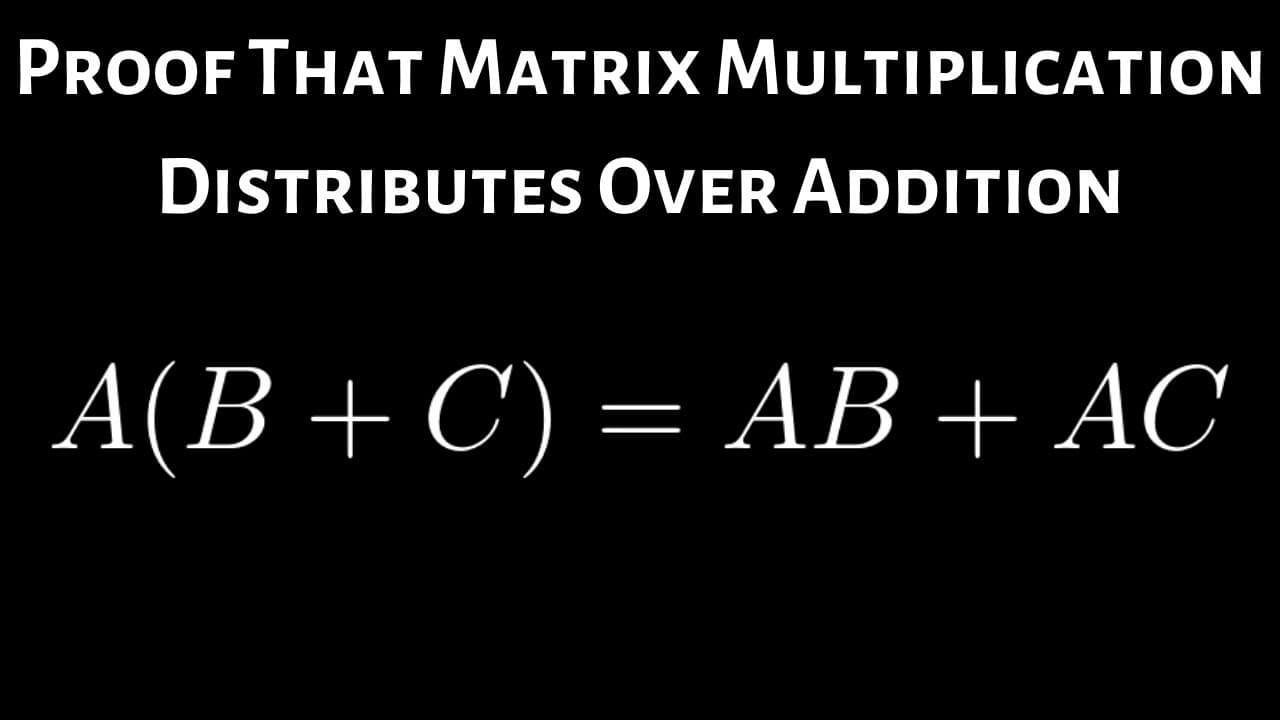
Matrix multiplication distributes over addition, meaning A(B + C) equals AB + AC. This is demonstrated by showing that both sides have identical entries through a systematic proof that utilizes matrix notation and the properties of dot products in matrices.
Transcript
let a b and c be m by m matrices we want to prove that a times b plus c is equal to a b plus ac so in order to do this we are going to show that this matrix here on the left has exactly the same entries as this matrix here on the right let's go ahead and go through the proof so in order to do this proof we need some notation so that we can identify... Read More
Key Insights
- 🪚 Matrix notation (a_ij, p_ij, c_ij) simplifies matrix entry identification.
- 🤨 Matrix multiplication involves dot product operations between rows and columns.
- 🏑 Distributive property of fields is used to simplify matrix computations.
- ❓ Equivalence proofs ensure accuracy in mathematical operations.
- ✋ Understanding matrix multiplication is fundamental in higher-level math.
- 🦻 Summation for matrix entries aids in determining equivalence.
- 🆘 Detailed proofs help in grasping complex mathematical concepts.
Install to Summarize YouTube Videos and Get Transcripts
Explore YouTube Video Summarizer or Get YouTube Transcript Extractor
Questions & Answers
Q: What does the ij entry of matrix (B + C) represent?
The ij entry of (B + C) is the sum of the ij entries of matrices B and C, representing the sum of corresponding elements.
Q: How is the ij entry of matrix (A * B) calculated?
The ij entry of (A * B) involves multiplying the ith row of matrix A with the jth column of matrix B, summing up the products.
Q: What is the significance of proving matrix equivalence?
Proving matrix equivalence ensures mathematical accuracy and consistency in operations involving matrices, essential in various mathematical applications.
Q: How does matrix multiplication demonstrate the distributive property?
Matrix multiplication showcases the distributive property by distributing a common element (A) across the sum of matrices B and C.
Summary & Key Takeaways
-
Matrix proof demonstrating equivalence in matrix multiplication.
-
Defined notation for matrix entries (a_ij, p_ij, c_ij).
-
Showed step-by-step calculation of (A * B) + C = A * B + A * C.
Read in Other Languages (beta)
Share This Summary 📚
Summarize YouTube Videos and Get Video Transcripts with 1-Click
Try YouTube Summary with ChatGPT & Claude or YouTube Transcript Generator
Explore More Summaries from The Math Sorcerer 📚


Summarize YouTube Videos and Get Video Transcripts with 1-Click
Try YouTube Summary with ChatGPT & Claude or YouTube Transcript Generator