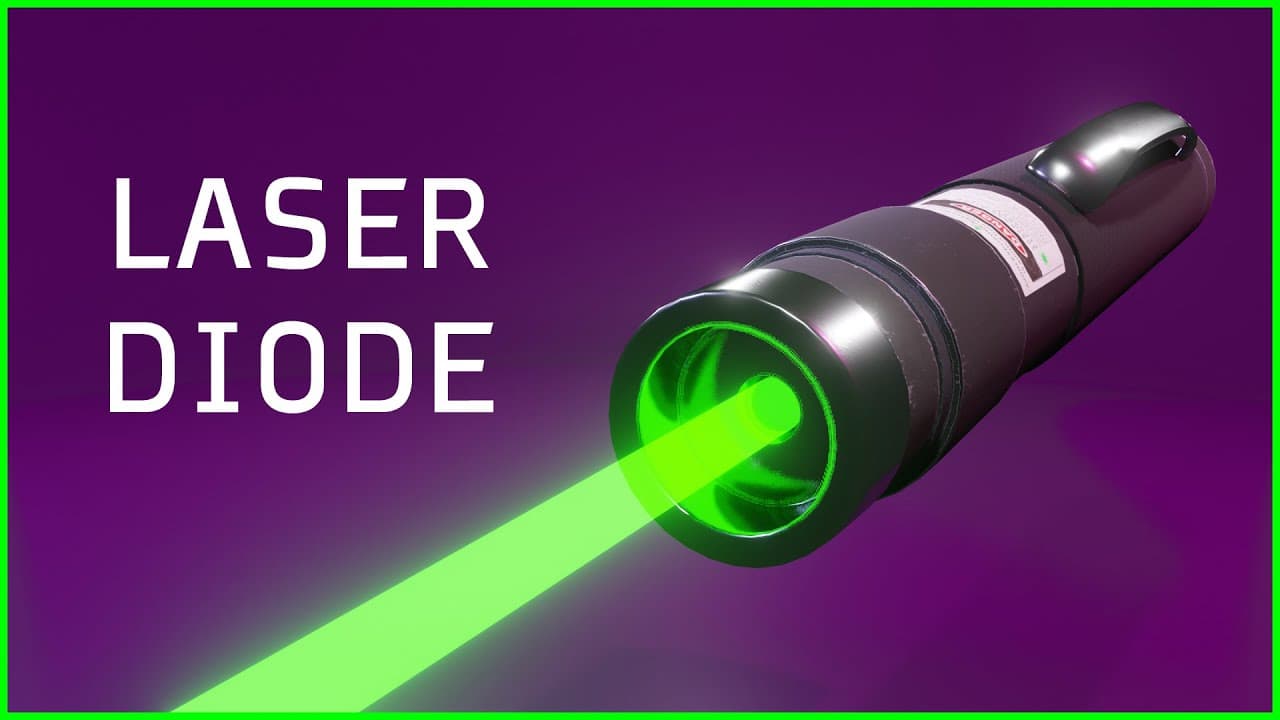
How a LASER DIODE Works ⚡What is a LASER DIODE
TL;DR
Laser diodes use stimulated emission to generate a coherent and focused beam of light, with applications in various industries.
Transcript
laser devices or light amplification by the stimulated emission of radiation are usually known for their spatial coherence which means concentrating a beam of light at a specific point which allows them to reach great distances however they also meet requirements that differentiate them from other light sources which mainly refer to the characteris... Read More
Key Insights
- 😘 Laser diodes are widely used due to their simplicity, low cost, and small size.
- 😁 The coherent beam generated by laser diodes finds applications in manufacturing, medical procedures, surface reconstruction, and autonomous vehicles.
- 🥵 Heat generation and imperfect collimation are limitations of laser diodes.
- 😁 Laser diodes utilize stimulated emission and resonators to amplify and produce a coherent beam of light.
- ❓ The distance between reflective coatings in a laser diode affects spatial and temporal coherence.
- 👋 Photons in lasers can be analyzed as both waves and particles.
- ❓ Laser diodes undergo spontaneous emission and stimulated emission to emit photons.
Install to Summarize YouTube Videos and Get Transcripts
Explore YouTube Video Summarizer or Get YouTube Transcript Extractor
Questions & Answers
Q: How do laser diodes differ from other light sources?
Laser diodes are spatially and temporally coherent, meaning the emitted photons have the same frequency and phase. This is unlike sunlight, which scatters in all directions with multiple frequencies and out-of-phase waves.
Q: What is the process of light emission in a laser diode?
When a laser diode is forward-biased, electrons pass from the n-type to the p-type semiconductor, resulting in recombination of electrons and gaps. This recombination releases photons through spontaneous emission.
Q: How does stimulated emission occur in laser diodes?
If a photon with the required energy passes through the recombination site, it induces stimulated emission, causing the electrons and gaps to recombine and generate a photon with the same properties as the initial photon.
Q: How do laser diodes achieve spatial and temporal coherence?
The distance between reflective coatings at each end of the semiconductor creates a Fabry-Perot resonator. Adjusting the distance to be a multiple of half the wavelength ensures that the photons create a standing wave, resulting in temporal coherence. A lens helps minimize spatial dispersion.
Key Insights:
- Laser diodes are widely used due to their simplicity, low cost, and small size.
- The coherent beam generated by laser diodes finds applications in manufacturing, medical procedures, surface reconstruction, and autonomous vehicles.
- Heat generation and imperfect collimation are limitations of laser diodes.
- Laser diodes utilize stimulated emission and resonators to amplify and produce a coherent beam of light.
- The distance between reflective coatings in a laser diode affects spatial and temporal coherence.
- Photons in lasers can be analyzed as both waves and particles.
- Laser diodes undergo spontaneous emission and stimulated emission to emit photons.
- The color and energy of light in lasers are determined by the frequency and wavelength of the photons.
Summary & Key Takeaways
-
Laser devices utilize spatial and temporal coherence to concentrate a beam of light at a specific point, allowing them to reach great distances.
-
Photons, the elementary particles responsible for the transport of electromagnetic waves, determine the color and energy of light.
-
Laser diodes, one of the most commonly used laser devices, rely on stimulated emission and a resonator to amplify and produce a coherent beam of light.
Read in Other Languages (beta)
Share This Summary 📚
Summarize YouTube Videos and Get Video Transcripts with 1-Click
Try YouTube Summary with ChatGPT & Claude or YouTube Transcript Generator
Explore More Summaries from VirtualBrain [ENG] 📚
Summarize YouTube Videos and Get Video Transcripts with 1-Click
Try YouTube Summary with ChatGPT & Claude or YouTube Transcript Generator