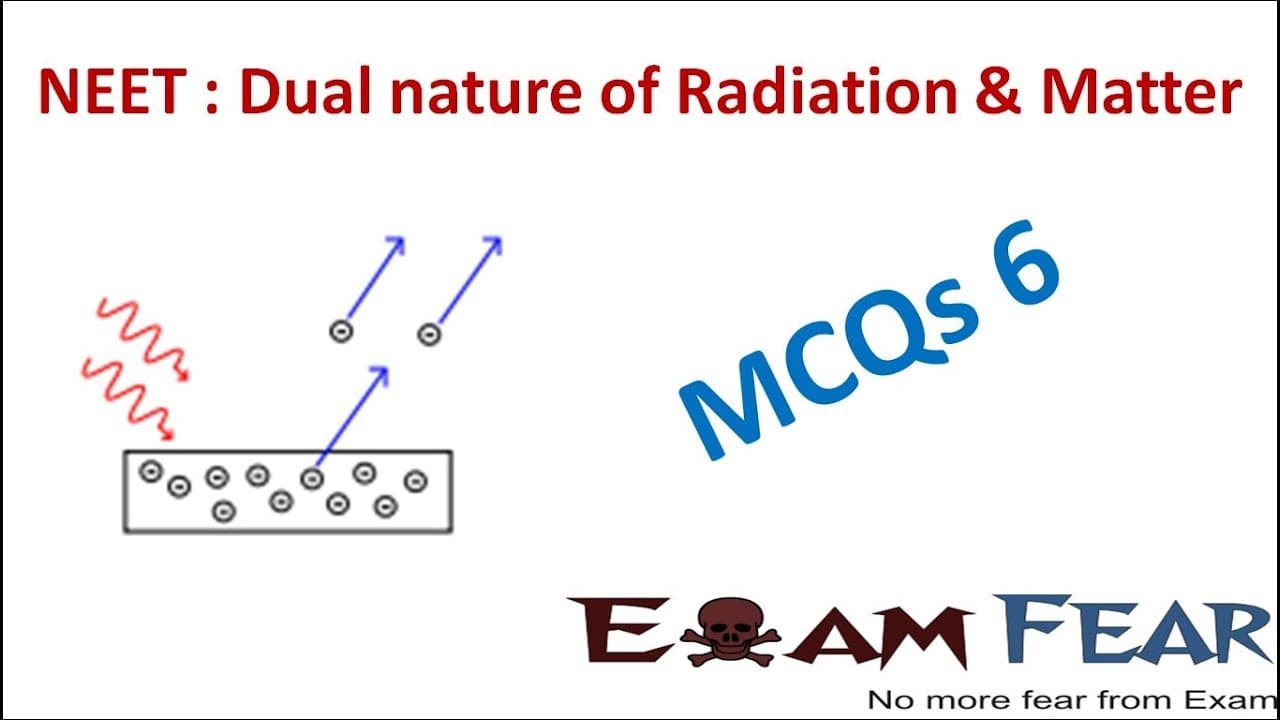
NEET Physics Dual Nature of Radiation and Matter : Multiple Choice Previous Years Questions MCQs 6
TL;DR
The video explains the concept of the dual nature of radiation and matter, focusing on the absorption and reflection of light. It also demonstrates how to calculate the force exerted on a surface and solve problems related to stopping potential and maximum kinetic energy of photoelectrons.
Transcript
Hello friends this video on neat dual nature of radiation and matter is brought to you by exam fear.com no more fear from exam question number 18 a beam of white light is incident normally on a plain surface absorbing 70% of the light and reflecting the rest if the incident beam carries 10 wat of power find the force exerted by it on the surface ok... Read More
Key Insights
- 🙂 Light can be both absorbed and reflected when incident on a surface.
- ✊ The absorbed power can be calculated by multiplying the percentage of light absorbed by the total power of the incident beam.
- 🛫 To find the force exerted on a surface, the rate of change of momentum needs to be calculated separately for the absorbed and reflected parts of the incident light.
- 💦 The threshold wavelength of a metal can be determined using the photoelectric equation, which relates the energy of the incident radiation to the work function and frequency.
- ⌛ The frequency of the incident radiation can be calculated by assessing the number of times the electric field becomes zero within one period.
Install to Summarize YouTube Videos and Get Transcripts
Explore YouTube Video Summarizer or Get YouTube Transcript Extractor
Questions & Answers
Q: How is the absorbed power of the incident light calculated in the scenario described in the video?
The absorbed power can be calculated by multiplying the percentage of light absorbed (70%) by the total power of the incident beam (10 watts). In this case, the absorbed power would be 7 joules per second.
Q: Why is it necessary to calculate the change in momentum separately for the absorbed and reflected parts of the incident light?
The change in momentum depends on the direction of light. In the absorbed part, the light is only striking the surface and not being reflected, while in the reflected part, the light is falling and getting reflected. Therefore, the net change in momentum is the sum of the changes in momentum for both parts.
Q: How is the threshold wavelength of a metal determined using the photoelectric equation?
The photoelectric equation, which relates the energy of the incident radiation to the work function and frequency (or wavelength), can be rearranged to solve for the wavelength. By substituting the given values into the equation and solving for the reciprocal of the wavelength, the threshold wavelength can be determined.
Q: How is the frequency of the incident radiation calculated when the video mentions the variation of the electric field becoming zero?
The video explains that the variation of the electric field becoming zero corresponds to the wave passing through zero two times within one period. Therefore, the number of times the electric field becomes zero within one period is divided by two to calculate the frequency. This frequency can then be used to calculate the maximum kinetic energy of the photoelectrons.
Summary & Key Takeaways
-
The video discusses a scenario where a beam of white light is incident on a surface, absorbing 70% of the light and reflecting the remaining. It explains how to calculate the absorbed power and the change in momentum for both the absorbed and reflected parts.
-
It then moves on to solving a problem involving the determination of the threshold wavelength for a metal plate exposed to a monochromatic beam of light.
-
The video concludes by explaining how to calculate the maximum kinetic energy of photoelectrons when a monochromatic beam of light with a given electric field falls on a metal surface with a specific work function.
Read in Other Languages (beta)
Share This Summary 📚
Summarize YouTube Videos and Get Video Transcripts with 1-Click
Try YouTube Summary with ChatGPT & Claude or YouTube Transcript Generator
Explore More Summaries from LearnoHub - Class 11, 12 📚

Summarize YouTube Videos and Get Video Transcripts with 1-Click
Try YouTube Summary with ChatGPT & Claude or YouTube Transcript Generator