Build production-ready AI Agents with Qdrant and n8n
TL;DR
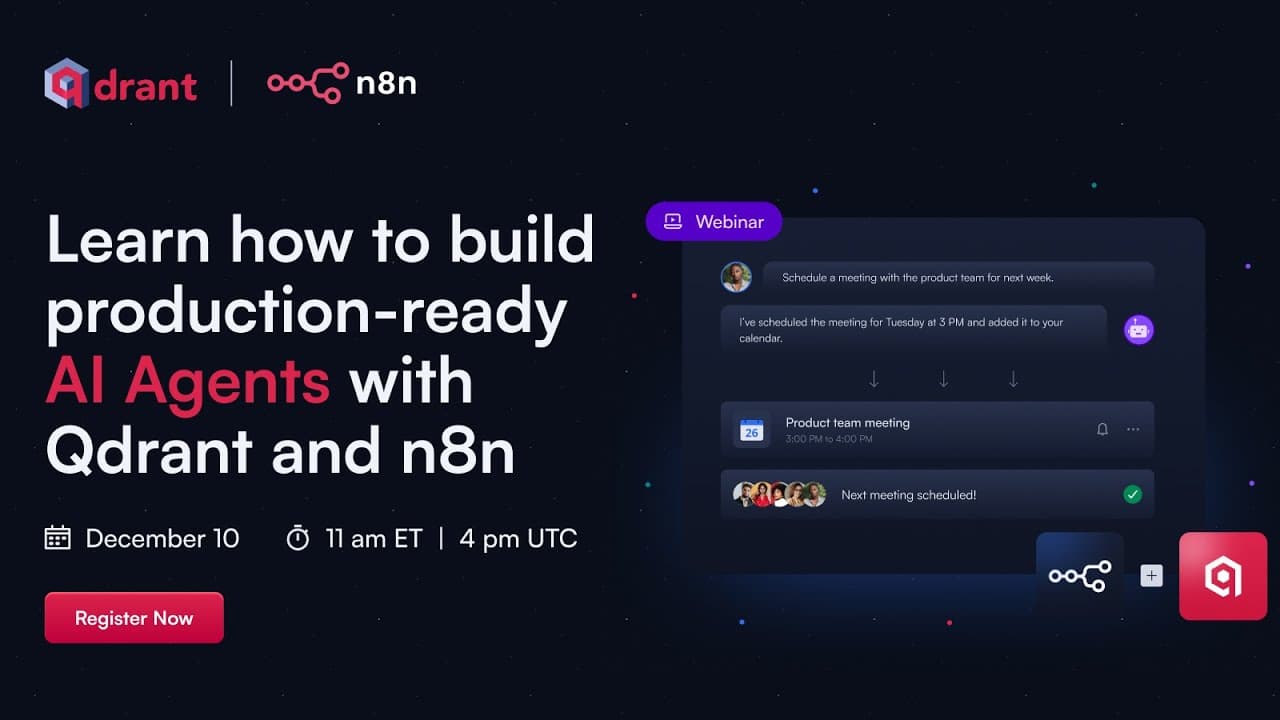
Learn to deploy AI agents using Qdrant and n8n for anomaly detection and classification.
Transcript
Max I want I want to have a bet with you how many people are going to watch us how many hundreds are you betting well at least one because I know my mom's gonna watch so a hi Max's mom so uh today we're having our webinar uh and it's a special webinar because I'm doing it with Max and I call him a che che che... Read More
Key Insights
- Qdrant and n8n enable the creation of production-ready AI agents by integrating vector databases with low-code automation platforms.
- AI agents can perform tasks beyond similarity search, like anomaly detection and classification, useful for scenarios with limited labels.
- Vector databases store vectorized data, enabling similarity and diversity searches, anomaly detection, and more.
- Embedding models convert data into vectors, which are stored in vector databases for efficient querying and analysis.
- n8n's low-code platform allows for the creation of workflows that integrate various AI tools and processes seamlessly.
- AI agents can be used to analyze satellite images for anomaly detection, such as identifying new structures or changes over time.
- The integration of AI agents with vector databases allows for scalable and efficient processing of large datasets.
- AI agents can automate complex tasks, reducing the need for manual intervention and enabling faster decision-making processes.
Install to Summarize YouTube Videos and Get Transcripts
Explore YouTube Video Summarizer or Get YouTube Transcript Extractor
Questions & Answers
Q: What are the main tools used in the webinar?
The main tools used in the webinar are Qdrant, a vector database, and n8n, a low-code workflow automation platform. Qdrant is used for storing and querying vectorized data, while n8n provides a platform for building and deploying AI agents by integrating various tools and processes.
Q: How do AI agents perform anomaly detection?
AI agents perform anomaly detection by analyzing vectorized data stored in vector databases. By using embedding models, data is converted into vectors, which are then queried to identify anomalies based on their similarity or dissimilarity to known data points. This process is facilitated by the integration of Qdrant and n8n.
Q: What is the role of vector databases in AI agent workflows?
Vector databases play a crucial role in AI agent workflows by storing vectorized data, enabling efficient querying and analysis. They allow AI agents to perform tasks such as similarity and diversity searches, anomaly detection, and classification. This enhances the capabilities of AI agents, making them more versatile and scalable.
Q: How does n8n facilitate the deployment of AI agents?
n8n facilitates the deployment of AI agents by providing a low-code platform for building and automating workflows. It allows for the seamless integration of various AI tools and processes, enabling users to create complex AI agent workflows without extensive coding knowledge. This makes it easier to deploy AI agents in production environments.
Q: What are some practical use cases demonstrated in the webinar?
Some practical use cases demonstrated in the webinar include anomaly detection in satellite images, where AI agents identify changes or new structures over time. This showcases the ability of AI agents to handle large datasets and perform complex analysis tasks efficiently. The session also highlights the potential for AI agents in various industries, such as agriculture and environmental monitoring.
Q: How do embedding models contribute to the AI agent's capabilities?
Embedding models contribute to the AI agent's capabilities by converting data into vectors, which are then stored in vector databases. This vectorization process allows AI agents to perform similarity and diversity searches, anomaly detection, and classification. Embedding models enable AI agents to handle various data types, such as images, text, and audio, enhancing their versatility.
Q: What challenges are addressed when making AI agents production-ready?
The challenges addressed when making AI agents production-ready include ensuring consistent output from large language models (LLMs), integrating tools seamlessly with AI agents, and managing agentic pipelines. The webinar demonstrates how to overcome these challenges using Qdrant's vector database and n8n's low-code platform, enabling the deployment of scalable and efficient AI agents.
Q: What benefits do AI agents offer when combined with vector databases?
When combined with vector databases, AI agents offer benefits such as enhanced scalability, efficient processing of large datasets, and the ability to perform complex tasks like anomaly detection and classification. Vector databases enable AI agents to store and query vectorized data, facilitating tasks beyond similarity search and making AI agents more versatile and capable of handling diverse use cases.
Summary & Key Takeaways
-
In this webinar, experts demonstrate how to build and deploy AI agents using Qdrant's vector database and n8n's low-code platform. The focus is on enabling AI agents to perform anomaly detection and classification tasks efficiently.
-
Qdrant's vector databases are used to store and query vectorized data, allowing AI agents to perform tasks beyond similarity search. n8n's platform provides a low-code environment for integrating various AI tools and automating workflows.
-
The session showcases practical use cases, such as analyzing satellite images for changes over time, highlighting the versatility and scalability of AI agents when combined with vector databases and low-code automation platforms.
Read in Other Languages (beta)
Share This Summary 📚
Summarize YouTube Videos and Get Video Transcripts with 1-Click
Try YouTube Summary with ChatGPT & Claude or YouTube Transcript Generator