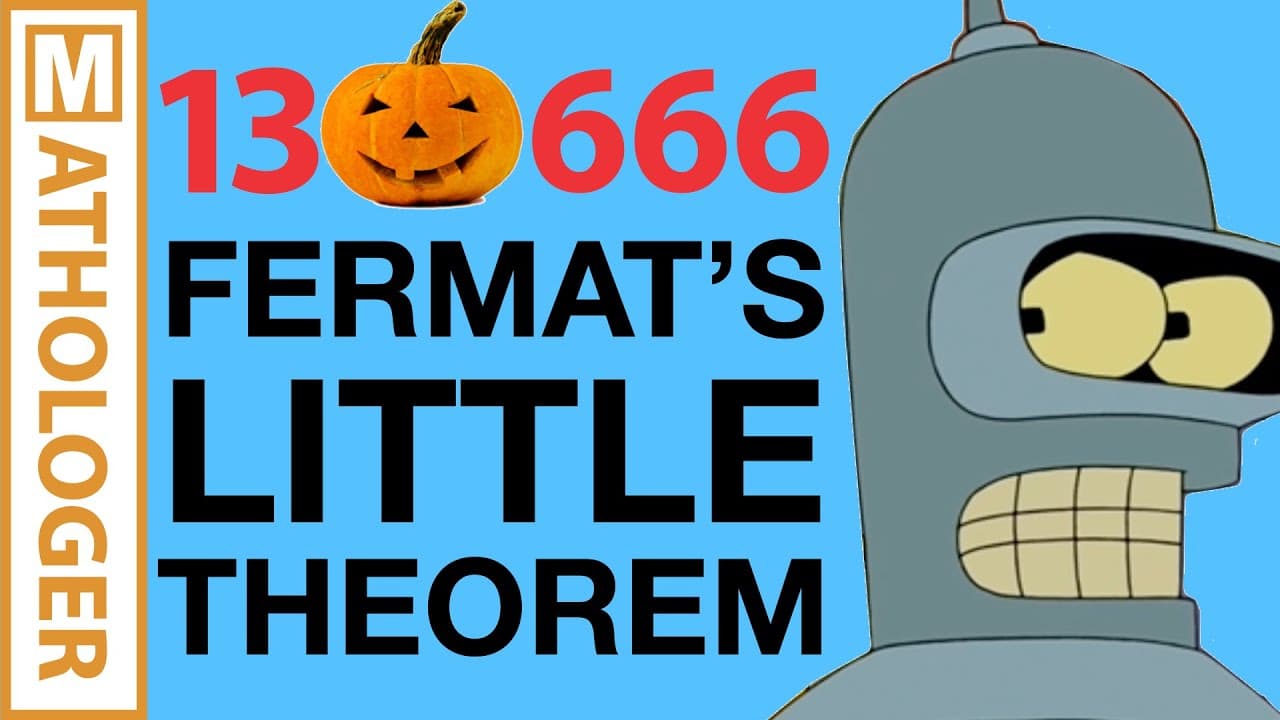
Fermat’s HUGE little theorem, pseudoprimes and Futurama
TL;DR
Discover Fermat's Little Theorem, its proof, and its applications in identifying prime numbers and solving mathematical problems.
Transcript
Welcome to a special Halloween edition of Mathologer. Recently I did a video on Fermat's mega famous Last Theorem Fermat's theorem says that the pretty Pythagorean integer identities like 3 squared plus 4 squared equals 5 squared or 5 squared plus 12 squared equals 13 squared don't have nontrivial counterparts if the exponent 2 is replaced by any i... Read More
Key Insights
- ✊ Fermat's Little Theorem states that for any prime number and positive integer, the prime must divide the difference of the integer raised to the power of the prime minus the integer.
- 🔄 The proof of Fermat's Little Theorem involves counting the number of necklaces with different colors and lengths, providing a unique approach to understanding the theorem.
- 💳 The theorem has practical applications in identifying prime numbers, particularly in generating large primes for encryption algorithms used in credit card transactions.
- 🤙 However, there are exceptions called Fermat pseudoprimes or Carmichael numbers, which cannot be easily distinguished from primes using the theorem.
Install to Summarize YouTube Videos and Get Transcripts
Explore YouTube Video Summarizer or Get YouTube Transcript Extractor
Questions & Answers
Q: What is Fermat's Little Theorem?
Fermat's Little Theorem states that for any prime number and positive integer, the prime must divide the difference of the integer raised to the power of the prime minus the integer.
Q: How is Fermat's Little Theorem proved?
The proof involves counting the number of necklaces with a certain length and various colors, showing that the total count can be expressed as a fractional power of the prime.
Q: How is Fermat's Little Theorem used to identify prime numbers?
By testing divisibility using the theorem, if the difference is not divisible by the given integer, then it is not prime. However, there are exceptions called Fermat pseudoprimes or Carmichael numbers, which cannot be easily distinguished from primes using the theorem.
Q: What are the practical applications of Fermat's Little Theorem?
One practical application is in identifying large prime numbers for encryption algorithms used in credit card transactions. Additionally, the theorem can be used to solve mathematical problems, such as finding remainders of large numbers when divided by primes.
Summary & Key Takeaways
-
Fermat's Little Theorem states that for any prime number and positive integer, the prime must divide the difference of the integer raised to the power of the prime minus the integer.
-
The theorem's proof involves counting the number of necklaces with a certain length and various colors, demonstrating that the total count can be expressed as a fractional power of the prime.
-
One application of Fermat's Little Theorem is in identifying prime numbers, as testing divisibility by an integer can indicate whether or not the number is prime.
-
However, there are exceptions called Fermat pseudoprimes or Carmichael numbers, which cannot be easily distinguished from primes using the theorem.
Read in Other Languages (beta)
Share This Summary 📚
Summarize YouTube Videos and Get Video Transcripts with 1-Click
Try YouTube Summary with ChatGPT & Claude or YouTube Transcript Generator
Explore More Summaries from Mathologer 📚
Summarize YouTube Videos and Get Video Transcripts with 1-Click
Try YouTube Summary with ChatGPT & Claude or YouTube Transcript Generator