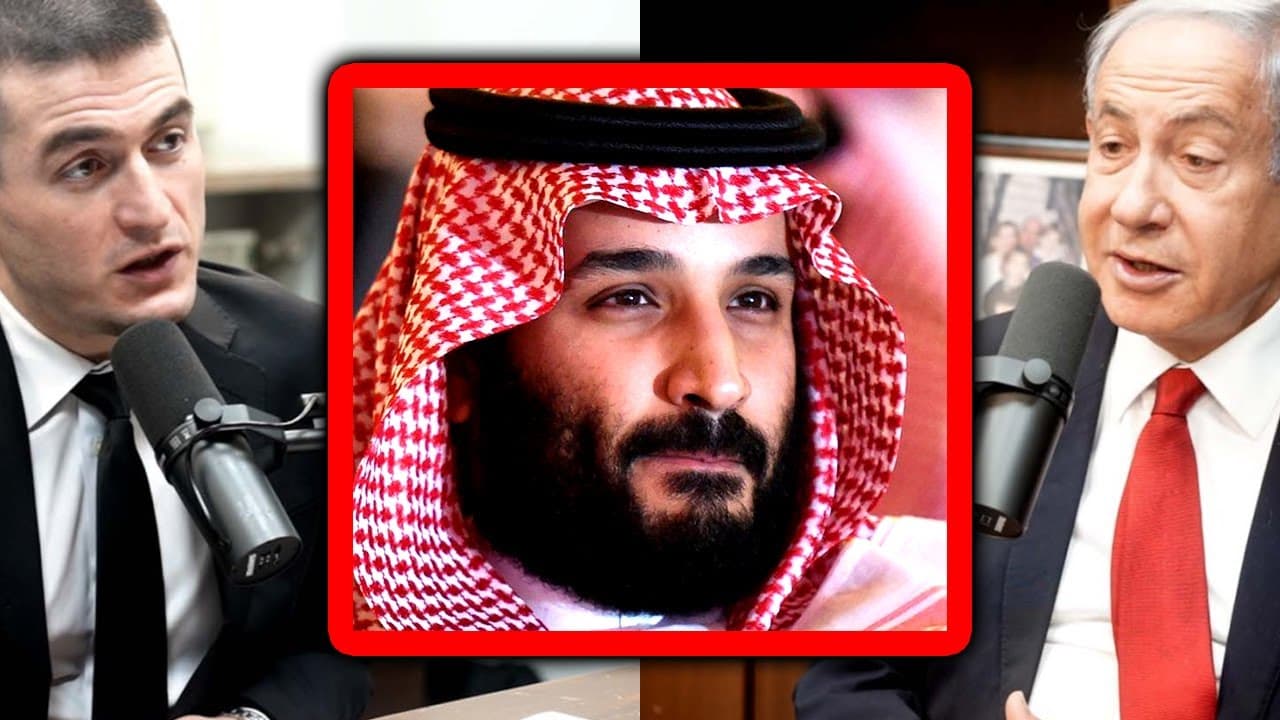
Benjamin Netanyahu on Mohammed bin Salman | Lex Fridman Podcast Clips
TL;DR
Israel has pursued a different approach to foster peace by forging historic peace accords with Arab countries, with the aim of persuading Saudi Arabia to join in through secret negotiations.
Transcript
I decided to go directly to the Arab capitals and to make the historic Abraham Accords uh and essentially uh reversing the equation not a peace process that goes inside out but outside in and we went directly to the uh the uh these countries and forged these uh these breakthrough Peace Accords with the United Arab Emirates with Bahrain with Morocco... Read More
Key Insights
- 💨 The Abraham Accords have paved the way for historic peace agreements between Israel and Arab nations like the UAE, Bahrain, Morocco, and Sudan.
- ✌️ Prime Minister Netanyahu proposes an alternative approach to peace by prioritizing Arab-Israeli relations before addressing the Israeli-Palestinian conflict.
- 🤗 Secret negotiations are seen as a more effective means of achieving peace, as open discussions may hinder progress.
- 〽️ Expanding the circle of peace to more Arab nations may contribute to a resolution of the Israeli-Palestinian conflict by altering regional dynamics and reducing hopes for Israel's destruction.
Install to Summarize YouTube Videos and Get Transcripts
Explore YouTube Video Summarizer or Get YouTube Transcript Extractor
Questions & Answers
Q: How has Israel approached peace with Arab countries?
Israel has taken an innovative approach by directly engaging with Arab capitals and forging peace accords with countries like the UAE, Bahrain, Morocco, and Sudan. This strategy aims to create a regional framework for peace.
Q: Why does Prime Minister Netanyahu believe that waiting for the Palestinian issue to be resolved is not the right approach?
Netanyahu argues that the assumption of eventual Arab assistance in destroying Israel creates an obstacle to peace. By first resolving the conflict between Israel and the Arab states, the hope for the destruction of Israel diminishes, making a realistic compromise more likely.
Q: Why does Netanyahu emphasize secret negotiations with Saudi Arabia?
Netanyahu believes that openly discussing a Saudi-Israeli peace will not be productive. Instead, discreet talks enable leaders to engage candidly, making it more likely to reach a mutually beneficial agreement without public scrutiny.
Q: How does expanding the circle of peace contribute to the Israeli-Palestinian conflict resolution?
Expanding peace to more Arab countries brings a conceptual change and a shift in regional dynamics. It creates an environment that may ultimately lead to an Israeli-Palestinian peace agreement by circling back to address the unresolved issues through a more favorable and comprehensive regional perspective.
Summary & Key Takeaways
-
Israel has pursued a unique approach to peace by directly engaging with Arab capitals and forging peace accords with the United Arab Emirates, Bahrain, Morocco, and Sudan.
-
Prime Minister Netanyahu believes that waiting for the Palestinian issue to be resolved before engaging with other Arab countries will lead to failure, and instead proposes resolving the conflict between Israel and the Arab world first.
-
Netanyahu emphasizes the need for secret negotiations with Saudi Arabia and believes that expanding the circle of peace will lead to a more realistic compromise and eventual Arab-Israeli peace.
Read in Other Languages (beta)
Share This Summary 📚
Summarize YouTube Videos and Get Video Transcripts with 1-Click
Try YouTube Summary with ChatGPT & Claude or YouTube Transcript Generator
Explore More Summaries from Lex Clips 📚




Summarize YouTube Videos and Get Video Transcripts with 1-Click
Try YouTube Summary with ChatGPT & Claude or YouTube Transcript Generator