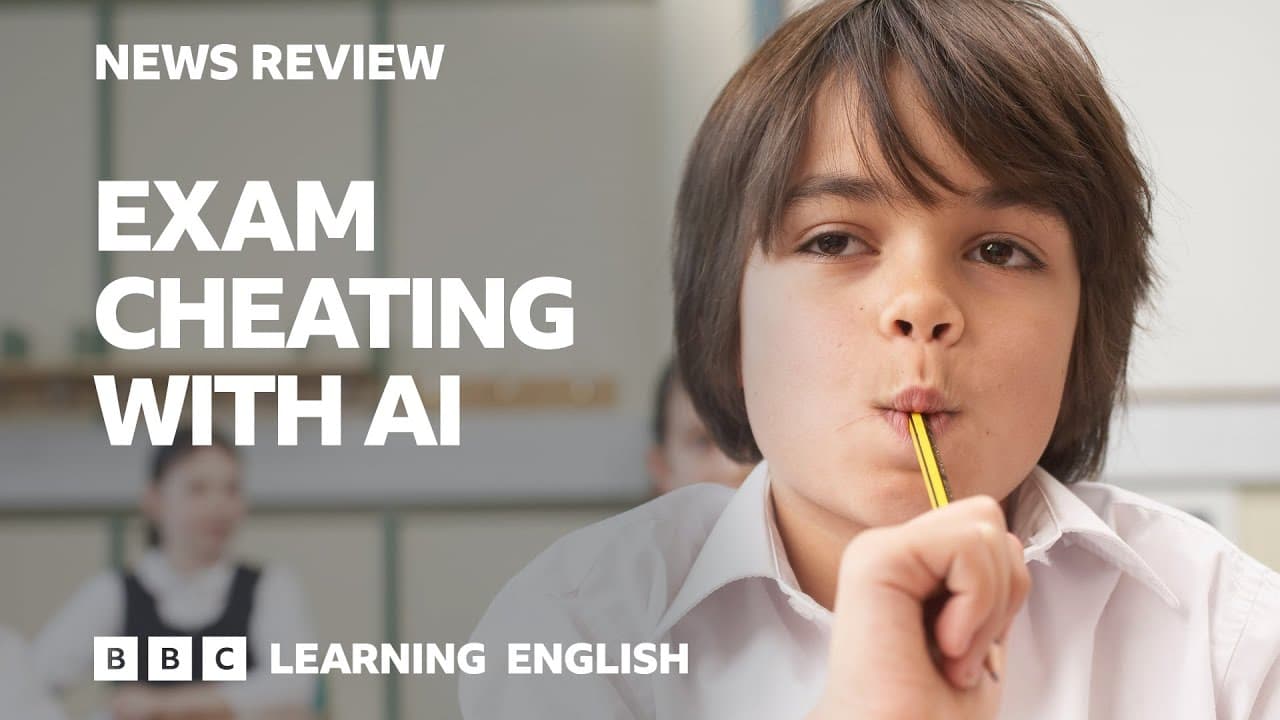
Exam cheating with AI: BBC News Review
TL;DR
AI might increase exam cheating, worrying educators.
Transcript
Will artificial intelligence lead to a rise in exam cheating? This is News Review from BBC Learning English. I'm Beth. And I'm Phil. Make sure you watch to the end to learn all the vocabulary you need to talk about this topic. And remember: subscribe to our channel, like this video, and try the quiz on our website. Now, today's story: Could cheatin... Read More
Key Insights
- AI apps like ChatGPT can generate human-like text, raising concerns about their potential use in exam cheating, making it difficult to distinguish between student and computer-generated work.
- The term 'fuelling' is used to describe how AI apps are encouraging plagiarism by making it easier for students to cheat on exams.
- Teachers in the UK are 'desperate for help' in dealing with AI's potential to write entire essays for students, indicating a strong need for guidance and solutions.
- The phrase 'dark ages' is used metaphorically to suggest that the current exam system is outdated and needs modernization in response to AI advancements.
- Some experts view the rise of AI in education as a positive development, potentially forcing necessary updates to traditional exam systems.
- The BBC Learning English segment aims to teach viewers the vocabulary needed to discuss AI's impact on education, using real-world examples to illustrate key terms.
- The discussion includes how AI is seen as both a challenge and an opportunity, highlighting different perspectives on its role in education.
- The content encourages viewers to engage with the topic by participating in quizzes and further exploring related educational materials on the BBC Learning English platform.
Install to Summarize YouTube Videos and Get Transcripts
Explore YouTube Video Summarizer or Get YouTube Transcript Extractor
Questions & Answers
Q: How might AI apps like ChatGPT affect exam integrity?
AI apps like ChatGPT can generate human-like text, which may lead to an increase in exam cheating. Educators are concerned that it will become difficult to distinguish between student-written work and text produced by AI, potentially compromising the integrity of exams and assessments.
Q: What does the term 'fuelling' imply in the context of AI and exams?
In this context, 'fuelling' refers to how AI apps are facilitating or encouraging plagiarism by making it easier for students to cheat. The term suggests that AI is actively contributing to the problem of academic dishonesty by providing tools that can generate text indistinguishable from student work.
Q: Why are teachers 'desperate for help' concerning AI in education?
Teachers are 'desperate for help' because they face challenges in managing AI's impact on education, particularly its ability to write entire essays for students. This creates a strong demand for guidance and solutions to ensure that students' work remains genuine and that academic standards are upheld.
Q: How is the phrase 'dark ages' used in relation to exams?
The phrase 'dark ages' is used metaphorically to suggest that the current exam system is outdated and needs modernization. It implies that traditional exam practices are antiquated and that AI advancements might force a necessary update to bring these systems into the modern era.
Q: What positive perspective do some experts have on AI in education?
Some experts view AI's role in education as a positive development because it could compel the educational system to modernize. By challenging traditional methods, AI may drive innovation and improvements in how exams and assessments are conducted, potentially leading to more effective educational practices.
Q: What vocabulary does the BBC News Review teach regarding AI and education?
The BBC News Review teaches vocabulary such as 'fuelling', 'desperate for', and 'dark ages'. These terms are explained with examples to help viewers discuss AI's impact on education, providing them with the language needed to articulate the challenges and opportunities AI presents in this context.
Q: How does the segment encourage viewer engagement with the topic?
The segment encourages viewer engagement by inviting them to participate in quizzes and explore additional educational materials on the BBC Learning English platform. This interactive approach aims to deepen understanding and facilitate further discussion on AI's impact on education, enhancing the learning experience.
Q: What is the dual nature of AI's role in education as presented in the segment?
The segment presents AI's role in education as both a challenge and an opportunity. While AI poses risks to exam integrity through potential cheating, it also offers a chance to modernize outdated educational practices. This dual nature sparks debate and encourages exploration of how best to integrate AI into education.
Summary & Key Takeaways
-
The BBC News Review discusses the potential for AI apps like ChatGPT to increase exam cheating, worrying educators who find it hard to distinguish between student and computer-generated text. Key vocabulary includes 'fuelling', 'desperate for', and 'dark ages', each explained with examples.
-
Teachers in the UK express a strong need for support in managing AI's role in education, as the technology can write complete essays for students. This has sparked debate over whether AI might force the educational system to modernize outdated exam practices.
-
The segment provides vocabulary to discuss AI's impact on education, using examples to illustrate terms like 'fuelling' and 'dark ages'. It presents AI as both a challenge and an opportunity, encouraging viewers to explore the topic through quizzes and additional resources.
Read in Other Languages (beta)
Share This Summary 📚
Summarize YouTube Videos and Get Video Transcripts with 1-Click
Try YouTube Summary with ChatGPT & Claude or YouTube Transcript Generator
Explore More Summaries from BBC Learning English 📚

Summarize YouTube Videos and Get Video Transcripts with 1-Click
Try YouTube Summary with ChatGPT & Claude or YouTube Transcript Generator