What Are Imine and Enamine Formation Reactions?
TL;DR
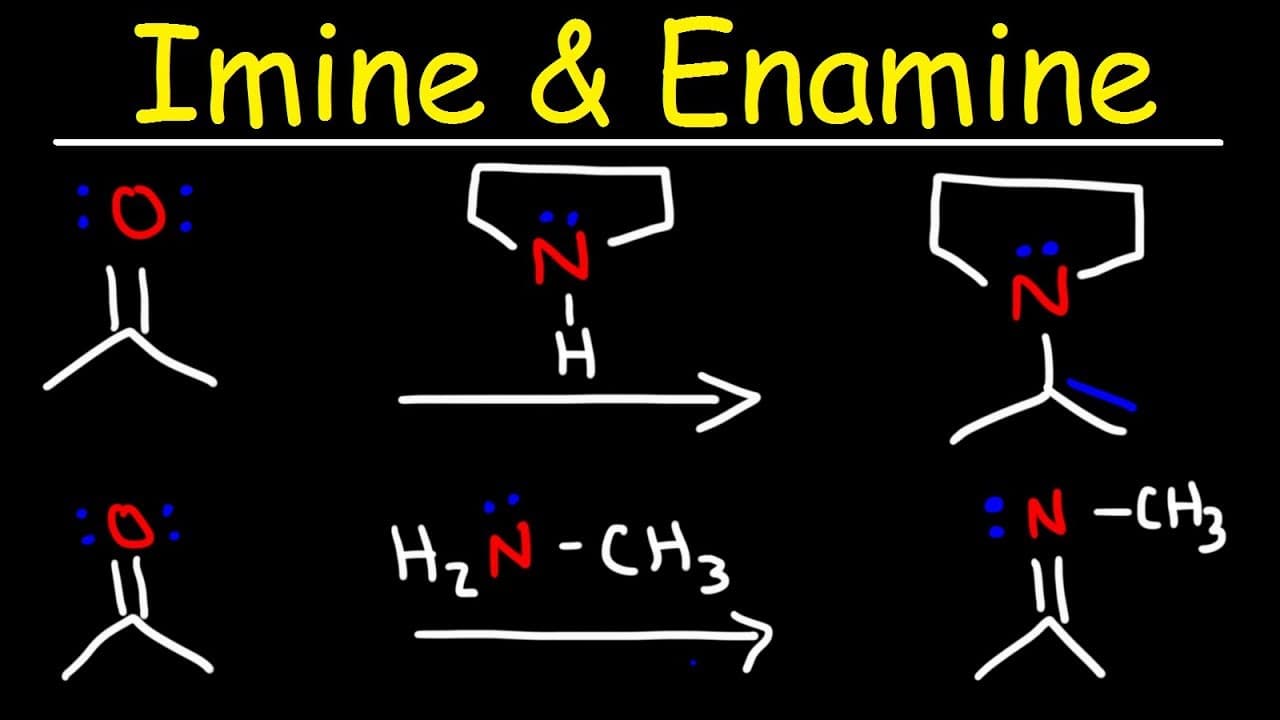
Imine formation occurs when a ketone reacts with a primary amine, resulting in the elimination of water. Enamines are formed by reacting a ketone with a secondary amine, placing the double bond on the more substituted side for stability. Both imines and enamines can be reduced to amines through reductive amination using sodium cyanoborohydride.
Transcript
in this video we're going to go over the formation of an enamine and an enemy so let's start with a ketone if we react a ketone with let's say a primary amine it's going to give us the immune product and to draw it all you need to do is remove water so if you take out h2o and then connect the remaining parts you're going to get an amine which looks... Read More
Key Insights
- 💁 Ketones react with primary amines to form imines and with secondary amines to form enamines.
- ⏫ The double bond in an enamine is preferred to be on the more substituted side for stability.
- ❓ Reductive amination using sodium cyanoborohydride can convert imine into amine.
- ❓ Enamines can also be reduced into tertiary amines using the same reductive amination process.
- 👊 The formation of imines and enamines involves protonation and nucleophilic attack.
- 😥 Preferred reaction conditions for imine formation are mildly acidic, around pH 4 to 5.
- 💁 Ammonia or other weak bases can be used in the imine formation mechanism.
Install to Summarize YouTube Videos and Get Transcripts
Explore YouTube Video Summarizer or Get YouTube Transcript Extractor
Questions & Answers
Q: What is the difference between an imine and an enamine?
An imine is formed when a ketone reacts with a primary amine, while an enamine is formed when a ketone reacts with a secondary amine. The main difference is the position of the double bond.
Q: How can an imine be reduced into an amine?
Imine can be reduced through reductive amination using sodium cyanoborohydride. This process adds hydrogen to the nitrogen and carbon atoms, converting the double bond into a single bond.
Q: Can an enamine be reduced into an amine?
Yes, an enamine can be reduced into a tertiary amine through reductive amination. Sodium cyanoborohydride is used to add hydrogen to the double bond, converting it into a single bond.
Q: What are the preferred reaction conditions for the formation of an imine?
The formation of an imine is favorable under mildly acidic conditions, with a pH around 4 to 5. Protonation and nucleophilic attack by ammonia or another weak base are involved in the mechanism.
Summary & Key Takeaways
-
A ketone reacts with a primary amine to form an imine by removing water.
-
Reacting a ketone with a secondary amine gives an enamine, with the double bond on the more substituted side.
-
Imine can be reduced into an amine through reductive amination using sodium cyanoborohydride.
-
Enamines can also be reduced into tertiary amines using the same reductive amination process.
Read in Other Languages (beta)
Share This Summary 📚
Summarize YouTube Videos and Get Video Transcripts with 1-Click
Try YouTube Summary with ChatGPT & Claude or YouTube Transcript Generator
Explore More Summaries from The Organic Chemistry Tutor 📚



Summarize YouTube Videos and Get Video Transcripts with 1-Click
Try YouTube Summary with ChatGPT & Claude or YouTube Transcript Generator