What's At The End Of The Universe?
TL;DR
The universe began with the Big Bang, expanding from a tiny point to its current vast state, supported by evidence like cosmic microwave background radiation.
Transcript
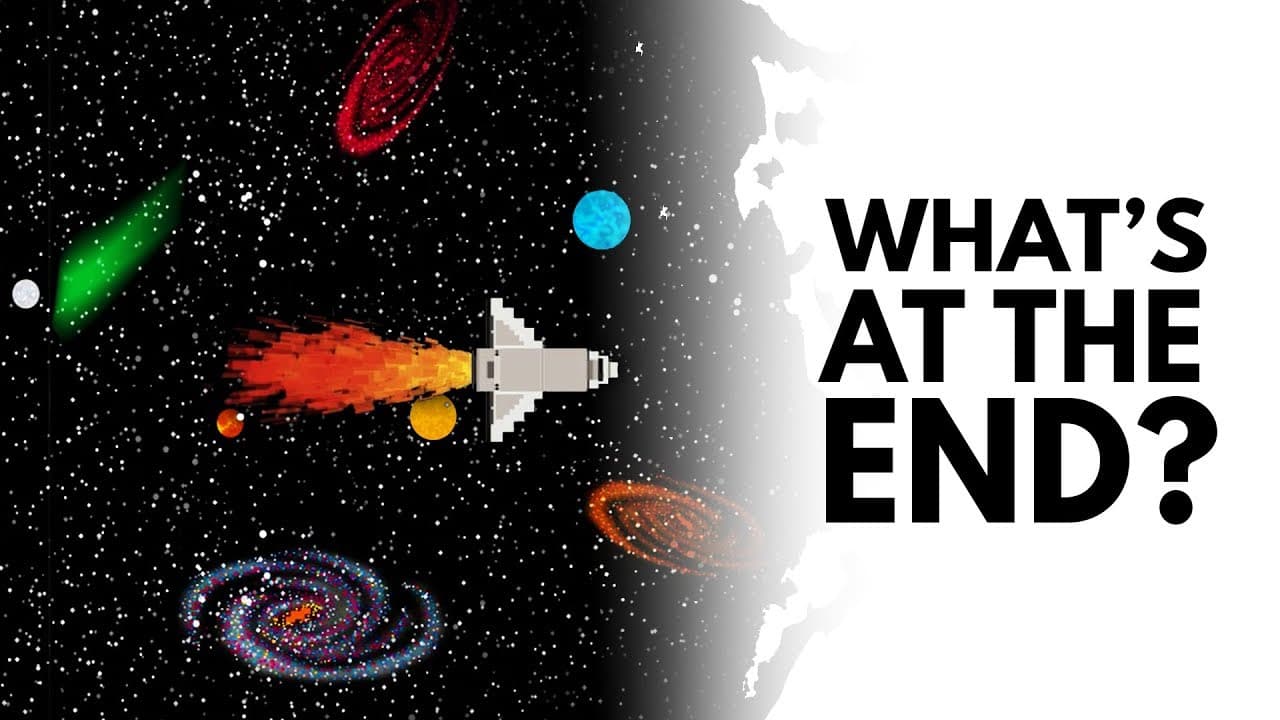
Hey there and welcome to Life Noggin. Just the other day, I was exploring my world with Triangle Bob and we found a place my animator forgot to design. The end of my world is just a big, scary cliff to nowhere! But you can float around so it's kinda cool. It did have me wondering though, what’s at the end of /your/ universe? If we want to know what... Read More
Key Insights
- 😥 The Big Bang Theory suggests the universe originated from a dense point and expanded.
- ❓ Edwin Hubble's observations of galaxies moving apart supported the concept of an expanding universe.
- 😅 Cosmic microwave background radiation serves as evidence for the hot, early universe predicted by the Big Bang Theory.
- 🐎 The universe's ongoing expansion at increasing speeds poses challenges in determining its ultimate fate.
- 👨🔬 Research missions like NASA's Cosmic Background Explorer have provided valuable insights into the universe's origins.
- 😥 The uniformity of cosmic microwave background radiation supports the idea of a singular origin point.
- ❤️🩹 The universe's endless expansion may prevent us from ever reaching its hypothetical end.
Install to Summarize YouTube Videos and Get Transcripts
Explore YouTube Video Summarizer or Get YouTube Transcript Extractor
Questions & Answers
Q: What is the Big Bang Theory and how does it explain the origin of the universe?
The Big Bang Theory posits that the universe began as a tiny, hot point that rapidly expanded, leading to the formation of stars, galaxies, and all matter.
Q: How did Edwin Hubble's observations contribute to the acceptance of the Big Bang Theory?
Hubble observed galaxies moving away from each other, indicating an expanding universe and supporting the idea that everything was once closer together, aligning with the Big Bang Theory.
Q: What role does cosmic microwave background radiation play in understanding the universe's origins?
The discovery of CMB radiation, a remnant of the early hot universe that has cooled to near absolute zero, supports the Big Bang Theory by providing evidence of the universe's past state.
Q: Why is it challenging to ascertain what lies at the end of the universe?
The universe's accelerating expansion at speeds faster than light makes it impossible to determine what lies at its end, leaving the ultimate fate of the universe uncertain.
Summary & Key Takeaways
-
The Big Bang Theory, proposed in the 1920s, suggests the universe started small and expanded to its current size.
-
Edwin Hubble's observation of galaxies moving away from each other supports the theory of an expanding universe.
-
Cosmic microwave background radiation and uniformity provide additional evidence for the Big Bang Theory.
Read in Other Languages (beta)
Share This Summary 📚
Summarize YouTube Videos and Get Video Transcripts with 1-Click
Try YouTube Summary with ChatGPT & Claude or YouTube Transcript Generator
Explore More Summaries from Life Noggin 📚

Summarize YouTube Videos and Get Video Transcripts with 1-Click
Try YouTube Summary with ChatGPT & Claude or YouTube Transcript Generator