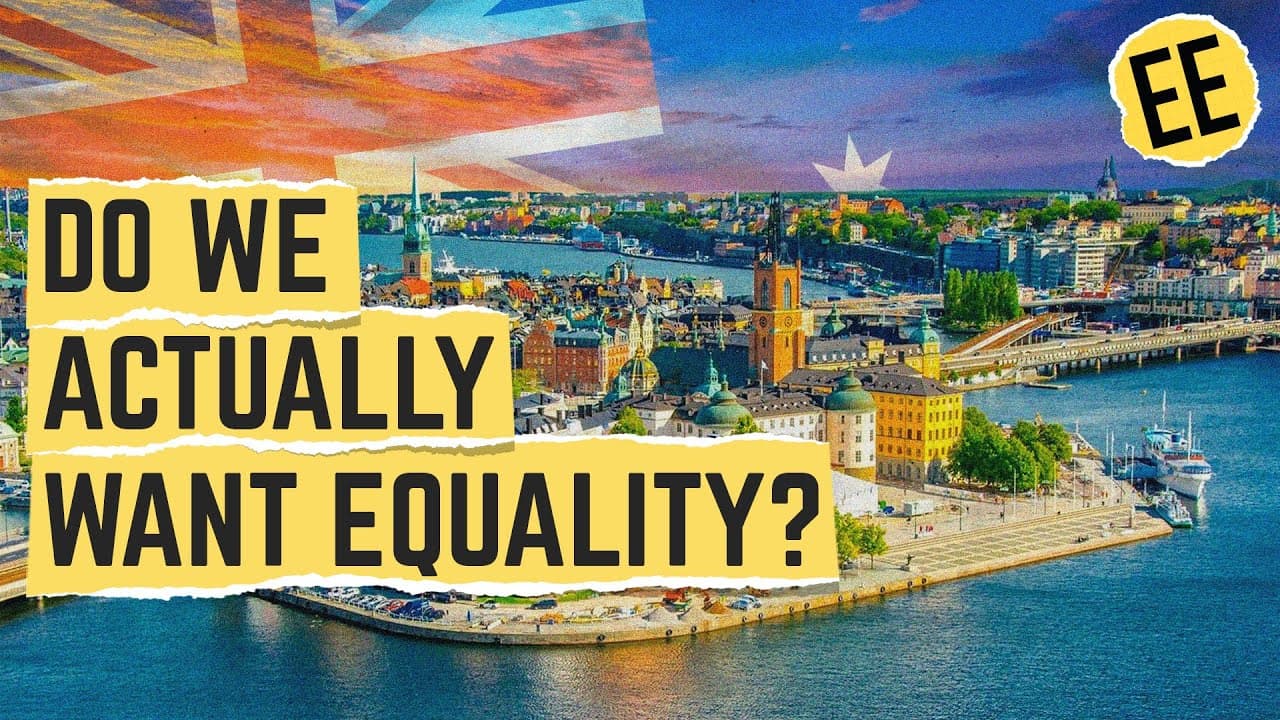
What Is The Most Equal Country on Earth?
TL;DR
Explores inequality in global economies, focusing on Iceland and Australia's economic equality strategies.
Transcript
- [Narrator] Inequality is one of the biggest issues that has divided economists for as long as economics has been studied and probably a good amount of time before that as well. One of the central questions that economists are constantly trying to answer is to whom the fundamentally limited resources of an economy should be provided to. There are ... Read More
Key Insights
- The Gini Coefficient is a key tool for measuring income inequality, with a lower score indicating more equality.
- Iceland, with a Gini Coefficient of 0.369, is considered one of the most equal countries due to its small population and resource advantages.
- Slovakia and Slovenia improve their income equality significantly through high taxes and government assistance programs.
- The Laffer Curve suggests that overly high taxes can reduce government revenue by discouraging work and encouraging tax avoidance.
- Wealth inequality, often greater than income inequality, is harder to measure due to subjective asset valuations and lack of wealth taxes.
- Australia combines high minimum wages and mandatory retirement savings to maintain low inequality while promoting entrepreneurship.
- Wealth inequality can worsen even as income inequality improves, as seen globally between 2020 and 2022.
- Economic equality involves more than just statistics; it requires considering quality of life and societal well-being.
Install to Summarize YouTube Videos and Get Transcripts
Explore YouTube Video Summarizer or Get YouTube Transcript Extractor
Questions & Answers
Q: What is the Gini Coefficient and why is it important?
The Gini Coefficient is a statistical measure used to gauge income inequality within a country. It ranges from 0 to 1, where 0 represents perfect equality and 1 indicates perfect inequality. It is crucial for economists because it provides a quantifiable metric to compare income distribution across different economies, helping to identify levels of inequality and assess the effectiveness of economic policies.
Q: Why is Iceland considered one of the most equal countries?
Iceland is considered one of the most equal countries due to its low Gini Coefficient of 0.369. This is attributed to its small population, abundant geothermal energy resources, and strong financial services and fishing industries. These factors, combined with an egalitarian culture and political system, contribute to its economic equality, although the measure is before taxes and transfers.
Q: How do taxes and government assistance impact income inequality?
Taxes and government assistance can significantly impact income inequality by redistributing wealth. High taxes on higher income earners reduce their net income, while government assistance increases the income of lower earners. This redistribution helps to narrow the income gap, as seen in countries like Slovakia and Slovenia, where post-tax and transfer Gini Coefficients show improved equality.
Q: What is the Laffer Curve and its significance in taxation?
The Laffer Curve illustrates the relationship between tax rates and government revenue. It suggests that there is an optimal tax rate that maximizes revenue. Beyond this rate, higher taxes can lead to decreased revenue as they discourage work and encourage tax avoidance. Understanding this curve helps policymakers set tax rates that balance revenue generation with economic activity.
Q: Why is wealth inequality more challenging to measure than income inequality?
Wealth inequality is more challenging to measure because it involves subjective valuations of assets like property and investments, which can vary widely. Unlike income, which is regularly reported for tax purposes, wealth data is less consistently tracked. Furthermore, wealth can be negative due to debt, complicating comparisons across populations and countries.
Q: How does Australia achieve low inequality while promoting entrepreneurship?
Australia achieves low inequality by implementing high minimum wages and mandatory retirement savings, ensuring that even low-income workers accumulate wealth over time. These policies, combined with a low unemployment rate and a favorable investment climate, support economic growth while maintaining a fair distribution of income and wealth, fostering both equality and entrepreneurship.
Q: Can improving income inequality worsen wealth inequality?
Yes, improving income inequality can sometimes worsen wealth inequality. When lower-income individuals earn more, they spend more at businesses or invest, increasing the value of these businesses. This disproportionately benefits existing wealthy individuals who own these businesses, as seen globally between 2020 and 2022, where income support measures increased wealth concentration among the rich.
Q: Why is economic equality more than just statistical measures?
Economic equality extends beyond statistical measures because it encompasses societal well-being and quality of life. While metrics like the Gini Coefficient provide insights into income distribution, they don't capture factors like access to healthcare, education, and overall happiness. A truly equal economy considers these qualitative aspects to ensure that all individuals can lead fulfilling lives.
Summary & Key Takeaways
-
The video discusses inequality in global economies, focusing on the Gini Coefficient as a measure of income inequality. Iceland is highlighted for its low Gini score due to its small population and resource advantages. However, the analysis reveals that income and wealth inequality are complex and multifaceted issues.
-
Slovakia and Slovenia are noted for their significant improvement in income equality through taxation and government assistance. The Laffer Curve is introduced to explain how high taxes can reduce government revenue by discouraging work and encouraging tax avoidance, complicating efforts to achieve economic equality.
-
Australia is presented as a model for balancing income equality with economic growth, using high minimum wages and mandatory retirement savings. The video emphasizes that economic equality involves more than statistics, requiring consideration of societal well-being and quality of life.
Read in Other Languages (beta)
Share This Summary 📚
Summarize YouTube Videos and Get Video Transcripts with 1-Click
Try YouTube Summary with ChatGPT & Claude or YouTube Transcript Generator
Explore More Summaries from Economics Explained 📚





Summarize YouTube Videos and Get Video Transcripts with 1-Click
Try YouTube Summary with ChatGPT & Claude or YouTube Transcript Generator