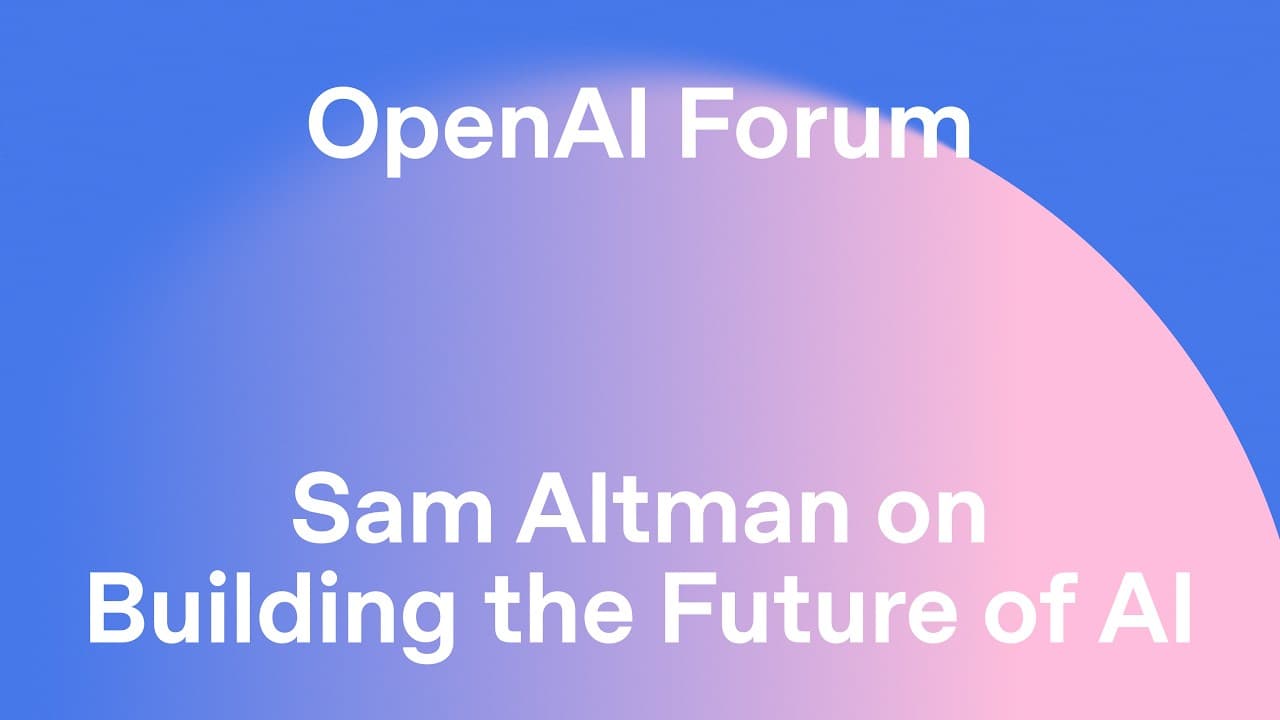
How Will AI Shape Our Future: Insights from Sam Altman
TL;DR
AI's rapid progress demands urgent public debate to harness its potential while mitigating risks. OpenAI's leaders emphasize the transformative potential of AI in science, healthcare, and startups, advocating for broad access and systemic resilience. They stress the need for new institutions and policies to ensure AI benefits everyone, not just the privileged few.
Transcript
Good afternoon everyone and welcome to the OpenAI forum. I'm Chris Nicholson and I'm glad to be here with all of you today. The forum is a place for serious conversation about how AI is being used in the world, what we're learning from that and how more people can help shape its trajectory. Today's conversation focuses on one of the biggest questio... Read More
Key Insights
- AI progress is accelerating, and OpenAI expects extremely capable models soon.
- Public debate is crucial for making informed decisions about AI's future impact.
- AI can revolutionize science, healthcare, and startups, offering unprecedented opportunities.
- Resilience involves preparing society for potential risks and ensuring robust safety measures.
- AI can democratize startup creation, enabling small teams to achieve significant breakthroughs.
- New institutions and policies are needed to ensure AI benefits everyone, not just the wealthy.
- AI's potential to enhance healthcare and education can drive down costs and improve access.
- A societal shift in tax and benefit structures may be necessary as AI transforms the economy.
Install to Summarize YouTube Videos and Get Transcripts
Explore YouTube Video Summarizer or Get YouTube Transcript Extractor
Questions & Answers
Q: How can AI revolutionize healthcare access?
AI can enhance healthcare by providing scalable, high-quality care and supporting medical research. It can assist in diagnosing conditions more accurately and quickly, helping patients navigate complex healthcare systems. AI can also handle administrative tasks, allowing healthcare professionals to focus on patient care, ultimately reducing costs and improving access.
Q: What are the potential risks of AI in cybersecurity?
AI's capabilities in coding can both identify and exploit software vulnerabilities, posing significant cybersecurity risks. To mitigate these threats, society must use AI to strengthen software defenses and develop rapid response systems. Collaborative efforts across organizations are essential to maintain secure digital environments as AI technologies advance.
Q: How might AI impact the economy and labor market?
AI's integration into the economy may shift the balance between labor and capital, necessitating new tax and benefit structures. While AI could automate many tasks, it also presents opportunities for new job creation in AI-related fields. Ensuring broad access to AI tools can empower individuals to create value in innovative ways.
Q: What role do new institutions play in AI governance?
New institutions can bridge the gap between private companies and government, providing governance and accountability in AI development. These entities can support policy implementation, ensure equitable access to AI benefits, and address societal challenges. Collaborative frameworks can facilitate the responsible deployment of AI technologies.
Q: How does AI democratize startup creation?
AI reduces the barriers to startup creation by enabling small teams to leverage powerful tools for innovation. It can automate tasks, provide insights, and support product development, allowing entrepreneurs to focus on creative and strategic aspects. This democratization can lead to a more diverse and dynamic entrepreneurial ecosystem.
Q: What are the societal benefits of AI in education?
AI can personalize learning experiences, adapting to individual student needs and pacing. It can provide additional resources and support for educators, enhancing the overall educational experience. By reducing administrative burdens, AI allows teachers to focus more on student engagement and instruction, potentially improving educational outcomes.
Q: Why is public debate important for AI development?
Public debate is crucial for navigating AI's ethical, social, and economic implications. Engaging diverse stakeholders ensures that AI development aligns with societal values and priorities. Open discussions can lead to better-informed policies, fostering trust and collaboration between technology developers, policymakers, and the public.
Q: How can AI contribute to scientific advancements?
AI can accelerate scientific research by processing large datasets, identifying patterns, and generating hypotheses faster than traditional methods. It can assist researchers in exploring complex problems, leading to breakthroughs in fields such as medicine, materials science, and environmental studies. AI's analytical capabilities can drive significant progress across various scientific disciplines.
Summary & Key Takeaways
-
OpenAI's leaders discuss AI's rapid progress and the need for public debate to shape its trajectory. They highlight AI's potential to revolutionize science, healthcare, and startups, emphasizing the importance of broad access and systemic resilience. New institutions and policies are necessary to ensure AI benefits everyone, not just the privileged few.
-
The conversation explores AI's role in democratizing startup creation and enhancing healthcare and education. Resilience involves preparing society for potential risks and ensuring robust safety measures. The need for new tax and benefit structures is discussed as AI transforms the economy.
-
OpenAI invites public engagement and feedback, offering fellowships and research grants to encourage further discussion and exploration of AI's societal impact. The forum highlights the importance of collaboration between policy makers, researchers, and the public in shaping AI's future.
Read in Other Languages (beta)
Share This Summary 📚
Summarize YouTube Videos and Get Video Transcripts with 1-Click
Try YouTube Summary with ChatGPT & Claude or YouTube Transcript Generator
Explore More Summaries from OpenAI 📚



Summarize YouTube Videos and Get Video Transcripts with 1-Click
Try YouTube Summary with ChatGPT & Claude or YouTube Transcript Generator