What Is TD3 and How Does It Improve Robotic Control?
TL;DR
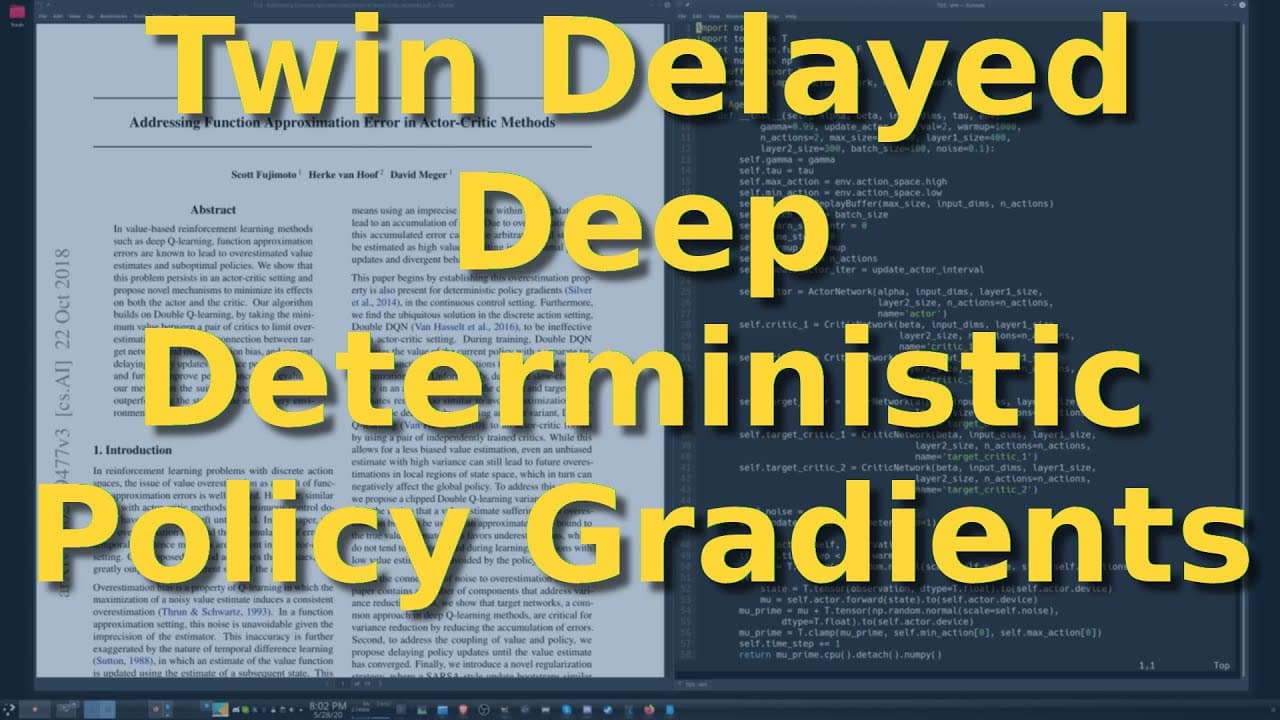
TD3, or Twin Delayed Deep Deterministic Policy Gradient, enhances continuous robotic control by addressing overestimation bias and approximation errors in reinforcement learning. Its key features include delaying policy updates, smoothing target calculations, and implementing double Q-learning critics, which collectively lead to more stable and effective learning outcomes in reinforcement learning tasks.
Transcript
welcome back everybody at my new course actor critic methods from paper to code has finally dropped and in this video I'm going to give you a free preview of how to code the twin delay deep deterministic policy gradient algorithm in pi torch let's get started but really quick few announcements before we put code to editor so this content is support... Read More
Key Insights
- 🧑🏭 The TD3 algorithm is an advanced actor-critic method that addresses function error approximation in reinforcement learning.
- 🎯 It overcomes overestimation bias and variance by delaying policy updates, smoothing the calculation of the target, and incorporating a double Q learning-type modification.
Install to Summarize YouTube Videos and Get Transcripts
Explore YouTube Video Summarizer or Get YouTube Transcript Extractor
Questions & Answers
Q: What is Twin Delayed Deep Deterministic Policy Gradients (TD3), and how does it work?
TD3 is an actor-critic algorithm designed to address function approximation errors, including overestimation bias and variance. It modifies Deep Deterministic Policy Gradients by delaying policy updates by every other step, smoothing the critic’s target calculation, and applying a double Q-learning-style change to the critic’s learning rule.
Q: What must be coded to implement TD3 in PyTorch?
The implementation requires a replay buffer, critic network, action network, and agent class. A separate file handles the main loop, while the code imports NumPy, PyTorch, PyTorch optimization tools, and OS for model checkpointing.
Q: How does the replay buffer work in this TD3 implementation?
The replay buffer stores state, new state, action, reward, and terminal memories, then samples stored experiences uniformly. Its maximum size prevents unbounded memory use, while a memory counter identifies where the next experience should be inserted.
Q: What happens when the TD3 replay buffer becomes full?
The insertion position is calculated using the memory counter modulo the maximum memory size. After the buffer fills, this calculation loops back to the beginning so new experiences overwrite the earliest memories.
Q: How does the replay buffer avoid sampling empty entries?
The sampling range is limited to the smaller of the memory counter and the buffer’s maximum size. This prevents the agent from training on the zero-filled entries that exist before the buffer has been completely populated.
Q: Why does the replay buffer store terminal flags?
Terminal memory records the environment’s done flags. Because the terminal state’s value function is zero, these flags can create masks that are later applied to critic values in the agent’s learning logic.
Q: What does the critic network do in TD3?
The critic network tells the agent the value of a particular state. Within the actor-critic structure, one component selects actions while the critic evaluates them and provides a signal when a different choice would be better.
Q: Does TD3 use discrete or continuous action spaces?
The algorithm specifically handles continuous action spaces. Consequently, the implementation’s “number of actions” parameter refers more accurately to the number of components in an action, rather than a count of separate discrete actions.
Summary & Key Takeaways
-
This video offers a preview of coding the Twin Delayed Deep Deterministic Policy Gradient (TD3) algorithm in PyTorch, which addresses function error approximation in actor-critic methods.
-
TD3 overcomes overestimation bias and variance in actor-critic methods by delaying policy updates, smoothing the calculation of the target, and implementing a double Q learning-type modification.
-
The video covers coding helper classes for the TD3 algorithm, including a replay buffer, critic network, action network, and agent class.
Read in Other Languages (beta)
Share This Summary 📚
Summarize YouTube Videos and Get Video Transcripts with 1-Click
Try YouTube Summary with ChatGPT & Claude or YouTube Transcript Generator
Explore More Summaries from Machine Learning with Phil 📚



Summarize YouTube Videos and Get Video Transcripts with 1-Click
Try YouTube Summary with ChatGPT & Claude or YouTube Transcript Generator