Controllers | Compensators | Introduction | Example | CS | Control Systems | Lec-129
TL;DR
Compensators and controllers stabilize systems and enhance performance.
Transcript
hello everyone in this session we will discuss the next topic is compensators and the controllers so generally these are the large topic in the control systems and these are the ending part this is the right so first what is the purpose of these compensators and controllers first if the system is unstable generally every system must and should be t... Read More
Key Insights
- 🎮 Compensators and controllers are integral for stabilizing unstable systems in control engineering applications.
- 🅰️ Type 2 systems usually exhibit instability and require specific compensatory strategies to stabilize.
- 📈 By adjusting gains, compensators can help a system reach desired performance metrics effectively.
- 🍉 The presence or absence of specific terms in the characteristic equation is crucial to determining system stability.
- 🤑 Lead compensators are particularly useful for transforming unstable systems into stable ones, ensuring satisfactory performance.
- 🖐️ Proportional and derivative gains play essential roles in modifying system response dynamics.
- 🎮 Understanding system characteristics and compensatory functions is vital for effective control system design.
Install to Summarize YouTube Videos and Get Transcripts
Explore YouTube Video Summarizer or Get YouTube Transcript Extractor
Questions & Answers
Q: What is the primary purpose of compensators and controllers in control systems?
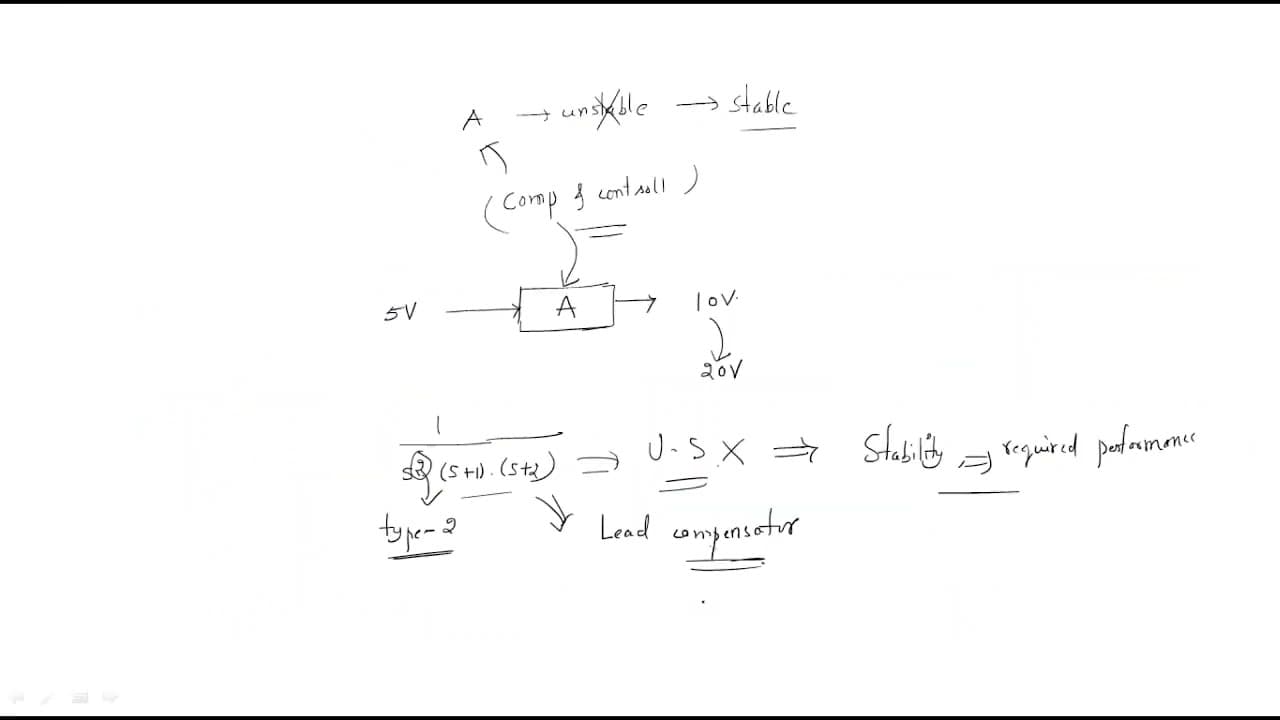
The primary purpose of compensators and controllers is to stabilize unstable systems and enhance their performance. By adjusting the system characteristics, these tools can change unstable systems into stable ones, ensuring that the output meets specific requirements and perform optimally.
Q: Can you explain what a type 2 system is?
A type 2 system is defined as one that has two poles at the origin in its transfer function. Typically represented by a second-order polynomial, type 2 systems exhibit instability. They require compensators to enable stability, which is crucial for ensuring desired control in system dynamics.
Q: How do compensators affect system output?
Compensators adjust the output of a system to achieve a desired performance level. For instance, if a system outputs 10 volts instead of the required 20 volts, incorporating a controller or compensator allows the system to manipulate its response, effectively doubling the output to align with expectations.
Q: What role does the characteristic equation play in determining stability?
The characteristic equation is central to analyzing system stability, typically represented as 1 + G(s)H(s) = 0. It helps define the behavior of the system by identifying pole positions; if any order of polynomial terms is missing, it indicates potential instability, necessitating the application of compensatory measures.
Summary & Key Takeaways
-
Compensators and controllers are essential tools in control systems, enabling the stabilization of unstable systems and improving overall performance. They allow for manipulation of system output to meet specific desired values.
-
A type 2 system, characterized by two poles at the origin, is inherently unstable. Lead compensators can be applied to these systems to achieve stability and desired performance outcomes.
-
The stability of a system is evaluated using its characteristic equation. By incorporating proportional and derivative gains, unstable systems can be transformed into stable ones, showcasing the critical role these components play.
Read in Other Languages (beta)
Share This Summary 📚
Summarize YouTube Videos and Get Video Transcripts with 1-Click
Try YouTube Summary with ChatGPT & Claude or YouTube Transcript Generator