Transmitter power | Calculation | Radar Systems | Lec-13
TL;DR
A detailed explanation of transmitter power and its effects on radar performance.
Transcript
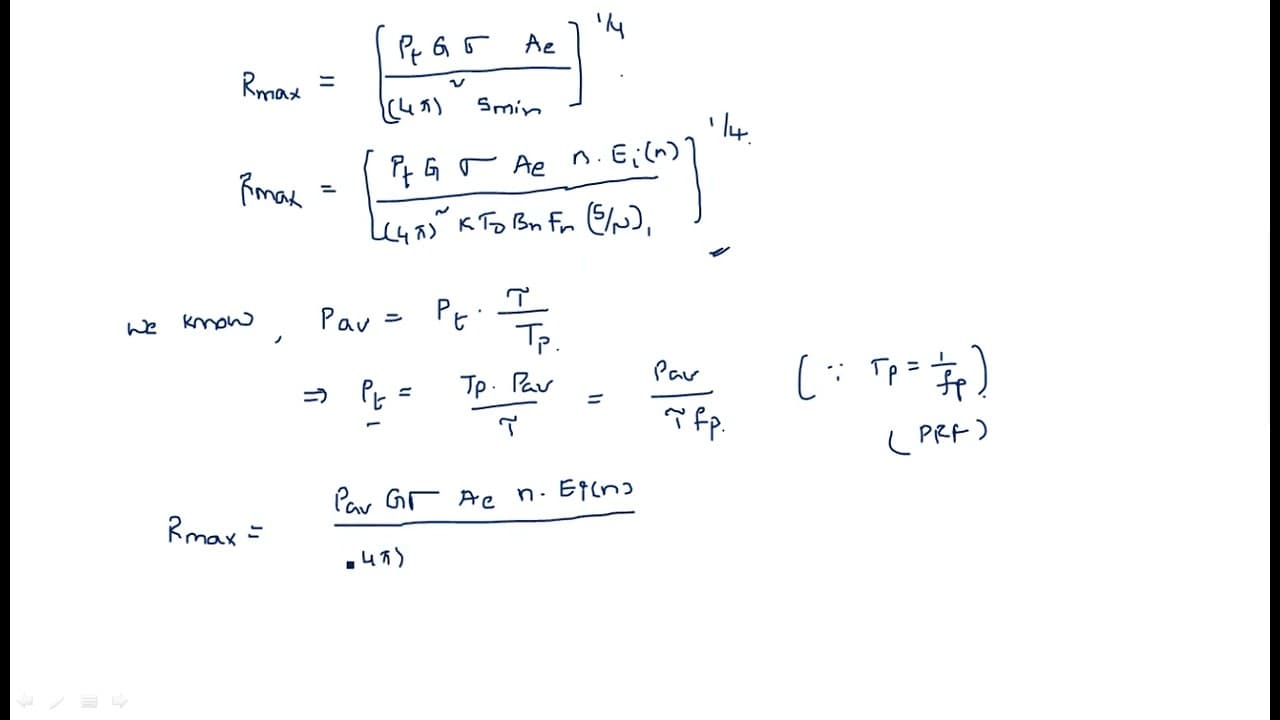
hi everyone in this video I'm going to explain about transmitter power in the r range equation R Max the standard maximum radar range equation R Max is equal to without any modifications I'm taking the basic standard notation PT G Sigma AE by 4 Pi s yes minan whole power 1X 4 so in this maximum R range equation so PT stands for transmitter power wh... Read More
Key Insights
- ✊ Transmitter power (PT) is usually measured in kilowatts to megawatts and is vital for radar identification.
- ✊ Peak power can fluctuate due to environmental factors, while average power remains consistent, which makes it preferable for analysis.
- ✊ The relationship between average power and peak power is crucial for accurately computing radar range and performance.
- 🥳 Signal-to-noise ratio becomes critical when dealing with multiple pulses to ensure effective target detection.
- 💗 The integration of radar pulses can improve measurement accuracy, addressing the challenges posed by noise.
- 💗 Both pulse width and noise bandwidth are essential parameters in radar signal processing, influencing detection capabilities.
- 👻 The maximum radar range equation can be adjusted to account for energy per cycle, allowing for comprehensive radar performance insights.
Install to Summarize YouTube Videos and Get Transcripts
Explore YouTube Video Summarizer or Get YouTube Transcript Extractor
Questions & Answers
Q: What is the importance of transmitter power (PT) in radar systems?
Transmitter power (PT) is crucial for radar systems as it determines the strength of the transmitted signal towards a target, influencing the detection range and accuracy. Higher power allows for better detection of distant or smaller targets, making PT a key parameter in radar performance analysis.
Q: How does average power differ from peak power in radar systems?
Average power represents the mean power output over a given time period, while peak power is the maximum power output at any instant. Since peak power fluctuates due to various factors like noise and signal interference, average power provides a more stable measure that can be used for effective radar analysis.
Q: How does the duty cycle affect average power in radar systems?
The duty cycle, defined as the ratio of the 'on' time to the total period of a pulse, directly affects average power. By multiplying the peak power by the duty cycle, one can calculate average power, which helps in assessing radar system performance during actual operations.
Q: Why is integrating multiple pulses important in radar analysis?
Integrating multiple radar pulses enhances the signal-to-noise ratio, improving target detection accuracy. This integration allows for a cumulative assessment of several waveforms, which helps mitigate the effects of noise and provides a clearer signal for identifying targets.
Summary & Key Takeaways
-
The video discusses the significance of transmitter power (PT) in determining the maximum radar range, emphasizing its relation to target detection.
-
It highlights the differences between peak power and average power, stating that average power is a more stable indicator of transmission performance.
-
The content also details the relationship between average power and peak power, including how various factors like duty cycle and noise bandwidth influence radar calculations.
Read in Other Languages (beta)
Share This Summary 📚
Summarize YouTube Videos and Get Video Transcripts with 1-Click
Try YouTube Summary with ChatGPT & Claude or YouTube Transcript Generator